Showing posts with label a field in england. Show all posts

Our Favourite Films of 2014

Tucker Johnson
The Immigrant
Inherent Vice
Boyhood
How to Train Your Dragon 2
Snowpiercer
The Babadook
They Came Together
The Rover
Life Itself
Interstellar


Scout Tafoya

Below is a list of films that I saw and loved last year, that only just saw US releases this year. My complete, long-as-christ's-beard list will go up very soon. 

1. The Immigrant
2. Vanishing Waves
3. A Field In England
4. Stranger By The Lake
5. The Congress
6. Moebius
7. A Spell To Ward Off The Darkness
8. Gebo & The Shadow
9. Me & You
10. Outrage Beyond


Michelle Siracusa
1. Snowpiercer
2. Nightcrawler
3. The Babadook
4. The Boxtrolls
5. The Guest
6. Grand Budapest Hotel
7. Only Lovers Left Alive
8. Cold In July
9. Under The Skin
10. The Rover


Sean Van Deuren
Boyhood
The Grand Budapest Hotel
The Wind Rises
Under The Skin 
Only Lovers Left Alive 
Nightcrawler
Life Itself 
Obvious Child 
Listen Up, Philip 
A Most Wanted Man


Kyle McDonald
Journey to the West
Snowpiercer
Over The Garden Wall
Interstellar
The Hobbit: The Battle of the Five Armies
A Field In England
The Lego Movie
The Grand Budapest Hotel
Under The Skin


Brettney Young
We Are The Best!
Edge of Tomorrow
Grand Budapest Hotel
Frank
Godzilla
Big Hero 6
Boyhood
Grand Seduction
The Hunger Games: Mockingjay Part 1
The Lego Movie


Mackenzie Lukenbill
 Nymphomaniac
See You Next Tuesday
Under the Skin
It Felt Like Love
Butter on the Latch
Gone Girl
Adieu au Langage
Night Moves
Exhibition
Lucy
Manakamana

Short:
Person to Person

Unreleased:
Incompresa
Approaching the Elephant


Olivia Collette

This list comes with the caveat that because I’m not a full-time critic, there’s a whole lot of cinema I still haven’t seen. Since much of it has already appeared on other full-time critics’ top 10 lists, it seems pointless to belabour the points already expertly drawn out by these fine folks. So I’ll stick to just a few of my faves. Warning: spoiler-ish details ensue.

The Congress
Animation has the potential of being graphene for the imagination, so I’m always disappointed when it’s used to look life-like. In Ari Folman’s previous film, Waltz with Bashir, animation was a tool to exhume and reconstruct memories, long crippled by the fog of PTSD. In The Congress, Folman collaborated once again with animator Yoni Goodman, this time to convey the fluidity of a hallucinogenic state, coupled with the idea of a world we’d prefer. The film explores the ramifications of fame on our collective consciousness, while challenging the notion of self-preservation and just how much of yourself really belongs to you. Goodman’s animation doesn’t try to be realistic, and the world he and Folman create is fragile and unreliable. It’s paved in betrayals of the mind, but it’s more candid about it than reality.

The Babadook
The scariest movies observe the horrors that live inside the mind. At the heart of this story is a mother, Amelia, who still hasn’t processed the grief of losing her husband as they were en route to the hospital to deliver their baby, or the resentment she feels towards her son Samuel for surviving what her husband didn’t. If this film is the spiritual sequel to Rosemary’s Baby, Amelia is the mother Rosemary turned out to be: exhausted, embittered, cursing her parental duties and her problem child. There are so few actors in The Babadook, and any character who’s steady or dependable enough to latch onto is never around for very long. The Babadook “monster” turns out to be a MacGuffin, because the film is more interested in the unsettled psyches of a mother and son who are essentially at war with one another. The film is a bloody good horror that spills very little blood.

The Grand Budapest Hotel
I don’t know if The Grand Budapest Hotel is the most Wes Anderson of all Wes Anderson films, nor if it’s the best among them. There’s certainly some maturity to the production, and because I wrote about Alexandre Desplat’s score for Matt Zoller Seitz’s upcoming book on the film, I’m biased about the way music textures the movie, or even how it establishes comedic beats. The reason it’s on this list at all is because it’s quite simply an entertaining romp. Looking just at the casting: Ralph Fiennes is wildly hilarious, Tilda Swinton is never too big for a small part, and a grunt from Willem Dafoe is more menacing than most movie villains with a gun manage to be. There’s a lot more going on in this film than a first viewing will catch, which speaks to the great amount of detail Anderson writes into his scenes. Altogether, it’s a fun trip to his distinct universe.

Jodorowsky’s Dune
What happens to movies that never get made? Usually, they’re forgotten forever in showbiz purgatory. But Alejandro Jodorowsky has proof that his mid-1970s version of a Dune movie could have happened. Reams of it! It’s all documented in a thick pre-production book that includes some of the most valuable drawings that may have been put together in a tome: concept art by H. R. Giger, storyboards by cartoonist Jean Giraud, aka Moebius, and production design by Chris Foss. Jodorowski also managed to recruit Dan O’Bannon for special effects, Pink Floyd for music, and he cast no less than Orson Wells, Salvador Dalí and Mick Jagger in key parts. In my favourite sequence, the storyboard is animated to show us of what the opening scene of Jodorowsky’s Dune would have looked like, and it’s a very exciting 30 seconds. But Jodorowsky’s project was too ambitious, and despite rampant Dune purism among the novel’s fans, I doubt that even its most loyal disciples would have sat through a 15-hour film. Still, wouldn’t it be great if they made a TV series out of it? I know it’s already been done, but Jodorowsky’s crazy wasn’t on it.

Lucas Mangum

Birdman
Cheap Thrills
Blue Ruin
Guardians of the Galaxy
20,000 Days on Earth
The Babadook
Nymphomaniac
The Lego Movie
Horns
The Grand Budapest Hotel

Honorable Mentions: Chef and Occulus


Daniel Khan

1. Citizenfour
2. Mr. Turner
3. Listen Up Philip
4. Under the Skin
5. Snowpiercer
6. Force Majuere
7. Only Lover Left Alive
8. The Babadook
9. The Dance of Reality
10. Nymphomaniac
11. The Grand Budapest Hotel
12. The Immigrant
13. Ida
14. The Rover
15. The Blue Room
16. Selma
17. The Tale of Princess Kaguya
18. Venus In Fur
19. They Came Together
20. John Wick

Honorable Mentions:
Captain America: The Winter Soldier, The Unknown Known, Birdman, Beyond the Lights, Gone Girl, Cold In July, Love Is Strange, Life Itself


Noah Aust

The Immigrant
Beautiful and heartbreaking. Film at its purest. This isn't the real world, this is the world of cinema, melodrama, doomed antiheroes and tragic love triangles. It's a reworking of Fellini's La Strada, but while that had elements of neorealism, The Immigrant is planted firmly in the world of operatic make believe. But it's a world I desperately want to believe in. Film critics talk about 'the death of cinema,' and sometimes it feels like they're lamenting this antiquated bourgeoisie artifact. But I'll miss cinema like The Immigrant.

Zero Theorem
I fucking love Terry Gilliam. Watching Baron Munchasen at six or seven changed my life; ever since, his films have basically defined the medium for me. So it's possible that I approach his new work with a certain level of bias. But holy shit, I loved Zero Theorem. It's his most mature film yet. Brazil was an adolescent punk rock rally against the system. It was exhilarating in its clumsy, angry energy. The message wasn't that complex-- it's the institution, guys, we're all cogs in the machine!!!-- but that didn't matter. The joy came from watching Gilliam hurtle every thought, idea, gag, anxiety, and fantasy against the screen.

Zero Theorem is an older, sadder vision. This time the conflict is personal. Even though the plot sounds typically zany, at its heart it's a very simple, quiet story about one man's struggle with anxiety and depression. The world seems dystopian, but that's only because it's shot through our protagonist's incredibly subjective viewpoint. The apocalypse is internal. Everybody else is having a blast. Everything feels a little sadder, a little more worn-out, bargain bin. (Gilliam's budget restraints definitely add to the feeling.) Usually Gilliam treats his characters a little like bugs, cackling as he brings down his boot. By the end of Zero Theorem, nobody's cackling. The smirking dark comedy is over. Gilliam's garish cartoon characters have turned into actual people, and Cohen's fate made me really, deeply, honestly sad.

Birdman
I thought it was brilliant. The acting, the camerawork, everything was absurdly wonderful. I loved Keaton's character, and I loved how his artistic quandaries mirrored so many of my own creative anxieties. It's cathartic to watch your deepest fears projected and made fun of on a movie screen.

The Grand Budapest Hotel
Kind of like The Immigrant, I was completely swept away by the beautiful storybook feeling of it all. Wes Anderson has this really unique style, and he keeps trying it out on different genres, trying to make sense of it and figure out what it means. With The Grand Budapest Hotel, I think it finally clicked. At the film's tragic ending, his aesthetic suddenly made sense to me. All the quirky affectations, the nouveau frills, the Wes Anderson-ness of it all took on this enormous dramatic weight of the loss of innocence. The storybook life ends abruptly, and we're left with an old man alone with his memories.

The Double
Loneliness and isolation have never been so fun. I loved the strange Kafka-esque world and the plot that clicked together like clockwork. In the film's first half, its absurdist style suggests a series of isolated, meaningless episodes. In the second half, you realize it's all cleverly concealed setup, and it all pays off with an amazing punchline. There are references to Švankmajer  Kafka, and Dostoyevsky, but it feels less like a postmodern remix and more like the latest in an old, classical storytelling tradition.

Snowpiercer
I love this movie's passion. I love its hyper-saturated zeal, with everything cranked up to manic surrealism. Put every 21st century anxiety into a blender, throw in Hong Kong action cinema, absurdist political theatre, and Tilda Swinton channeling somebody's nightmarish grade school teacher, and this is what you get. Above all, I love a movie with the guts to say "Sometimes it's better to blow up the train."

I also reallllly dug Mike Fink's webseries Mick Fink.

Zones of Bliss

I hope that the idea of guilty pleasure is dying. Not only is the term a copout, it puts up a wall between us and what Joseph Campbell might call our bliss (though I wouldn't be the first to misinterpret his famous statement, so forgive me, eh?). Our enjoyment of art leads us down a path toward better understanding our needs and desires (or anyway, it can if we let it), things we may not otherwise have learned to articulate. I think placing something under the banner of 'guilty pleasures' unintentionally obfuscates clues to the kind of art we find most meaningful or more accurately the properties, shapes, sizes, colours and places that we want to see more of. Recently the brilliant critic Aaron Cutler defined something for me that retuned my antennae, so to speak. He told me a simple difference between poetry and prose: blank space on the page. The second he said it, so much about the films, music, books and paintings I loved came into focus and I think I understood a little more about who I am as both a hyperactive consumer and a person. Cinematic space that makes you feel at ease tells you a lot about the kind of environment that makes you the most comfortable, which may end up helping you decide where you want to live and in what conditions. Or maybe that's just me? The 'blank space on the page' has come to mean a lot to me in the last few months. More and more I see films and feel as though I've been waiting to discover them all my life, namely František Vláčil's Marketa Lazarová, John M. Stahl's Leave Her To Heaven, Teinosuke Kinugasa's Gate of Hell and perhaps most profoundly Kristina Buožyte's Vanishing Waves, which spends a lot of time and energy inventing dream spaces for its characters to inhabit unperturbed by earthly concerns. Every new material and surface the dreamers conjure is a clue to who they are. Each sunrise or sunset a pretty big indicator of how and where they like to spend their time. We make the same choice everytime we put a DVD or Blu-Ray on. I can't go to the humid South Pacific and take a boatride down river to a sun-coated, foliage-enshrouded manse, so instead I watch Wake of the Red Witch, Apocalypse Now Redux and Donovan's Reef. 

Everyone's preferred zones are different, naturally, which is why the best critics rarely agree on anything. I've learned about myself that many of my favourite films are also home to the environs I'd like to mentally vacation in. Last summer I went to Film Forum's essential 35mm screening of Michelangelo Antonioni's L'Avventura with the express aim of nodding off before the two lead characters meet each other to start searching for their mutual friend, when the plot changes gears entirely. I've seen L'Avventura more than a dozen times and knew exactly what I wanted from this particular screening: to wake up in the middle of the film. I felt as if I'd been living in the movie's vacant Italian landscape for days. There are few pleasures as rare, and those satisfactions are permanent. Just as I can always search for images of Edward Hopper paintings or listen to Fleetwood Mac's Pious Bird of Good Fortune, anytime of the day or night, I can drink in the technicolor silence of Leave Her To Heaven, drift around James Mason's house in the cold night air of North By Northwest or walk the delectable beaches of M. Hulot's Holiday. There are several movies that posses this stillness, the ability to display a setting and create a mood that fits it like a glove. They're not just works of art, they're places. They needn't even be good movies if they do it, so long as they capture the timeless signposts of the era and frame faces and objects properly. The Mystery Science Theater 3000 episodes that cover the last two films of misanthropic auteur Coleman Francis, Skydivers and Red Zone Cuba (Originally titled Night Train to Mundo Fine), for instance, may be terribly made, horribly bleak visions of this country, but they don't lie about the desert, the cars, the pug faces of men, the depression plainly evident in every look and halting line reading. Mike and the bots commentary make it feel like home (it helps that I grew up with these episodes). I've learned that when a film hits that part of my brain and creates a place I'd love to live in I can become willfully blind to its faults. Or rather, they stop mattering. They're subsumed into the idealized viewing experience and I can't imagine any one part being removed. On Tour, Contempt, Inception, Pandora & The Flying Dutchman, The Lady With The Little Dog, Tabu, Johnny Guitar, The Red Shoes, L'Eclisse, The Tree of Life and 2001: A Space Odyssey and many, many more allow me to become weightless and live a few feet above the ground of beautifully alien landscapes, the kind only cinematographers can create. 

Those last three examples are important because their influence has become a hallmark of a few of my new favourite films. The chain of events starts with L'eclisse, which abandons the characters for the final scene in favor of gorgeously off-kilter street scenes and lifeless architecture. The audience is denied closure and forced to recognize the hopelessness of the narrative, meanwhile Antonioni chases his fascinations down abandoned alleyways, following Joseph Campbell's advice. Knowing how rarely major directors halted their narratives for an experimental flourish that consumes the story makes it no less gripping a divergence after the sixth, tenth or fortieth viewing. It's one of cinema's great endings and the ripples were immediately apparent. The following year Henri-Georges Clouzot began planning a movie called L'enfer that would make extensive use of experimental photography, but he had to scrap it. The techniques he researched would resurface in his final film, 1968's Women in Chains. With a quarter of the film left to go our heroine is in a crash that puts her in a coma and has a colourful nightmare filled with beautiful, geometric abstraction. In the meantime Hiroshi Teshigahara had started experimenting with similar endings to his films The Face of Another and Man Without A Map, visions of apocalypse courtesy of bizarre juxtapositions, the music of Toru Takemitsu, over-exposures and vacant architecture seemingly on loan from Antonioni. Stanley Kubrick's 2001: A Space Odyssey, a major event film from one of the most popular American artists, surrenders its plot to a pre-Laser Floyd freakout. Soon stunning tricksy photography begins to warp narratives in progress, as in Alejandro Jodorowsky's The Holy Mountain, as filled with perfectly symmetrical compositions as it is mind-altered scenarios and off-colour philosophy and myth-making. Saul Bass' Phase IV films the-endtimes-by-insect with graphic precision, beginning and ending with unnerving suggestion and jagged electronic music. The most obvious thing that unites these films is that they could only work as movies and take full advantage of what a camera can do, and incorporating a full range of poetry, painting and music besides to augment their artistry.
Fast forward a few decades; Rob Zombie's The Lords of Salem feels under attack from the gods of John Boorman's Zardoz and ends in a heavy trip from witch burnings to Ken Russell to black metal. Ben Wheatley's A Field In England slowly lets madness creep over it until it finally grabs a handful of mushrooms and bakes under the heat of a black planet while the film regurgitates itself under the influence of strobing effects. At the 45 minute mark Ari Folman's The Congress ditches the 3D world for a splashy cartoon indebted to Ralph Bakshi and allows literally anything to happen to its dogged lead. Andrew Bujalski's Computer Chess has its share of hallucinations, not to mention a deadpan leap into colour film for three hysterical minutes at the end of act 2. Last but not least, Jonathan Glazer returned to cinema after a decade with Under The Skin. Glazer has been one of my favourite directors since I was a kid. I loved his music videos back when their was a place on television that ran them, then realized he was the same guy behind Sexy Beast. His follow-up was the textural delight Birth, which I've maintained since the day I saw it is one of the great films of the modern era. That was 2004 after which he made nary a peep but at last the sleeper has awakened with his boldest dare yet. Depending on your point of view, its biggest selling point or its biggest gamble is its myriad reference points. Cinephiles have picked up on them because they're impossible to ignore, but the casual moviegoer interested in a movie about aliens? 

We open on a melding of forms that looks very similar to the eclipse that opens Phase IV, which we see is the creation of a human skin, specifically an eye, as Scarlett Johansson's alien lifeform - Monica Vitti in Mick Jagger's Performance hair - practices human diction beneath the unyielding score by Mica Levi (which often sounds like Jon Brion and John Cale adapting the theme from Gilbert Gunn's The Cosmic Monster). As if the Phase IV connection weren't clear enough, we then get a close-up of that film's nemesis: an ant on Johansson's fingertips. Though it looks like it's ready for a close-up at the start of Ingmar Bergman's Persona. And just like the creatures in Bass's psychodrama, its intelligence is an extraterrestrial gift. All throughout I was reminded of 2001: A Space Odyssey, Women in Chains, Luis Buñuel, Nic Roeg and Eadweard Muybridge, John Carpenter's The Thing, The Face of Another and Glazer's own work as a music video director. Crucially none of these influences ever got in the way or subordinated the purity of Glazer's vision. I'm as suspicious of the term 'pure cinema' as I am 'guilty pleasure' but there is a kind of purity in Glazer's art. It could only be attempted in a film, and only by someone who was probing the outer reaches of the medium's capability, possessing some of Johansson's curiousity about what it's capable of. It may occasionally name drop, but it never feels remotely close to second hand. Knowing that Glazer had taken the time to offer an old-fashioned out-of-plot experience immediately put Under The Skin in my good graces. Practically achieved synesthesia. Glazer and cinematographer Daniel Landin, quite obviously, pointed their camera directly into lights, producing visions in the midst of a dramatic arc. That's worth a lot to me. 
The main body text is Scarlet Johansson's interactions with unsuspecting Scotsmen, playing The Vanishing with a big van on teeming high traffic areas (concealing our director, probably, looking at the hidden cameras he's placed all around his lead). Like The Tree of Life, the film's acting feels like the product of practiced naturalism put to the test, and has cosmic motives on its mind. Unlike Terrence Malick's masterpiece, however, its focus is rather more unclean, like a thirsty flea on the back of religious art, biting its thumb at divine creation. Johansson's improvised interactions, captured in murky digital, have the purposeful aimlessness of Pedro Costa's documentaries. Like the addicts of Fontainhas, Johansson and her mostly willing captives sit and talk in darkness, unaware of their own power, fueled by the urge to do evil, deafening industrial humming often just out of earshot. The van is unsafe, filled with mystery and the fear of the game ending. Johansson drives away as often as her potential partners walk away, just as full of fear as they are. Her purpose beyond, as we learn, collecting bodies for some twisted, incomprehensible harvest, is to create a zone of constructed mutual fantasy. She must make the men believe in her as a real woman who has taken an interest in them. The space only becomes solidified and false when she enters the mirror-smooth room where the men are collected in a pool of predatory liquid. But by then it is too late. "Why come here?" She asks a tourist of the beautiful rocky vista she's located him in. "Because it's nowhere." Which is certainly true of the sleek studio where she ends her seductions. What causes her to break out of her cycle is when one man doesn't buy into the fiction she has prepared. It takes all of her wiles to get him to submit, and because of his perception of himself. He has a condition that makes him resemble Joseph Merrick and views Johansson's pick-up as the ruse it is, even if he ultimately can't say no. When it's over she looks at herself (after having stared into a face different from her usual subjects) and wonders what it is about her skin that coaxed these men into her company. How many were reluctant? How many couldn't say no? Is it their fault? Reflection turns to empathy and the mission is over and done with, though thankfully the film is not. She can no longer look at human life objectively. Nor can Glazer maintain his distance from her. His camera begins sympathizing with her crises of identity and conscience, and the tricks he used to give us insight into the mechanics of alien existence (which look a lot like some of the imagined spaces and cosmic orgies of Teshigahara, Kubrick and Clouzot) give way to a softer digital embrace, displaying neither the sheen of the draining room nor the Costa-ist roughness of the claustrophobic cruising scenes. The high and low are forced to meet in the middle just as Johansson sheds her solipsistic view of humans. Glazer cares more for her than he has any of his heroes, but in a thematic rhyme with Lars Von Trier's Nymphomaniac, cruelty runs deeper than any of us can reasonably counter. Lose the distance you keep from your fellow man and they'll quickly attack. 

I loved Under The Skin, but it is such a peculiar, specific vision of what cinema can do and be, that it was destined to polarize and has with gusto. Under The Skin, it turns out, is one of those films I love so much that I'm blind to its faults. Neil Young, a friend and one hell of a critic, hated the ending after greatly enjoying the set-up, and it's hard to argue that the shift from the alien pick-ups to the search for meaning at the end is jarring to say the least. Dan Sallitt, someone I look up to hugely, confessed to hating it but even he found Glazer's direction impossible to write off. David Cairns, who I love like a father, very reasonably points out that Glazer's aim, to show earth through the eyes of an alien, isn't really what winds up on the table. And Richard Brody, in whose direction myself and any half-way smart young film writer genuflects, wrote a perfectly reasoned and typically great pan that I cannot find much fault in. Yet even as I recognize that their opinions aren't wrong (and I don't mean in a diplomatic sense either; I think their charges stick) I can't help but love it all the same. It exists perfectly to me, and I felt compelled to simply exist in the state of suspended animation it reserves for willing viewers, in the blank space between lines. Between its spiky, Duchamp-inspired abstraction, and softer, Romantic portrait of innocence I found something like bliss. 

The Best Horror films of 2013

Lucas Mangum


Lords of Salem
by Rob Zombie
While we've written extensively about this film before, I can't say enough nice things about it. As director, Zombie takes his cue from the classical, but at no point does the work feel derivative or like a mindless tribute. It's his most mature work to date, as well as his most cinematic. While it's tempting to say The Devil's Rejects is an overall superior experience, it's unfair to compare the two. Rejects was the glorious sophmore effort from a new filmmaker in which he perfected the rough edges of his "everything but the kitchen sink" debut. Lords of Salem is a confident masterwork of an artist now comfortable in his medium.

Stoker 
by Park Chan-Wook 
Park Chan-Wook followed up his wonderful vampire film Thirst, with this, his first English language film. A strange portrait of a damaged family, the story comes together slowly like some sort of depraved puzzle. Each character is memorable, but huge kudos is owed to Nicole Kidman for her portrayal as the tragic, alcoholic mother. Stoker does a fantastic job holding the viewer's attention and doesn't stop being interesting.

Evil Dead
by Fede Alvarez 
Like Dawn of the Dead before it, a remake seemed at its best unnecessary and at its worst blasphemous. The Dawn of the Dead remake silenced naysayers by being one of the most exciting zombie movies in years and the Evil Dead remake did the same by being one of the best horror movies in recent memory. Beginning with a fiery prologue, the story then segues into a different take on the familiar cabin-in-the-woods motif. While lacking the humor of the original, the remake wins for being a visceral journey where the main character's struggle is real, and the triumph earned. Bonus points go to the icky and glorious practical effects.

V/H/S/2
by various
V/H/S/2 is an example of a sequel that improves vastly upon the original. There isn't a weak link in this handful of shorts that make up this anthology, just soon-to-be-iconic horror moments: zombies attacking a picnic in the woods, aliens crashing a slumber party, a woman giving birth to Baphomet. While the standout is by far, "Safe Haven" (a short film that achieves more in 15-20 minutes than most horror movies do in 90), each segment has its merits and if this is the new standard for the franchise, I eagerly await the third.

The Conjuring
by James Wan
In this 1970s-set thriller, James Wan abandons his death metal music video sensibilities and delivers his most confident and effective film to date. Recalling the glories of The Amityville Horror and The Entity, he employs classical gags and a multilayered story to create horror movie magic. I don't buy the accusations that it's misogynistic or right-wing. With the collaborative solution to the big evil following the failure of the exorcism, I think it could be argued that the film is anything but. Regardless, a fun, chilling haunted house flick.

Beneath 
by Larry Fessenden
We both knew this would end up here for reasons we discussed in our review. I think you hit the nail on the head when you said that the presence of a physical monster that you could touch adds a lot to the film's effectiveness. The film also has a lot to say about people and relationships, but does it amidst a survival crisis to make it interesting. Fassenden really outdid himself here.

You're Next
by Adam Wingard
This home invasion/survival horror sendup is a hard sell when taken too seriously. By the end credits, when the blood splashes upon the screen and forms the declaration "You're Next," it all becomes clear: the filmmakers are using the genre as a playground, much like Craven/Williamson with Scream and Whedon/Goddard with Cabin in the Woods. A fun romp through familiar territory, it's clear Wingard loves the genre and it's fun watching him have fun.

Warm Bodies
by Jonathan Levine 
This film's trailer misrepresented the work as zombies gone Twilight, when really it was closer to something like Return of the Living Dead. The jokes are genuinely funny, the bonies (zombies in advance states of decay) are genuinely scary, and the story is genuinely touching. I loved every minute of this film and I'm not ashamed to say so. With the saturation of undead media over the last ten years, I'd even go so far as to say that the subgenre was overdue for such a clever sendup.

American Mary
by Jen & Sylvia Soska 
The Soska Sisters, who are quickly becoming my favorite filmmakers, delivered this wonderful body-mod horror film and got right what countless Saw sequels got wrong. There are horrifiying things done to the human body in this film, yes, but the Soskas make this shit matter. A three-dimensional character who struggles hard sits at the center of this modern masterpiece and elevates the story to intense emotional levels.

Curse of Chucky
by Don Mancini
Yes, the multiple endings were a bit much. Yes, another Chucky movie was probably unnecessary. However, to deny the sense of fun surrounding this whole project would be doing yourself a disservice. For most of the film, it starts thing with a mostly clean slate. We know what's coming, but the characters don't, and that anticipation is what drives the story for much of the film. When the action begins, it's earned and totally worth the wait. I'd recommend this to fans of any film in the franchise.


Scout Tafoya

We Are What We Are
by Jim Mickle
I'm thankful in a lot of ways that in making this list, I had to keep asking myself what qualifies as horror. Time and again I'd encounter the fantastic likes of Stoker (one of the best films of the year), Sightseers and +1 and wonder if they count. They're frightening, sure, dark and immersive trips into nightmarish worlds, but are they horror? We Are What We Are is a little more forward than some of the films I left on the fence this year. There may be better films this year but none that managed to be completely absorbing drama as well as a very effective horror film and one of the finest remakes I've ever seen. Jim Mickle's been getting better with every film and here we arrive at something on the level of Ti West's House of the Devil, though it's far closer in style to The Innkeepers. A wife and mother of three dies, leaving them to carry on in her absence as an important ritual draws nearer. Bill Sage's father is the source of the film's best scares, himself a kind of walking jump scare. Religious fervor is the subject, and the faces of children a series of reflections. It's frightening as anything in the moment when something unexpected comes into the frame without warning, but the scare lasts longer when it's against a child's hope of the life they want. The eldest daughter's dream doesn't include her father or his way of life, and in the film's most abrupt, violent outburst, he becomes the most scary force she's ever encountered. Everything she's ever believed is shattered, and yet she can't bring herself to turn away because family is all she has. Mickle's film overflows with moral conundrums but none he harps on. They merely colour the precedings as things spiral further and further out of everyone's grasp. I've still got to write more on the film and why it speaks to me the way it does because We Are What We Are was one of my favourite horror films of this decade. 

Lords of Salem / A Field In England
by Rob Zombie / Ben Wheatley
As noted above, these movies aren't films dedicated to frightening you as they are crawling inside your unconscious mind like a worm. Their images creep off the screen like a mist, long deliberate pans and zooms. They are the strongest, and derive their power not only from their directors sense of how to compose and emphasize, but from their sense of manipulating elements from cinema history. Everything from the hats to the wallpaper are callbacks to a dreamscape conjured by Michael Reeves, Stanley Kubrick and John Carpenter, men who went looking for the abyss by way of H.P. Lovecraft and Edgar Allen Poe. These films are about people unwittingly drawn into the search for an altered state, a new dimension, some place between film and nightmares. A brief note must be made for Phillippe Grandrieux's phantom trip White Epilepsy, which is a disquieting, slow-motion journey into human flesh and its navigation of more of the same. That film lays a trap for your brain. More like these please. 

The Evil Dead
by Fede Alvarez
Remakes are inevitable; they're in the water now. They can be useless, and indeed most of them are, but they do occassionally come from people with talent that can't be bested by the system that produces them. Mark Hartley, he of Not Quite Hollywood and Machete Maidens Unleashed notoriety, redid Patrick one of the greatest films of the 70s Aussie horror boom and proved himself in line with a new tradition of warped Oz gore fiends. A wacky diversion, though I'm glad he hasn't totally given up the docs he built his home with. More my speed was the relentless retelling of Sam Raimi's Evil Dead, a film I've been close with for most of my life. I understand everyone's objections, but don't care about them, because Alvarez is a fabulous director, creating a terrifying world solid and striking as a figure from Bosch rendered in marble. His colors are canyon deep, and he lights like he couldn't afford Bruno Delbonnel and needed to make it look like he showed up anyway. Craft is important, but most importantly, I had the daylights scared out of me. 

Mama
Andrés Muschietti

Muschietti is clearly also a fan of Sam Raimi and Stanley Kubrick (and maybe Ole Bornedal), and like Alvarez he's confined to a single location for most of Mama. He might not have the same way with actors or production design, but he might have an even better sense of how to scare. His monster is a fucking doozy, and he knows it. He shows her a little too much, but I forgive the impulse because she's one of the greatest beasties in recent memory. But the film wouldn't work at all were it not for a trio of performances from unreal actresses. Jessica Chastain only released one film last year (which for her counts as vanishing), but she made it count, totally entreating her goth rocker with enough spiky attitude and believable shades of compassion that she never feels less than 100% authentic. She doesn't grow more than you expect her to because a lifetime that produced that hair and those tattoos doesn't produce a secret Maria Von Trapp. And as good as le Chastain is, she almost can't compare to her young charges. Megan Charpentier and Isabelle Nélisse are stunningly assured performers, and they're both under 10. They're the heart of the film and do some of the greatest acting from children I've ever seen. They've been given no recognition that I've been able to find, which is a crime. Nevermind your definition of good horror, these girls are fantastic. 

Magic Magic
by Sebastián Silva
The first film that successfully makes American entitlement (circa the recent past) a ghoul on par with anything in the Dario Argento playbook. Updating one of Roman Polanski's isolationist psychodramas to the present wanderlust culture and finding that the old cure for exhaustion, a change of climate and a little rest, aren't nearly as soothing as they used to be. Silva turns tiny moments into exploded agony, expressionistic renderings of anxiety that are as unseasonably pretty as they are chilling. Juno Temple gives if not her best then maybe my favourite performance she's ever given. though she's matched in every way by the cosmic obnoxiousness of Michael Cera, turning up the anti-charm to 11 in ways few other people could hope to know. An exquisite portrait of someone coming off the rails.  

Beneath/The Jungle
by Larry Fessenden / by Andrew Traucki
Two old school monster films, one a tribute to Jaws, the other a very clear homage to The Blair Witch Project, going back to the root of movements as we understand them and trying to appreciate why we still look to them for answers. I think the Fessenden is the more unique of the two, and a fine addition to his catalog of things that go bump in the night (and under the boat), but both are great for scares both unconventional and reliable as a well-built house. 

V/H/S/2
by various
Here's the thing. The V/H/S movies are not created equally. There are two great segments and everything else is a waste of time. Last time David Bruckner and Radio Silence walked away with the film handily. This time the night belongs to Gareth Evans, he of Indonesian martial arts gangbang The Raid: Redemption. If you haven't seen that, you're gonna wanna do that right now. Then come back and watch his segment (co-directed with up-and-comer Timo Tjahjanto) "Safe Haven". A camera crew visits the homebase of what turns out very quickly to be a death cult with Satan's direct line. Few features have this kind of gory intensity and ingenuity. You'll laugh and scream and want to do it again. Jason Eisener's concluding segment "Alien Abduction Slumber Party" ain't half bad either. I like Eisener and think he's a great short film director, typically balancing the grim and the cute with something like aplomb. Wish he hadn't killed the dog, but, it is all in good fun, and that counts for something. 

Dark Touch
by Marina de Van
When the makers of the newest Carrie went into production they might have known they were engaged in a futile exercise far more successful in lining Stephen King's pockets than adding anything to the horror canon, but they couldn't have guessed that Marina de Van was going to make their efforts completely hollow and meaningless. Her version of Carrie, Dark Touch, is far more painful than anything King's ever written. It means to shed blood, to make you feel bad. It's a take no prisoners account of an abused orphan whose parents were killed under mysterious circumstances. Her foster parents discover a few shocking insights into the crime as they get to know Niamh, played by Missy Keating. She's got powers she can't control that make themselves known whenever she feels threatened. We are taken prisoner in the unformed understanding of a child who's both bullied, as you'd expect from a kid with self-esteem issues in a horror film, and punished by parents who thought themselves more adept at parenting than they turned out to be. A truly blistering exercise in sympathy. This one stays with you. 


Honorable Mention: Other than the footnotes scattered throughout mine, I want to give props to World War Z for introducing the coolest character in any boilerplate disaster movie: Daniella Kertesz's bald soldier Segen. She redeems whatever the movie got wrong, though I don't think it's an utter disaster. I enjoyed Europa Report, specifically Sharlto Copley's excellent performance as an American astronaut, putting George Clooney in Gravity to fucking shame. And lastly Frankenstein's Army, which is a very dimwitted movie, but there is a nightmare logic to its visuals and monsters that I greatly admire. Things just kind of appear in frame, descending from nowhere, killing at random. It's sort of like someone turned In The Fog into a videogame. It's callous, dumb and misanthropic, but directed in a kinetic, enjoyably lunatic fashion. 

Noah Lyons on the changing face of Cinematic truth/faith, circa 2013

Noah Lyons gave me a list of the best films of the year when I asked him too but he did so with the understanding that if he caught up with better films I'd allow him to update the list. So when we posted our favourites of the year, he endured a marathon watching bout and revised his list. Here are the awesome results. Noah's got one of my favourite brains currently at work, so enjoy!
-Scout

1. Act of Killing – Representing the trend of inevitability, boundary-pushing, and end-game aesthetics this year in film, this documentary/horror story makes us question the ethics of filmmaking and storytelling, the relationship between media and actions, and the power of self-deception. The final vomiting sequence is the most real, satisfying, and ghastly scene I saw all year. Is the film ethical? Yes, because it tosses aside status quo ethics to plunge into a world otherwise inaccessible by a camera – the evil soul.  

2. Night Across The Street – Take the best elements of Lynch, Fellini, and Jodorowsky, and you get this pitch-perfect surrealist adventure through the memories and brain of a dying man. Ruiz manages to capture the mood and style of Eugene Ionesco better than I have ever seen in a film; the non-sequitur logic, the inversion of spatial coordinates, the exploration of the liminal space between the screen and the body. I laughed and applauded more than anytime else all year. “Why do you come to the cinema, if you don’t even know anything about the film you’ve just seen?” asks Beethoven. The boy/us: “We came to have fun, not to learn anything.” The magic of the moving image again becomes joyous and miraculous. 

3. Leviathan – This is what I mean by an end-game aesthetic. As Scout has pointed out, there is really no way to make a documentary now that we have been witnessed a pure embodied POV that challenges our notions of documentation and the abilities/limitations of the camera. With no real plot or characters to speak of, Leviathan is pure visceral experience of slaughter and the sea, colored by rust and blood, free from the laws of gravity and photographic restraints. 

4.  You Ain’t Seen Nothing Yet – Resnais’ Last Year at Marianbad changed everything I thought I knew about film; again, Resnais blows the mind with another challenge to the aesthetical ontology of the silver screen, and our relationship to it. Theatre, movies, remakes, adaptations, the dialogue backstage and onstage, all interweave into a funereal fugue which speaks to the ghosts of past loves and words. I am astonished by the envelope-pushing of 2013; just when I think there’s no space left to challenge and unravel the structure and ontology of film, I’m reminded by the great auteur that indeed, “you ain't seen nothing yet”. 

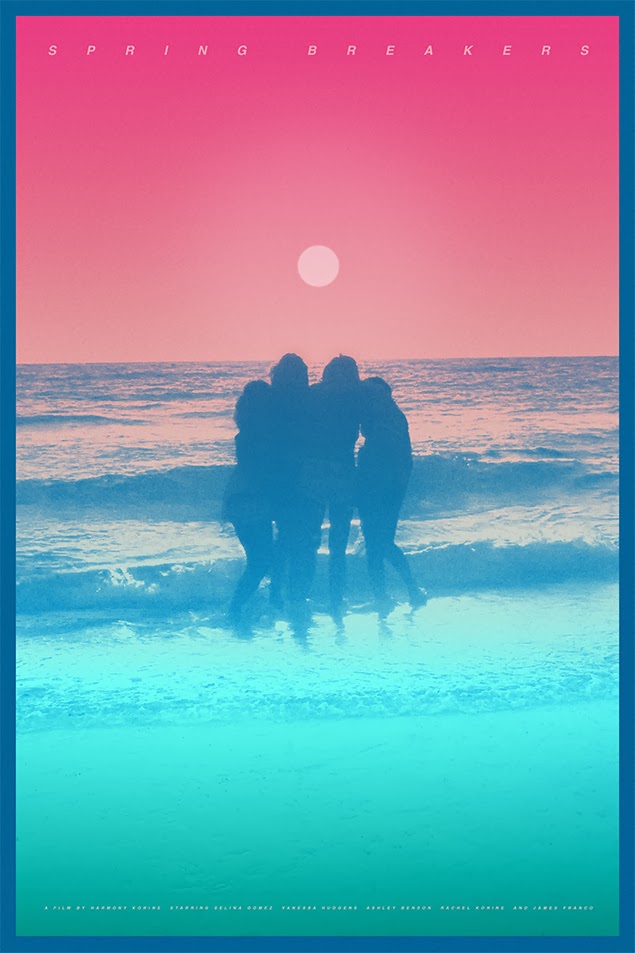
5. Spring Breakers / The Bling Ring – I will defend these two films to the death. I include them together because they are two sides to the same coin. Like a bloody car crash, I could not look away from these piercing cuts into the American teenage myth/dream of the modern era. Few have yet to truly examine these myths of celebrity and college escapism with a critical eye. Ironically, Korine, who usually has as his subject spheres of Americana that go unnoticed here looks at the most obvious representation of ‘Americana’, and blasts it with so much ironic satire that it somehow morphs into concern, rather than fatalism and absurdity. And it looks good. Sadly, it suffered from a terrible mismarketing campaign that turned off pretentious critics and high-minded individuals in lieu of attracting the very types the film is critiquing, who of course hated it. Same with The Bling Ring, which also examines a seemingly obvious slice of the American pie but manages to transcend the banality and strike terror into our hearts as we realize that this is not fantasy. There is a difference between reality and truth; these films are true. And what else more can we really say, now? These films had to happen, and did. 

6. Computer Chess – Refreshing and revitalizing, despite the fact that this is an aesthetic and cultural throw back to 1980. It caught me off-guard countless times with its brilliant genre twists and arid humor. The dramatic irony of knowing where technology will lead us in regards to dating and connectivity makes it all the more enjoyable and poignant. 

7. Vanishing Waves – Disclosure: one of the two films this year that made me cry. I admit I am a sucker for movies about the retrieval and/or destruction of memories; nevertheless, this romance (in the skin of sci-fi) strips away all conceit and plot contrivances to reveal what it looks like and how it feels when two hearts fall in love. The montage of the comatose woman and the doctor rolling naked in a Malick-lit wooden room is exactly that. The Antichrist-esque/Cronenbergian [the man himself wishes we'd say Cronenbergundian, ed.] image of nude limbs and flesh crawling in and out of each other manages to avoid horror/sci-fi shtick. Forget Eternal Sunshine of the Spotless Mind. 

8. The Past – If this was an American film, it would win the Oscar for best picture without a doubt. This is how drama is made, and a case study for any aspiring actors. There’s really not much more to really say; it’s tight and fully packed (as Lynch says of his singer/muse Chrysta Bell). I include this, and no other “perfect” films, on my list because it reaffirms the power of a story told well without the bells and whistles of star power and Hollywood. 

9. To The Wonder – I read somewhere that Malick is to light what Welles was to shadow; whoever said that is correct. While shadow is usually the optical and aesthetic frame and delineation of a form, for Malick light is the frame, the line, the ray, the alien force descending upon the earth. This film is also about silence, and the invisible currents (of toxic waste, bleeding hearts) that flow through our time here on this beautiful earth. 

10. Dormant Beauty – The other film that made me shed quite a few tears. Much could be said about Bellocchio’s excellent use of topical politics as a backdrop for his drama; however, I was more intrigued by the theme of faith that underscores the four plots. Faith in God, faith in The Resurrection, faith in the Revival of the comatose, faith in the Rebirth of love. Faith supports us, but it is also alienating. Should I abandon my faith in Jesus Christ and the miracle of the resurrection, for faith in the love of a stranger? The faith that my heart is still capable of feeling? Should the cross lie across my breasts or turned around, invisible, to lie on my backbone? Does God desire life or death, joy or pain? Despite all of these questions, I never questioned the foundation of my faith but the way in which I express it and when/if I recognize other faiths in other people. Connectivity and love require the faith that when they die, we will move on. Also, I could stare at Alba Rohrwacher’s face for aeons. 

11. A Field In England – A Shakespearian tragedy translated by Jodorowsky and performed by Samuel Beckett ghosts under the influence of mushrooms. This is the weirdest film I saw this year, and I loved every minute of it. When the alchemist begins gobbling mushrooms, my head truly felt like it was crackling and spewing lava. It is hard to “do weird” these days; this is how it’s done. 

12. Blue Jasmine – This slot also includes the likes of 12 Years a Slave, The Great Beauty, American Hustle, Her, Inside Llewyn Davis, etc. That is those films that are extremely well executed but offer nothing to the future of cinema. All of my ‘best’ or ‘favorite’ films would more accurately be described as the most important ones; importance is when a film closes, with a to-be-continued, the chapter on a movement or style or technical achievement or reveals the potential of future explorations. Or it begins blazing a new path. Blue Jasmine does not do any of these things. Woody, I’m tired. I’m tired of the same shit movie after movie. Woody, you are a perfect director. There is nothing wrong with this film and that’s why I hate it. Not only is it a carbon-copy of your other films, with new brilliant performances, it does not innovate or challenge or even have a hint of imagination. Woody, return to experimentation of form and genre, rather than creating perfect cinematic ice cream cones. 

Honorable Mentions: Fruitvale Station, Post Tenebras Lux, Upstream Color, Lords of Salem, We Are What We Are, Gravity, Side Effects