Showing posts with label genius. Show all posts

Best Film of 2000 B.C.E. - 2009 C.E.

Modern Depiction of the Tree of Life

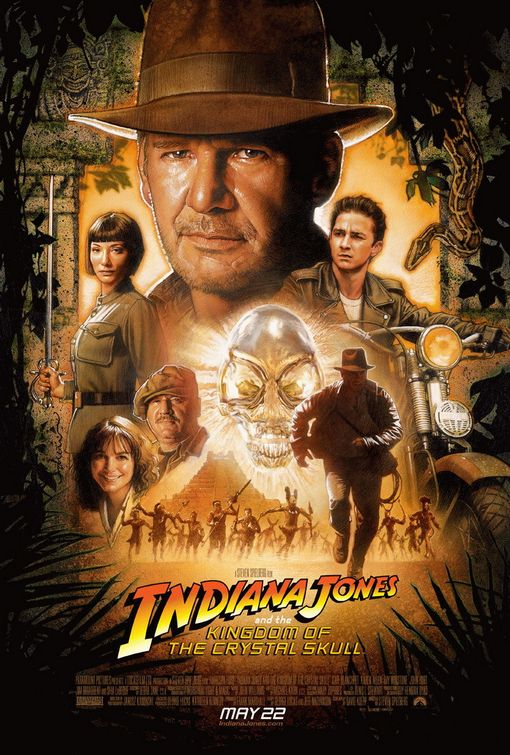
Okay you culture snobs, I think it goes without saying that you have been purposely avoiding the inclusion of Indiana Jones and the Kingdom of the Crystal Skull on your "best of 2008" lists. Spielberg's long-anticipated magnum opus clearly operates on levels of esoteric beauty and significance what has slipped under the radar. It is the timeless, cross-cultural story of the messiah archetype's journey to an ultimate reality, the Hindu concept of moksha.

Jesus-Buddha-Muhammad

Prof. Henry Jones Senior, Dr. Henry Jones Junior, and the recently-introduced Henry "Mutt Williams" Jones the third are a characterisation of the Christian idea of the Holy Trinity, expressed as a dharmic henotheistic representation. Jones Sr. is the foundational father, Yaweh, Brahma, or otherwise considered: he has paved the foundational structure upon which our road to enlightenment will be built upon. He is followed by the Jesus-Buddha figure, Indiana, who is the messiah and martyr figure. Spielberg ingeniously harkens us back nearly three decades to Indiana Jones and the Raiders of the Lost Ark, in which Indiana is crucified for trying to protect the Ark of the Covenant.

Vanguards of the New Era of Enlightenment

The ark represents not only the four cardinal virtues of both Christian and Platonist philosophy in it's fourfold geometry and tenfold (remember that in the base ten number system, ten is the unit comprised of four even quarters) commandments, but also by it's super-mundane presence in the Jungian fact of collective consciousness. The ark is the sacred knowledge of law, which Yaweh (Henry Jones Sr.) had long sought to protect alongside the blessed knowledge of all, enlightenment: the holy grail, out of which Jesus (Indiana) drank ambrosia (the Holy Water) and was bestowed with the knowledge of good & evil (and thus cured His Father, at the expense of being banished from the Garden of Eden, thus resulting in the ultimate destruction of treasury of Petra). However, this is deviating from the original topic.

A combination of Jung's "Abusive Mother" archetype and Frudian facts of the Oedipus Complex, Spielberg has all the bases covered and watched vigilantly.

Following Tibetan Buddhist tradition, the ultimate successor of the Jones lineage is found by a supernatural search: the Dalai Lama, "Junior Junior", is revealed as the perfect completion of the Triple Goddess' form.

Vishnu the Destroyer & Jesus the Preserver

Try watching Indiana Jones and the Kingdom of the Crystal Skull again with these thoughts in mind, and see if you have a change of heart. Next week I will delve further into the symbolism as it applies to the movie's turning points and thematic developments.

My Favourite Film Number 2

This is part of my effort to write about my 100 favorite films in two pages or less. This film is important to me for a lot of reasons, as evinced by my naming the place after it. So I only hope my words help you seek it out and uncover its mysteries. 

Apocalypse Now
by Francis Ford Coppola

“You Americans are fighting for...the biggest nothing…” That’s how artists must have felt all throughout the 1970s. A friend of mine who was around for it told me that people had been predicting a progressive era before the early 60s happened. They killed everyone…the peace movement became a joke…no one seemed to believe in love anymore. The films of the 1970s all had that feel, that joy was on it’s way out. Bertolucci, Scorsese, Coppola, Makavejev, Godard, Peckinpah, Bergman; it was a tough love the great directors gave to the world in the 70s. Film theory was being tested in a big way; the old ways of the studios was essentially abandoned, and vision was now dark, elaborate, and unfathomably long. The ways of the peaceful artiste, the harmless beatnik were gone in favor of the colorful realist. The idealist was dead; murdered like the ridiculous protagonists in Easy Rider. The centerpiece of the beautiful banquet of morbidity and lost love was Apocalypse Now.

Three hours long, darker than noir and twice as violent, and astoundingly beautiful, Francis Ford Coppola’s Apocalypse Now long went unseen as he intended it (and unlike more zealous epics like 1900 or The Last Emperor, it does benefit from it’s length), and so the breadth of Coppola’s disdain for America/organized humanity was long unknown. The movie is not a war film as had ever been done before. It’s a message, an elegy to peace and love, written backwards. Based on Joseph Conrad’s Heart of Darkness, Apocalypse follows Captain Benjamin Willard on a mission up the Nung River into Cambodia during the Vietnam war to kill a renegade colonel called Kurtz. He’s asked to do it by dry higher-ups in olive fatigues, and we will slowly learn the metaphor, the real nature of the mission as Coppola and co-writer John Millius envisioned it. Williard, the hero, has been sent to murder an idea, the innocence of America. Kurtz is an affront to order, standing in the way of the tidy military operation the men in green wish they were running. He is the free love that turned sour when Charles Manson started killing people (Manson’s face makes an appearance in a newspaper that the high-strung Chef reads in the mail). He is the irony of sending a pot-smoking 17-year-old African American to murder families to make his own family proud. The politics I suppose couldn’t be more clear-cut, the recurring musical theme is a Door’s song for pete’s sake. This is a movie that fed hundreds of cynical teenagers who’d missed 1968 by a few years.

“He dies when it dies”. Dennis Hopper’s photojournalist, the last jabbering follower of the dying colonel squeals when Willard finally arrives to do the deed. When Willard kills the man (an act just as inevitable as the one in I Shot Jesse James), his armed followers, his children, throw down their guns and obey the conquering soldier, just like the baby boomers threw away their ideas, put suits on, and started their own wars. Murder is literally everywhere and men are supposed to function as people, let alone as soldiers. Kurtz’ retreat into his own world would make sense to any bored basement-dweller today, and so the legacy of the late 70s lives on. Will they act when the time comes? The Iraq War continues. During the late 70s the young mavericks were getting to use old Hollywood stock players they had so long worshipped. Wim Wenders got Nicholas Ray, Roman Polanski got John Huston, Bernardo Bertolucci got Sterling Hayden and Burt Lancaster, and Coppola got Dennis Hopper and Marlon Brando. Brando’s first appearance in the film is not unlike a child’s nightmare. Martin Sheen, the man we’ve been pulled into complicity with, our guide through the horror of war, is a man of average height. The photograph we’ve seen of Kurtz makes him look like a beast; sasquatch or a serial killer. He lies, bathed in shadows, his enormous head and hands looking inhuman next to Sheen’s. His face is always partially shrouded in shadow, just like the mission. Of course Brando is almost no match for Sheen who gives one of his strongest performances. He wears every second of combat on his face, and I feel no one else was quite capable of taking this journey from weary GI to bleary-eyed killer and staying in control.

And what a journey. This film is as much Coppola’s as it is Walter Murch and Vittorio Storaro’s. Murch, the chief editor and sound designer gives this movie it’s frantic, combat-like pace. All war films that followed were in his debt. The sounds, breaking from the background and raging to the foreground, is riveting. Like the characters, it moves in and out of fog, becoming warped here and crystal clear there. He went to great lengths to let us know the difference between the ending throws of Ray Manzarek’s organ and the guitar solo on the small tape player at the Do Lung bridge. Storaro, already one of the greatest working cinematographers, paints the most vivid picture of his career. The last trick the movie has up its sleeve is the change in color scheme. As Willard nears his objective, the danger heightens, the death toll rises, and the colors become lush and tropical. I’m always stricken by the difference between Martin Sheen’s sweating figure and the serene water behind him. Every set piece and symbol comes in colors; the purple flares, the blood, the pink tracer rounds fired from the jungle, the deep greens that constantly surround the boat. Smoke, haze, fog, rain, fire, layer upon layer, each ignited by the ferocity of their context. It is a brilliant, bold color scheme, one that is wonderfully dissonant with the muddled humanity on display. The movie tries repeatedly to evoke the feeling of a drug-induced state; I surmise that the vividness of the color, and the incredible soundscape were attempts at recreating both the feeling of war through the filter of an acid trip.

Part of the reason I love this film as much as I do is because of the history I’ve had with it. In the sixth grade, when my dreams were still hazy, I was eyeing my first electric guitar, my love for film already cemented, my teacher, a 30-something ex-soldier, used to talk to me freely, unlike the rest of my class. We would discuss music and film (I bought him a Grateful Dead bootleg for Christmas, and he lent me The Doors greatest hits), and he suggested I watch Apocalypse Now. The sound and the color were not given justice on the warped VHS tape I rented, and there were many Americans who had never heard the word Redux, but I knew this wasn’t like anything I’d ever seen before. “Do you think Kurtz was right to do that?” My teacher asked me the day after I watched it. He clearly considered doing something similar, fed up as he was with my classmates. I had no idea; I still have no idea. At the start of my senior year, after my initial foray into foreign cinema, I found it playing, heavily censored, on network television. They began running it once a week, and I made a ritual of watching it (always with guacamole chips and black bean salsa). The place where I usually tuned in was when the boat stops at a French plantation. Willard listens in a daze to the noise of an entire family (the conversation is a marvelous insight into colonial mentality, but that’s not what did it for me). After dinner Willard and Roxanne, the only member of the family not related by blood retire to the deck of the house. Her silky French tongue and the swelling synth music prepared me for something that never came; a tender love scene. Instead Roxanne takes Willard to her bedroom, gets him high like she would her deceased husband, and then undresses, a scene made more haunting in the TV edit as her naked body would become a dark blur in the lowlit room, a nightmare in the middle of a rapturous dream. The scene isn’t tender or romantic, but overpowering and urgent. Her words to him make perfect sense, more sense than anything about the Vietnam War, “All that matters is that you are alive.”

Composition/Arrangement

I think what makes new bands stand out above all their peers is the approach they take to arranging their music once it's been written. Some bands are content to play the songs the same way again and again (now, mind you this does occasionally work), but in my experiences music becomes so much vital and exciting when the bands take the time to change the way they play them. Broken Social Scene changes the tempo of many of their songs and almost every guitar part changes at every show (not exactly the most original concept, but it saves their concerts from becoming reruns). There is one band in particular that has taken a really proactive approach to re-imagining their tunes: Grizzly Bear. It's hardly unexpected that a crew of chic artist types from Brooklyn would be so interested in turning each song into something new for every performance, but these guys do it better than nearly anyone I've seen. Seeing them live was a revelation because not only did it show me that every member of the band sings, they've all got a whole bevy of effects running simultaneously to turn the songs into a whole new fleet. They highlighted their spirit of change in the Friend EP, wherein they redid a few of their own songs, had other bands interpret their work and even did a Crystals cover (it's a faithful rendition but it's pretty amazing nevertheless). They have a style and a sound and so to hear them turn regular sounds into the heavy, crunchy Grizzly Bear sounds.

What's more every member of the band has their own personality that enters into the music. Obviously bassist/clarinet player Chris Taylor and drummer/keyboardist Christopher Bear add very unique elements to the music (Taylor's awesome backing vocals for one, Bear's light-delay heavy drums for another) but where the real difference comes in is the dynamic between lead vocalists Ed Droste and Dan Rossen. Ed has a much deeper voice and you could swim in it when it takes off. His tracks tend to be darker and sweeter. Rossen has a lighter, earthier sound and tends to accompany it with slighter instrumentation. Their voices appear equally on Yellow House, the bands first real record as a band (though technically) and the difference is at first so slight as to appear as if there might just be one voice, but, upon closer inspection the differences are made apparent. It's really cool to listen to Rossen sing his Deep Blue Sea and then hear Droste sing He Hit Me to see exactly where their styles part ways. Rossen is also a remarkable guitar player which just makes their improvisation and fascinating compositions easier to envy and impossible to turn off. What's more they seem to be completely unpretentious.