[Editor's note: The following piece on HBO's True Detective, written by Nic Pizzolatto and directed by Cary Fukunaga, was written by Fox the day after the pilot premiered. My apologies for the late delivery! -Scout}
I once watched a TED Talk with JJ Abrams where he explained the importance of something called “The Mystery Box”. This concept stems from the idea that an audience is more prone to stick with a story if they know there’s something in it for them. He cites Star Wars, a sci fi mythology hybrid that really never presents a mystery. At least not a in the traditional sense. But Abrams goes on to explain that because we keep meeting new characters, going new places, and seeing new things without any of them being over explained to us from the get-go, we appreciate that there is a mystery to these people. Princess Leia’s recording in R2-D2’s memory bank alone pulls the story along and can’t help but pull the audience with it. True Detective begins it’s pilot with one hell of a mystery box. We’re immediately presented with two versions of both Matthew McConaughey and Woody Harrelson. I say versions because even though it’s immediately clear that the show is essentially a flashback told in the present by Harrelson & McConaughey, the real angle of the re-telling of their first case together is to set up just why these two men have changed so much both in appearance and more importantly temperament. Harrelson presents himself as a veteran cop with a closely shaved head of hair and a bit of a beer gut. McConaughey on the other hand looks like a maniac. He's being filmed in an interview room but he stares off into space and ignores the fact that he’s indoors as he attempts to light up a cigarette. With hiss wild head of hair and equally crazy moustache he looks not unlike Charlie Manson. Within the first five minutes we’re presented with a hook. How on earth did these two men get from point A to point B in their careers and more importantly in their lives?
Rust Cohle (McConaughey) is described by Marty Hart (Harrelson) as insanely smart. This is another wonderful set up because even though it’s very clear that Cohle is heading down a road that will lead to the wild present tense version of himself, we’re able to see that here is a man who is really good at what he does. And it raises a question. Is he still good at what he does? Is his desert island appearance just a part of a larger whole that we don’t understand yet? Do you want to keep watching yet? I sure do. By the end of the episode we learn that the two are being interviewed because another murder has occurred in the present and it's nearly identical, to the detail, to a murder they at least thought they had solved over a decade prior. Now we’re talkin’.
And the mystery doesn’t always revolve around police work. We get an early glimpse into Cohle’s apartment; it's stocked with a mattress on the floor, some books on psychoanalysis and criminal minds and that’s about it. Hart looks around the empty apartment in mild awe that a man could live this way. His present self mentions that a middle-aged man without a family can be dangerous. He clearly doesn’t understand Cohle but wants to. And Cohle quickly makes it clear that he wants to learn about his new partner as well...in his own way.
All of these pieces make for a great pilot. They allow for a logical progression of details being delivered to both the characters within the story and the audience without anything seeming out of place or odd that it hadn’t been revealed earlier. True Detective does manage to find good storytelling in clichés as well. Hart is a by the book detective who hunts for real evidence to make a case. Cohle on the other hand is far more cerebral, basically doing unauthorized undercover work to gather information about the people he’s suddenly surrounded by. He even garners the nickname “Taxman” because of the ledger he keeps with him at all times to keep track of all the wheels that are turning. We’ve seen this partnership before but it doesn’t feel stale here. Instead we sort of revel in watching these familiar roles being played by two of the finest actors working today. The series itself was ordered for an 8-episode season and every one of them is written & directed by the same two guys. This is insanely rare for both television, even HBO, but from what I’ve seen so far I’m happy to see what the duo can do.
The pilot’s paradoxical title actually does a lot to explain what we’re in for as an audience. Early on in the episode Cohle goes off on a bit of rant about how humanity doesn’t make sense as a species. He surmises that we sort of broke the rules by being here with everything we have. We’ve superseded any control and exist completely independent of nature itself. Hart calls bullshit on him but the idea gets planted in both his mind and the audience’s. If humanity has somehow broken the rules of nature then what we’ve done or what we do must be in some way, evil. Cohle’s ramblings also suggest that the natural world is a place of beauty even if it is uncompromising. It’s humanity that pushes wrongdoing and hurt into the world. So in being technologically advanced, civilized beings we can’t help but shed light on our own horrifying faults. The time that humanity has spent on this earth can only be seen as the planet’s darkest period. And it’s nobody’s fault but ours.
Showing posts with label jj abrams. Show all posts
Ramblin' 'bout Amblin: Close Encounters of the Third Kind
Close Encounters of the Third Kind is a film about a lot of things. It's about aliens, family, government control, and obsession. I'm sure there's more but we'll start with broad strokes. This film went through an extremely troubled writing process with plenty of big name screenwriters turning in drafts. (Paul Schrader and John Hill to name just a pair). Ultimately though, Spielberg hated almost every treatment and script he received and ended up taking on the task of writing the film himself. This marks one of the very few films he's received a writing credit for.
Viewing the film this close to Jaws and E.T. was a learning experience. Spielberg's definitive theme, and it's evident in all of his films, is the importance of family. I could go on all day about the wonderful special effects, the now famous yet utterly simple score by John Williams, or even the complete and utter badassery that is getting François Truffaut to head up a committee of eager scientists but the film starts with two families and so then will this article.
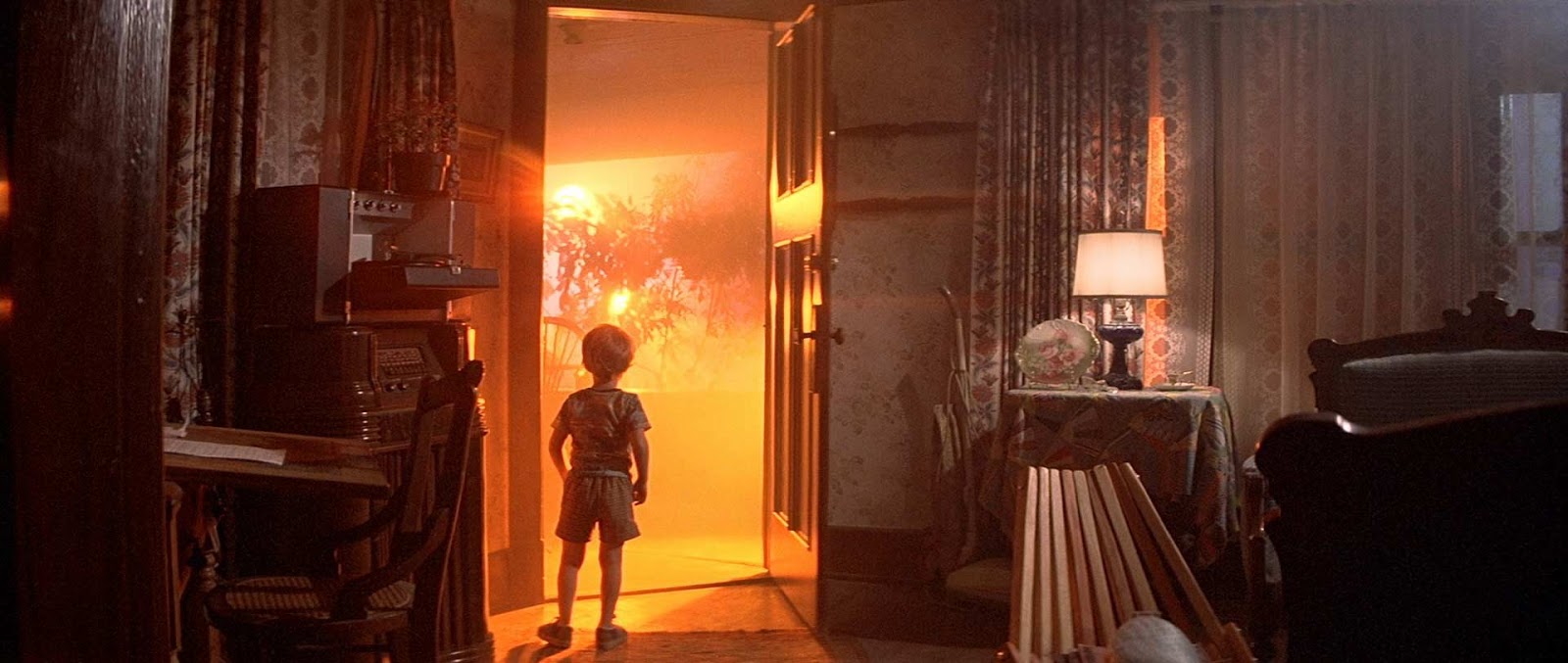
Without explaining too much of the plot, Close Encounters is about two families. Both these families have members that end up having a 'close encounter' with an unexplained force. Barry Guiler (a 3 year old) and Roy Neary (Richard Dreyfuss) are the two most affected by them. Barry is abducted by aliens early in the story while Roy becomes obsessed with a number of images that have seemingly been burned into his brain. These images drive him throughout the film and wind up taking him and Barry's mother Jillian (Melinda Dillon) to Devil's Tower in Wyoming. It's here that humankind makes official contact with these aliens. In a quick summation there's nothing overly jaw dropping about this film. We've seen this story before (often as a result of parody and emulation of this film) but Spielberg takes a fairly pat science fiction story and turns it into a classic with the same methodology he used on Jaws. The early scenes show two families simply living their lives. I don't know what Spielberg does but he has a way with child actors that I've never seen with any other filmmaker (save maybe J.J. Abrams in Super 8). He manages to capture children as they are rather than children trying to act like children. Watching Barry's face light up with excitement or confusion as he encounters otherworldly beings is something we've all seen a thousand times when interacting with little cousins or siblings who discover something new. Spielberg's family dynamics are the same way. They ring true in a way that forces the viewer to drop what they're doing and get completely sucked into the film. I can't imagine a film like this being made today with the same patience. The first time we meet Roy Neary he's using model trains to try and help his son with his math homework. They spend the next ten minutes arguing about the family's plans for the evening. There's no hurry to get to the titular event. For all we know it may never come. But with how well these household situations are handled I really didn't mind waiting. Spielberg does this same thing in Jaws.
It's been a great experience watching all of Spielberg's early work so close together. Close Encounters is a healthy marriage of Jaws and Raiders of the Lost Ark. We've got the great family dynamics and story I just mentioned and we've got these wonderful supernatural elements that help drive the framework of the film. The World War II era planes that suddenly appear in the Sonoran Desert is the opening of the film could be a story set up taken right out of an Indiana Jones film. And the story is built in such a way that anytime you start wondering whats going on with the scientists behind the scenes you get a scene switch and you're with them finding a tanker ship plopped down on a sand dune or one of my favorite sequences in the film, listening to hundreds of Dharmsala Indians singing the five tone musical phrase of the film's theme and pointing toward the sky. To borrow a phrase from J.J. Abrams, these elements create a "mystery box" that do wonders to push the story forward. Spielberg dangles just enough information in front of his audience to keep them wanting more without ever revealing the film's ultimate secret. He also achieves the delicate balance of giving just the right about and never too little. Time and time again, mystery films use too many clues that don't mean anything to keep people on the edge of their seat and it generally has the opposite effect.
The film's final act is a long one. The "contact" sequence is one of the most famous in American film history but what's interesting is that out of context it's completely underwhelming. Close Encounters is sewn together in such a great way that even though the ending might appear slow or anticlimactic, to the audience it's completely wonderful. Many of the films questions are answered and the dazzling natures of the colors and sounds used in the alien ship's design is nothing short of awe inspiring.
And it's this ending that sets Close Encounters apart from so many other science fiction efforts. There's no battle. There's no threat. Instead there is hope. A hope for humanity I've never seen in other films. There's a wonderful quote from a film critic named Charlene Engel that says that the film "suggests that humankind has reached the point where it is ready to enter the community of the cosmos". Doesn't that just reek of Carl Sagan? And rightly so. It's a beautiful notion. Sure, plenty of sci-fi films present aliens as villains but its even more easy to believe that we'd be the aggressors were we to ever actually encounter an otherworldly force. And the idea that they allow a human chosen team aboard their ship only enhances the idea of an open dialogue between worlds. It's a wonderful ending to a great film and I give Spielberg a lot of credit for making it.
Next up:
Viewing the film this close to Jaws and E.T. was a learning experience. Spielberg's definitive theme, and it's evident in all of his films, is the importance of family. I could go on all day about the wonderful special effects, the now famous yet utterly simple score by John Williams, or even the complete and utter badassery that is getting François Truffaut to head up a committee of eager scientists but the film starts with two families and so then will this article.
Without explaining too much of the plot, Close Encounters is about two families. Both these families have members that end up having a 'close encounter' with an unexplained force. Barry Guiler (a 3 year old) and Roy Neary (Richard Dreyfuss) are the two most affected by them. Barry is abducted by aliens early in the story while Roy becomes obsessed with a number of images that have seemingly been burned into his brain. These images drive him throughout the film and wind up taking him and Barry's mother Jillian (Melinda Dillon) to Devil's Tower in Wyoming. It's here that humankind makes official contact with these aliens. In a quick summation there's nothing overly jaw dropping about this film. We've seen this story before (often as a result of parody and emulation of this film) but Spielberg takes a fairly pat science fiction story and turns it into a classic with the same methodology he used on Jaws. The early scenes show two families simply living their lives. I don't know what Spielberg does but he has a way with child actors that I've never seen with any other filmmaker (save maybe J.J. Abrams in Super 8). He manages to capture children as they are rather than children trying to act like children. Watching Barry's face light up with excitement or confusion as he encounters otherworldly beings is something we've all seen a thousand times when interacting with little cousins or siblings who discover something new. Spielberg's family dynamics are the same way. They ring true in a way that forces the viewer to drop what they're doing and get completely sucked into the film. I can't imagine a film like this being made today with the same patience. The first time we meet Roy Neary he's using model trains to try and help his son with his math homework. They spend the next ten minutes arguing about the family's plans for the evening. There's no hurry to get to the titular event. For all we know it may never come. But with how well these household situations are handled I really didn't mind waiting. Spielberg does this same thing in Jaws.
The film's final act is a long one. The "contact" sequence is one of the most famous in American film history but what's interesting is that out of context it's completely underwhelming. Close Encounters is sewn together in such a great way that even though the ending might appear slow or anticlimactic, to the audience it's completely wonderful. Many of the films questions are answered and the dazzling natures of the colors and sounds used in the alien ship's design is nothing short of awe inspiring.
And it's this ending that sets Close Encounters apart from so many other science fiction efforts. There's no battle. There's no threat. Instead there is hope. A hope for humanity I've never seen in other films. There's a wonderful quote from a film critic named Charlene Engel that says that the film "suggests that humankind has reached the point where it is ready to enter the community of the cosmos". Doesn't that just reek of Carl Sagan? And rightly so. It's a beautiful notion. Sure, plenty of sci-fi films present aliens as villains but its even more easy to believe that we'd be the aggressors were we to ever actually encounter an otherworldly force. And the idea that they allow a human chosen team aboard their ship only enhances the idea of an open dialogue between worlds. It's a wonderful ending to a great film and I give Spielberg a lot of credit for making it.
Next up:
Subscribe to:
Posts (Atom)