Showing posts with label ramblin bout amblin. Show all posts

Ramblin' 'bout Amblin: The Lost World

After Jurassic Park's success, both Spielberg and an enormous number of fans put pressure on Michael Crichton to write a sequel. The author had already written plenty of books but he'd never taken a stab at a sequel before. It was a quick turnaround and right as the novel was published in 1995, production began on the film version. Having actually read the novel long before I saw The Lost World I went into this film with  high expectations. Crichton did a phenomenal job on his first ever sequel and unfortunately the expertise in story telling and building upon Jurassic Park didn't carry over to the film.

I don't have too many specific issues with The Lost World. The largest gripe I've got toward this film is the screenplay written by David Koepp. The reason Jurassic Park succeeds so well is because its working with just enough characterization to make its characters human and genuine without ever going overboard or losing focus on the film's true direction. Koepp has a shared writing credit with Crichton on the original film but worked alone on the sequel. Seeing such a success followed by a failure leads me to believe that the duo was able to strike up a really perfect working relationship. Crichton's novel has much more character depth and development but that's the language the medium speaks. Working with a screenwriter like Koepp forced Crichton to choose exactly what character traits were important enough to make it into the film, which descriptors would truly drive these characters home, etc. Koepp then made sure that the film kept a brisk pace and would play well onscreen. It's actually a great idea for a writing team especially since Crichton's novels are already written in such a cinematic fashion. Crichton's heart definitely wasn't in the idea of adapting the sequel novel for film based on the reason he wrote it in the first place. So the job fell solely on Koepp who approached the material in much the same way he did Jurassic Park. Except this time he didn't have a wall to bounce ideas off of and the film runs into problems that its predecessor was able to avoid. Koepp oversimplifies the characters so much that we really don't care about any of them. They end up playing genre roles rather than being actual people. Sure the film moves along briskly and has far more action than the first but because we don't care about the people that the action is happening to, all that falls on deaf ears.

Getting away from the film's writing, the other big issue is its heavy reliance on CGI. There's less of a marriage between practical FX and digital ones in this film and due to the higher level of dinosaurs in the film, any and all flaws become much more apparent. It hardly looks terrible but I truly feel that comparing the FX of Lost World to Jurassic Park is a bad idea. I think the first film did it better and even the four years of CGI development wasn't enough to allow this film to rely as heavily as it does on them.
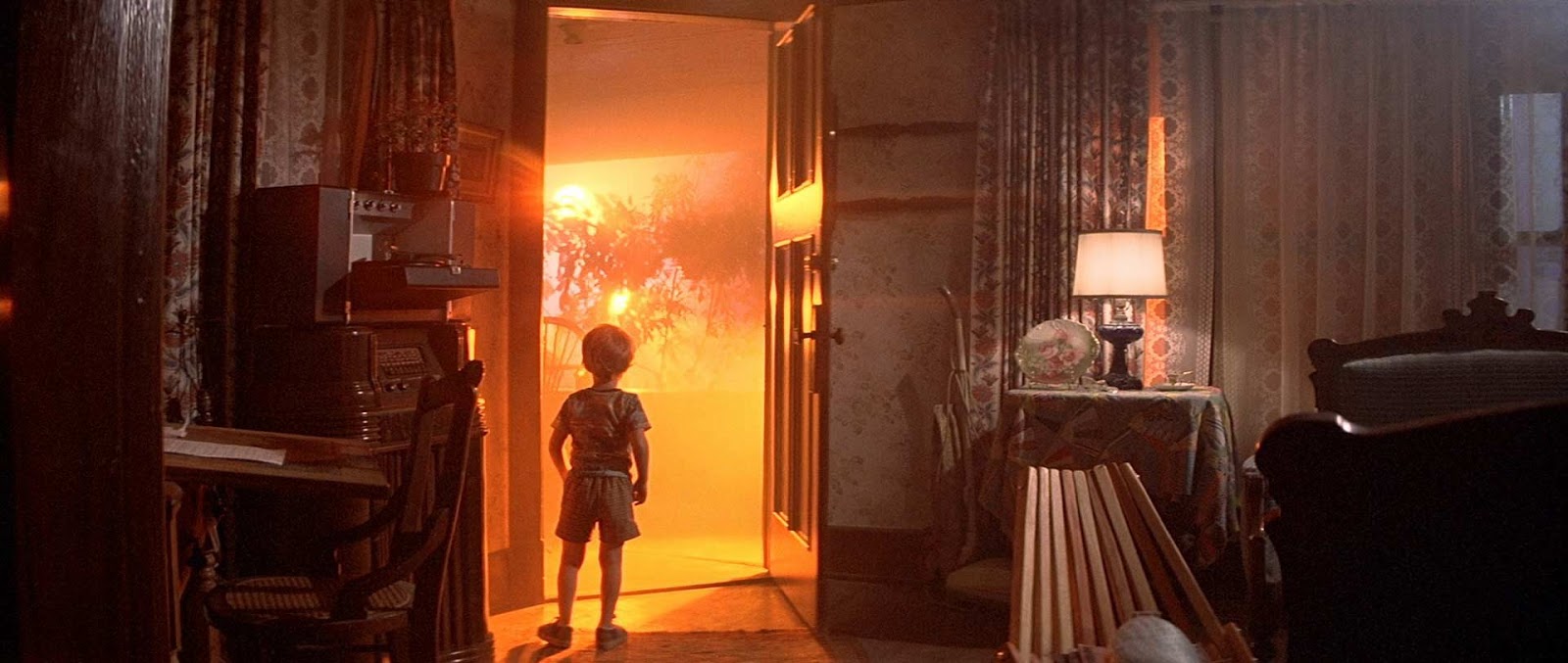
I think my ultimate issue with The Lost World though resides in its spirit. This isn't an adventure film, it's an action film. The wonder that emerges from watching the Brachiosaur stand on it's hind legs to reach the highest branches of a tree or a baby Velociraptor pushing its way out of an egg has been almost completely done away with. The image above shows the closest sequence in film that has this kind of adventurous spirit. And after about forty seconds it turns into a CGI filled chase sequence that loses all the wonder it started out with. It' definitely the pressure that gets put on a sequel to outdo the original but unfortunately The Lost World ends up playing out like a film created solely to sell tickets.

Up next:


Ramblin' 'bout Amblin: Schindler's List

The list is an absolute good. The list is life.

Steven Spielberg did not want to direct this film. The filmmaker doubted his maturity level and saw the film as too important for him to leave his mark on. He tried to pass the project onto a number of other filmmakers including Roman Polanski who's mother was killed at Auschwitz, as well as Sydney Pollack and Martin Scorsese. Scorsese was actually attached to direct the film for some time before Spielberg's conscience got the better of him. Spielberg believed he'd "given away a chance to do something for my children and family about the Holocaust" and using Cape Fear as a bargaining chip, was able to re-establish his place at the film's helm. His final push to direct came from the rise of neo-Nazism after the fall of the Berlin Wall and the growing numbe of Holocaust deniers. Already having gotten more in touch with his faith while raising his children, Schindler's List may have actually come at the perfect time for Spielberg. He pushed Jurassic Park to the top of his priority list knowing he wouldn't be able to move to a new project for a long time once Schindler was completed.


Moving into production Spielberg left no stone unturned to make sure audiences felt the personal and political weight the story carried for him. He sought out a number ancestors of the Schindler Jews to play roles in the film. The script itself boasts 126 speaking roles and over the course of shooting over 30,000 extras were hired, many of which were Holocaust survivors themselves. The film's producers were tasked with finding as many of the people portrayed in the film as possible after Spielberg conceived the idea of the film's epilogue.

I realize that's a lot of trivia but I think it's incredibly important to know how personal this film was to Spielberg. Looking back on his career prior to Schindler's List it's hard to believe that he'd even be capable of a film that took on this type of subject matter. Even his most personal films up to this point had been lighthearted if not adventurous. Schindler's List is not only one of the most important American films ever made but also a clear turning point in Spielberg's career. A point where, save for a few films, many of his projects became much darker and more serious in nature. What's amazing though is despite the film's heavy nature it's still incredibly watchable. Spielberg has this incredible ability to make cinematic masterpieces from even the darkest material and never pulling punches. Schindler's List never lacks in its ability to wrench the heart and it does so often.

My favorite thing about this film is the way that Spielberg decided to shoot it. He partnered with Janusz Kaminski (the cinematographer Spielberg now works with exclusively) and told the film's story the way that history does: in black and white images. Like photos from books or a museum, Schindler's List presents a story told in timeless fashion. Using handheld, almost gonzo techniques, the film looks more like a documentary than a prestige picture and because of this doesn't have any kind of time stamp on it. Watching this film with no knowledge of the few famous faces within gives no sign of what year it was created and it makes the material presented all the more powerful. You can't pull out bad CGI from the 90's. You can't pull out that famous single that was all the rage when the producers were trying to figure out how to market the film. Schindler packs so much more of a wallop because of all these choices. I truly feel its one of his most "Spielbergian" films. By that I mean there's nothing diluting his creative process. There are no crane hots. There are no silly action scenes. This film is pure Spielberg and paired with the fact that it's undoubtedly his most personal film, Schindler's List is one of the most important films out there.

Up next:


Ramblin' 'bout Amblin: Jurassic Park

I had the immense pleasure of being able to see this film in a theater very recently. Spielberg decided to honor the film's 20th anniversary by giving it the 3D treatment and letting people spend way too much money on the glasses that make the film viewable. I never saw Jurassic Park in theaters. When the film came out I was only four or five years old and my parents would never have deemed this film appropriate from my fragile mind. My love for this film is attributed entirely to the medium of VHS. Because of it, this film lived in every single one of my friends homes as well as my own. It was our go-to movie as kids (and it still is whenever I need a nice pick me up). And more often than not, the adults would end up stopping whatever they were doing to sit and watch with us. I wore out my copy. Then dvd's were invented and my love for the film was rekindled. I didn't think I could enjoy it any more than I had been. Then I saw it in theaters.

Now because I never saw experienced it thusly until now (and even if I had I can't imagine I'd be focusing on the same things I am now) so I have to assume that some work went into the sound mix. If not then wow because I have to tell you: If you haven't seen Jurassic Park with theater quality sound, you really haven't seen it. It changes the entire experience of the film. When the T-Rex first escapes it's paddock, it goes from thrilling and enjoyable to absolutely terrifying simply because of how intense the sound mix is. When that dinosaur roars you feel it in your blood. You feel it in your bones. And if you really focus you'll see that you're desperately in need of your mommy.
I talk about Jurassic Park a lot in my everyday life. It's a film everyone has seen and most people enjoy so it's a great conversation piece. But rather than relating my favorite scenes to people I usually only bring the film up to make one point. The CGI is out of this goddamn world. This film was released in 1993. The true digital pioneers that worked on this movie changed the way that films are made. Sure, at times Jurassic Park looks a tad dated but I fully believe that the scene that that spawned the above still is not one of them. And though Spielberg's approach to this style of filmmaking ended up coming from a place of desperation rather than intent, his methods have been emulated since in only the best heavy CGI films. The methods I'm referring to are creating a hybrid of practical and computer generated effects. For every instance of a computer generated dinosaur in Jurassic Park there are double the number of animatronic or claymation creatures helping actors have something to act off of or giving DP Dean Cundey a focal point and in so doing, giving the digital fx developers a sense of how light and color will play on the surfaces of these dinosaurs. Without this understanding and relation to environment, CGI effects fail. Perhaps not as much nowadays where the power of computer imagery is absolutely astounding (and whole films are made with them) but for the decade and a half after Jurassic Park, filmmakers and studios tried to cut corners and doomed their projects in the process.
Jurassic Park's other success as a film is that its got great characters. Sure it's a monster movie. Sure it's a disaster movie. Certain characters need to be played. But Jurassic Park manages to ride an extremely fine line in storytelling. We see and learn just enough about these people to know that they are in fact real people rather than positions that were filled. And yes there's definitely a few dud moments. The kids get a tad annoying but on the flip side, some of the film's best scenes wouldn't be what they are without them. And seeing the film in theaters twenty years on was awesome when it comes to the hacking and dated technology of the film. Everyone had a nice appreciative laugh. "It's an interactive CD-Rom" is my particular favorite of these.

Admittedly I'm extremely biased. I love this film. For what it's worth I find it to be one of the most exciting and enjoyable films ever made. But I think it's earned it. With a perfect mixture of well done special effects, fresh and simple storytelling, and a director who understands exactly how to mix all these things together, you've got the perfect adventure story.

And before I wrap up I need to figure out how on earth John Hammond saying "Dr. Grant, my dear Dr. Sadler. Welcome to Jurassic Park" makes me almost cry every single time I watch this film. It's a mystery to me. But a mystery I'm fully intent on analyzing for the rest of my days.

Up next:


Ramblin' 'bout Amblin: Hook


1991's Hook was a sequel no one needed. Peter Pan was a rather open and shut storyline and I doubt too many people were dying to know exactly how Neverland turned out after Captain Hook was defeated. It turns out Steven Spielberg was one of the few people who were wondering about Neverland's uncertain future. What's more, Spielberg didn't want to know what happened after Hook died. Instead he wanted to know if Hook died at all. His answer: a rapturous no.

Spielberg came and went from this project a few times starting in the early 80's. But when he finally did come on board in the beginning of the next decade he was ready to make a film that centered on a subject matter near and dear to his heart. For Spielberg like so many others in his generation were raised on the story of Peter Pan. And frankly what child since its publication hasn't been enthralled by the heroic story? Spielberg tackles the father-son relationship again, saying that this time he was the boy in a relationship with a father who had zero time for him. What's interesting about Hook is that Spielberg gives the father a chance at redemption. In fact, the entire story revolves around whether or not Peter Banning will decide to find his courage and fight to save his children. Spielberg's own relationship with his father drove the narrative's inception. The director's personal comment on the film and the time period was as follows:

I think a lot of people today are losing their imagination because they are work-driven. They are so self-involved with work and success and arriving at the next plateau that children and family almost become incidental. I have even experienced it myself when I have been on a very tough shoot and I've not seen my kids except on weekends. They ask for my time and I can't give it to them because I'm working.

Hook is the film that cements my idea that though Steven Spielberg makes films for the masses, he rarely forgets his heart. Sure there have been time where we've genuinely wondered if he made a film for anything but the money but when he does come out with one of his greats they're genuinely rooted in a deep feeling. And like many of his other films Hook remembers what it's like to be a child and though the film spends its majority in a fantasy world, the children are true to their name. They're fun-loving, innocent and an essential part of helping the older characters (maybe not the villains) realize who they once were and more importantly, who they really are. And speaking of villains, good god is Dustin Hoffman killer as Captain Hook.
Hook isn't a perfect film. But luckily it doesn't take itself seriously enough to warrant to much anger toward its flaws. It's fun, loving and like many of Spielberg's films spreads an important message. I will say though for those who have seen the film, the sequence where Peter and Wendy return home to find the children have been taken by Hook is one of my favorite scenes on film. The scar that Hook leaves on the walls from the front door all the way to the nursery is a setpiece of shear terror and in my opinion shows Spielberg's true power as a filmmaker. He utilizes a simple visual to tell you so much and horrify you at the same time. Simply wonderful.

Up next:

Ramblin' 'bout Amblin: Indiana Jones and the Last Crusade


Indiana Jones and the Last Crusade manages to reclaim much of the adventurous spirit that Temple of Doom tried to strangle and bury in a shallow grave. It was great watching this trilogy almost entirely at once. I got to watch Spielberg treat a storyline with almost the exact same style of filmmaking throughout. Generally when a series of films is being made, the director (assuming it's the same one throughout) grows as a filmmaker. I'll never say that this is a negative though there are plenty of film series that change dramatically in visual style and tone as they go on. Generally it fits in with the tone of the story being told. Spielberg becomes a nice exception to the rule. All three Indiana Jones films are treated very similarly in terms of production style. Though they do get bigger and better in the traditional sense they look and smell the same. As if they were all made at once and cut into three sections much later in the creative process. Even a series like Peter Jackson's Lord of the Rings shifts dramatically in presentation from film to film. Color schemes and even lighting and camera style are all over the place in that series. Now I'm not calling it a detriment to the films but to people who cut apart cinematography in their spare time (i.e. the people who write for this blog) it makes that element of production seem like an afterthought. What I'm trying to say is that Indiana Jones doesn't do this at all. All the films have a great look and feel that carries over between entries. And why shouldn't it? These films are an homage to a bygone era of storytelling. Spielberg and Co. weren't reinventing the wheel with these films. They were using a pre built template to tell a new story in an old medium. Still with me? Good. Let's roll.


Steven Spielberg took five years to decide exactly what kind of film Last Crusade needed to be. As I wrote in my review of Temple of Doom, Spielberg wasn't the biggest fan of his contribution to that film and took a much more assertive role in the production of the third installment of this franchise. The film's many script and story ideas rival that of Alien³. Spielberg was hellbent on making an enjoyable film to apologize for the last outing.  

His big push was to include Indiana's estranged father as a major story arc. This is where Spielberg's tastes really begin to appear. Close Encounters, Hook, E.T. and even future films of his like Catch Me if You Can and Minority Report deal in one way or another with a strained relationship between fathers and sons. Though Spielberg's treatment of the issue is fairly lighthearted in this film he's still using it as a powerful tool. The climax of the film sees Indy and his father Henry finally reuniting for a common goal and admitting their true feelings for one another. It brings a sense of heart to the trilogy that it had been missing before and it really helps to conclude a great adventure story. By adding this element to the series, it forces an audience to care about the characters in a way that the previous entries had never done before. Spielberg achieves the impossible by very realistically portraying a working relationship between father and son in a fantastical adventure story. As a son there is hardly a more powerful drive in life than not only impressing your father, but surpassing him and being told you've done well by him. It seems trivial but it's an incredibly important element in a young man's life. Spielberg's choice to include it in Last Crusade , even in the scenes you may not always remember when discussing the film with friends, brings the film from simple adventure territory to a film that can safely reside close to home.

Up next:


Ramblin' 'bout Amblin: Empire of the Sun

Spielberg's first stab at a World War II drama is an odd duck of a film. Beginning it's production in the same way that Jaws did, Spielberg pushed to direct the film after originally signing on to produce for David Lean. 
So begins a pseudo trilogy of World War II dramas from Spielberg (the others being Schindler's List and Saving Private Ryan).

Empire of the Sun is an attempted epic in scope. The story follows a young boy over the course of several years as he goes from living in a wealthy British family in Shanghai to becoming a prisoner of war in Lunghua Civilian Assembly Center. Spielberg has actually gone on record to call the film his most profound work on the loss of innocence and though definitely see that that's the film's message it does too much meandering to really drive the point home efficiently.

The film clocks in at 154 minutes. The first act of the film grabs up about 45 of those minutes. In that time Jamie (Christian Bale) loses touch with his family when they're separated in a riot, fends for himself by squatting in the abandoned mansions of family friends and then finally surrenders when starvation seems the only other option. Somehow though the film manages to be completely uninteresting though all of that. The riot sequence has plenty of fire fights, and war machines but it all plays out as very stale. Spielberg hardly captures the horror of a child being separated from his parents. The whole film really does lack for any real emotional attachment. The problem is that outcome would be brilliant if it were intended. If I felt that detached walking out of a story about a boy losing everything including his own sense of humanity and the director was just standing at the theater exit laughing maniacally, I'd adore that film forever. 


Unfortunately thats just not the case with Empire. Late in the film the base is "saved" by a number of US planes. Bale's character (and I'll say now before I forget that Bale does a wonderful job in this film and without his great performance it'd be a total loss) after having been abandoned by everyone in his life, and learning that stealing from the dying to save the living is part of this new existence has a conniption when he actually sees the American fighter planes. He shouts and screams with excitement like only a child can do. Its the most moving moment in the film. The problem is it doesn't work with the story that Spielberg is trying to tell. Bale's character loves planes with all his heart and though I'll never stomp on a child's happiness I really wanted to see him ignore the planes. To see them soar over his head and instead of being happy, he continues about his routine of survival. 

I have to make an aside about John Malkovich in this film. His performance is wonderful as always but in a movie that really defines vanilla his character is one of the grayest complex people I've ever witnessed on film. I really wish the story moved passed Bale's youth and into his adulthood so that we could see more of Malkovich in person and more of him develop in Jamie.

I'm really ripping on the film here but I must reinforce that it's hardly a loss. Spielberg's craft is the best I've seen it so far in this chronological run through his films. He tells a long(winded) story and manages total control over some huge settings and character's. The amateur mistakes of Jaws and the campy nature of the Indiana Jones films have been left by the wayside to make a very professional-looking war epic. The trouble definitely resides in a script that keeps telling the audience it should be feeling but never really works hard enough to illicit that much emotion out of anyone.

Up next:


Ramblin' 'bout Amblin: Indiana Jones and the Temple of Doom

Ready to have your mind-hole blown? Temple of Doom is a prequel to Raiders of the Lost Ark. Yeah, let that sink in.

Okay that's probably not news to many of you but it sure as shit was news to me. It does explain a lot though. The disappearance of Karen Allen. The sudden and horrible presence of Indy's two new sidekicks. It's almost worth pretending that this was the first Indiana Jones film just so you can credit the series' creators with having the good sense to get rid of the two side characters and essentially pretend this film never happened. Why? Because it's a goddamn train wreck.

George Lucas made a push for the film to be a prequel because he didn't want Nazis as the villains. First mistake. He turned in a treatment and Lawrence Kasdan who wrote Raiders immediately said no. He seems to be the only one who was thinking clearly. Since then even Spielberg has come out and said he doesn't look positively on the film. Spielberg wanted Karen Allen to return as Marion Ravenwood and possibly introduce Abner Ravenwood (the young man portrayed by Shia Labouf in Kingdom of the Crystal Skull). It hurts to know these ideas were shot down by Lucas. One, because I love Karen Allen in these films and two, because this means that we would've got a different young actor to portray Abner which is something we can all agree would've been wonderful.

It's a shame. Having Marion and Abner in the place of Willie Scott and Short Round would almost immediately fix this film for me. The plot isn't the issue. Sure the film's portrayal of Indian and Hindu culture is astoundingly bad, but I'll let most of it slide if it means I don't have to listen to Kate Capshaw and Jon Ke Quan bray like a pair of carnival animals for the first hour and fifteen minutes of this film. Alright I'll try not to openly bitch anymore. Thats not what this article is supposed to be about.

Spielberg does a great job again of approaching the genre with the campiness that made its predecessor so wonderful to watch. They even took it a step farther by making the film much darker in tone (It contributed heavily to the creation of the PG-13 rating). The film has some wonderful moments. The opening in the Chinese Nightclub. The escape from the gangsters that immediately follows. And the mine cart sequence when Indy and gang escape the Temple of Doom at the film's conclusion. All really entertaining stuff. What's funny is all three of those scenes were cut from Raiders of the Lost Ark. They wouldn't quite fit into the first films narrative and were reused for Temple. It makes sense that they're far and away the best parts of the film but it hurts to know that they built an entire film out of scraps and ill-judged crap. 

The film spends its first hour wandering around aimlessly trying to make jokes. And fails in the process. I can't blame the writing on Spielberg since he had little to do with it but its really a shame he didn't put his foot down more. From everything I've seen and read, Spielberg's contributions would've changed the film's shape completely for the better. So for that I have to blame him a little. But the brunt is still on George Lucas. Why? Because its just so easy. Spielberg's final ruling on the film is that "there's not an ounce of my own personal feeling in Temple of Doom". Really Steve? Then why do it?

Up Next:


Ramblin' 'bout Amblin: E.T. the Extra-Terrestrial

E.T. was the highest grossing film of all time when it was released. It held that record for ten years. Then Jurassic Park ousted it. It could be that I'm writing this the day after the bombings at the 2013 Boston Marathon but there is something so calming about the fact that for a decade American's favorite film was a film devoid of violence. It was a film about friendship. About family. About helping a stranger.

There are a lot of great parallels between E.T. and Close Encounters. Namely the idea that at least for some people, discovering a being from another world isn't a cause for alarm. Sure, in E.T. the government does pose much more of a threat than they do in Close Encounters but what I find so wonderful about E.T. is that ultimately it's not the government thats the problem. It's more generally adults. E.T. is a film told almost entirely from a child's perspective. Spielberg utilizes numerous low angle POV shots to illustrate this. Though it was many years earlier I saw a lot of Terrance Malick's Tree of Life in much of this film's cinematography. Though Tree does a better job of portraying the beauty and energy of a child's view, E.T. managers to portray the sometimes terrifying nature of being surrounded by people who control you simply because they're larger. Spielberg never over complicates this issue either. Almost every adult is wearing a mask in this film. And it's perfect. Almost no individual adult is important save for Elliot's mother and possibly one of the scientists that gets involved. Masking the adults, whether it be literally or in shadow, is the perfect way to turn them into agents of evil without having to show any kind of violence.


The story in E.T.  is over simplified but I really feel it does nothing to soften the film. Instead it just supports the claim that the film is about and for children. A child wouldn't find out everything he could about a new friend's home-world or genetic make up. He'd simply want to spend time with them. I really can't fight with E.T. on any level. It's a wonderful film with a great message with one of the most touching conclusions I've ever seen. I hand it to Steven Spielberg for keeping the film as innocent as a child.

Up next:


Ramblin' 'bout Amblin: Raiders of the Lost Ark

George Lucas' dream was to create a modern version of the serials of the 1930's and 40's even though he'd basically already done that in 1977 with Star Wars. It was while trying to escape the madness that that very film created that Lucas and Steven Spielberg discussed the notion of directing a James Bond film. Lucas convinced Spielberg that he'd invented a movie hero that was better than Bond but just as adventurous. After the premise was explained Spielberg said he loved the idea: "Bond without the hardware". Lucas' original name for the character was Indiana Smith. Spielberg flexed his creative control right from conception and made him change it to Jones. Thank our stars. Spielberg also had some interesting ideas for the character himself. Mainly that he'd be a drunk like Bogart's character Fred Dobbs in The Treasure of the Sierra Madre. This idea fell away as the script was developed by Lawrence Kasdan and after five drafts they had what we now know as Raiders of the Lost Ark.

I didn't grow up with the Indiana Jones movies like most of my friends. I'm not sure why. They just never made it into my house. So by the time I was introduced to them I honestly found them underwhelming. But the more I watch them the more I love the effects and silly nature of a lot of the combat. Looking at the films production there's some great stuff to be learned. All of the silliness in the movie was done entirely on purpose. Every major studio rejected Raiders thinking that it would be far too expensive to make as well as too over the top narratively. Paramount pictures finally stepped up to fund the project but layed down the law in the process telling Spielberg the film had to stay on budget and schedule. Spielberg pre-pro'd like never before, hiring four illustrators to storyboard every scene as much as possible. Spielberg also took it upon himself to shoot the film "quick and dirty" as was the style of the Saturday matinee serials he was emulating. All the effects were all done practically using puppets miniatures and in camera tricks to keep costs down. The time and money crunch definitely aided the success of the film. Spielberg himself even said "Had I had more time and money, it would have turned into a pretentious movie".

All the background info aside I like this film more and more every time I see it. It's nothing if not a blast. Especially in a world where films that should be fun end up taking themselves too seriously. Knowing Spielberg meant to make the film look over the top allowed me to turn my head at some of the campy effects the first few times I watched it. But now I embrace the film's presentation with open arms. It's interesting because I used to find the Indy films artless but it takes a serious filmmaker to make a movie thats so reminiscent of a bygone era of storytelling. It's funny how often the film comes off as an indie production with bare bones costuming and sets. It never hurts the movie but it's great to see a film that's so highly regarded have a few budget moments. Aspiring filmmakers need to take note of things like this in huge feature films. It's a glimmer of hope.

I really don't have anything negative to say about this film. Spielberg's technique is hidden behind emulation but if you make yourself familiar with old serials both narratively and visually, you can see how great a job Spielberg and his team did on Raiders. I'll take a just a second to recognize John Williams for creating yet another amazing musical theme. Where would great American films be without his musical touch?

Up next:


Ramblin' 'bout Amblin: Close Encounters of the Third Kind

Close Encounters of the Third Kind is a film about a lot of things. It's about aliens, family, government control, and obsession. I'm sure there's more but we'll start with broad strokes. This film went through an extremely troubled writing process with plenty of big name screenwriters turning in drafts. (Paul Schrader and John Hill to name just a pair). Ultimately though, Spielberg hated almost every treatment and script he received and ended up taking on the task of writing the film himself. This marks one of the very few films he's received a writing credit for.

Viewing the film this close to Jaws and E.T. was a learning experience. Spielberg's definitive theme, and it's evident in all of his films, is the importance of family. I could go on all day about the wonderful special effects, the now famous yet utterly simple score by John Williams, or even the complete and utter badassery that is getting François Truffaut to head up a committee of eager scientists but the film starts with two families and so then will this article.

Without explaining too much of the plot, Close Encounters is about two families. Both these families have members that end up having a 'close encounter' with an unexplained force. Barry Guiler (a 3 year old) and Roy Neary (Richard Dreyfuss) are the two most affected by them. Barry is abducted by aliens early in the story while Roy becomes obsessed with a number of images that have seemingly been burned into his brain. These images drive him throughout the film and wind up taking him and Barry's mother Jillian (Melinda Dillon) to Devil's Tower in Wyoming. It's here that humankind makes official contact with these aliens. In a quick summation there's nothing overly jaw dropping about this film. We've seen this story before (often as a result of parody and emulation of this film) but Spielberg takes a fairly pat science fiction story and turns it into a classic with the same methodology he used on Jaws. The early scenes show two families simply living their lives. I don't know what Spielberg does but he has a way with child actors that I've never seen with any other filmmaker (save maybe J.J. Abrams in Super 8). He manages to capture children as they are rather than children trying to act like children. Watching Barry's face light up with excitement or confusion as he encounters otherworldly beings is something we've all seen a thousand times when interacting with little cousins or siblings who discover something new. Spielberg's family dynamics are the same way. They ring true in a way that forces the viewer to drop what they're doing and get completely sucked into the film. I can't imagine a film like this being made today with the same patience. The first time we meet Roy Neary he's using model trains to try and help his son with his math homework. They spend the next ten minutes arguing about the family's plans for the evening. There's no hurry to get to the titular event. For all we know it may never come. But with how well these household situations are handled I really didn't mind waiting. Spielberg does this same thing in Jaws.


It's been a great experience watching all of Spielberg's early work so close together. Close Encounters is a healthy marriage of Jaws and Raiders of the Lost Ark. We've got the great family dynamics and story I just mentioned and we've got these wonderful supernatural elements that help drive the framework of the film. The World War II era planes that suddenly appear in the Sonoran Desert is the opening of the film could be a story set up taken right out of an Indiana Jones film. And the story is built in such a way that anytime you start wondering whats going on with the scientists behind the scenes you get a scene switch and you're with them finding a tanker ship plopped down on a sand dune or one of my favorite sequences in the film, listening to hundreds of Dharmsala Indians singing the five tone musical phrase of the film's theme and pointing toward the sky. To borrow a phrase from J.J. Abrams, these elements create a "mystery box" that do wonders to push the story forward. Spielberg dangles just enough information in front of his audience to keep them wanting more without ever revealing the film's ultimate secret. He also achieves the delicate balance of giving just the right about and never too little. Time and time again, mystery films use too many clues that don't mean anything to keep people on the edge of their seat and it generally has the opposite effect.

The film's final act is a long one. The "contact" sequence is one of the most famous  in American film history but what's interesting is that out of context it's completely underwhelming. Close Encounters is sewn together in such a great way that even though the ending might appear slow or anticlimactic, to the audience it's completely wonderful. Many of the films questions are answered and the dazzling natures of the colors and sounds used in the alien ship's design is nothing short of awe inspiring.


And it's this ending that sets Close Encounters apart from so many other science fiction efforts. There's no battle. There's no threat. Instead there is hope. A hope for humanity I've never seen in other films. There's a wonderful quote from a film critic named Charlene Engel that says that the film "suggests that humankind has reached the point where it is ready to enter the community of the cosmos". Doesn't that just reek of Carl Sagan? And rightly so. It's a beautiful notion. Sure, plenty of sci-fi films present aliens as villains but its even more easy to believe that we'd be the aggressors were we to ever actually encounter an otherworldly force. And the idea that they allow a human chosen team aboard their ship only enhances the idea of an open dialogue between worlds. It's a wonderful ending to a great film and I give Spielberg a lot of credit for making it.

Next up:
Ramblin' 'bout Amblin: Jaws

Fox Its release was a watershed moment in motion picture history. In 1975 Steven Spielberg was a relatively unknown filmmaker. He was 26 and had one theatrically released feature film under his belt, the neo-noir The Sugarland Express. Dick Richards, who'd just put out his own debut The Culpepper Cattle Co. had slotted Jaws to be his second film but the producers dropped him for Spielberg.

I think they chose correctly.


Jaws became the first summer blockbuster in history and it's a bit of downward spiral from there as far as popular American film is concerned.


I've seen this film plenty of times but only in this most recent watch did I take a hard look at it for Spielberg's touch. And even so early on in his career he'd developed some of the key traits we associate with his shooting style. The full dolly pushes forward on characters at moments of revelation, really realistic performances despite the fact that Jaws is essentially a monster movie, and, probably the oddest touch for me, an overwhelmingly classical view towards the 
titular man-eating shark. Robert Shaw's Quint rapidly becomes Captain Ahab but at no point in the film does the viewer worry about Brody or Hooper's exposure to the man. Instead we're treated to a lot of laughter and camaraderie, accompanied by John William's oddly upbeat score as they chase harpoon-led barrels around the Atlantic.

Two main things stood out to me on this most recent viewing: John William's score and the narrative's focus. Williams is arguably the greatest film composer of all time. Almost every single theme known by the masses belongs to the man and Jaws is the birth of the legend. Many times I've heard anecdotes about how Spielberg laughed with incredulity at William's when he came to him with the theme to Jaws. "That's it?" was Spielberg's reply. Whether it's true or not is beside my point though. What got me about the score on this viewing was how jovial it is. Most of the film utilizes a really upbeat classical sounding score with very lively string arrangements. The famous theme makes plenty of appearances but Spielberg uses it the same way he uses his reveals. Most of the time the theme is used instead of the actual shark (Though this is due mostly to the malfunction of the shark prop). The first time you really see the shark is about an hour into the film. Spielberg plays it close to the chest and it makes the film so much better. And that's where the narrative comes in.


Now Spielberg didn't write the screenplay but his love of the novel was what got him into the film in the first place. And it shows.


The film's opening is mighty famous. Skinny-dipping teenager gets eaten by an unseen monster. With horror we watch as this girl gets dragged every which way through the water as her too-drunk partner passes out on land and can't possibly help her. The sequence is horrifying, though I couldn't help but laugh. The three minute sequence was definitely shot during at least three different times of day. The quality of light ranges pretty greatly throughout the scene. In fact this kind of error happens quite a bit throughout the film. Hardly an unforgivable mistake but it's interesting to think of films as legendary as Jaws having these kinds of continuity errors. And since I'm thinking of it the best error comes once the final trio are on the Orca late in the film where Roy Scheider is talking and the scene quite literally fades out mid sentence. It'
s hysterical.

What's interesting though is after this initial attack the film goes quiet. We get a really close look at the town on Amity Island and learn quite a bit about its economy and lifestyle. This is where the film shines in my opinion. Because of Spielberg's patience, this thriller's punches end up really packing a wallop. Spielberg makes sure there's real heart in this thing. Whether it be Roy Scheider's sheriff's son being in danger or the mother of one of the shark's victims slapping him in front of the whole town, Spielberg makes sure that at the heart of this film there's a real town with real people in it. This allows for him to not only stave off seeing the shark for so long but also to truly give the film weight that lasts long after people have left the theater.

I'll probably end up having more to say about Jaws when I take a run at Spielberg's earlier work (especially Duel). For now though I'll say that its a great flick and a perfect jumping off point for this project.


Emily D Tucker and I have recently been discussing what makes a good horror movie 'good'. We keep coming back to the same popular opinion that, of course, what makes a horror movie work is for the creator to remember that the film still needs to adhere to the standards of any other movie genre. It must have a fully developed story with equally developed characters; the horror element can’t be expected to carry the film alone. (I’m looking at you, Candyman).

One of my favorite ways that some horror films carry this out is to emphasize a character’s life outside of the main plot. This not only creates a more interesting and three-dimensional character, but also ensures that the character is not simply a vehicle for the plot. The Exorcist, for example, begins by showcasing Regan and her mother under normal circumstances before their new demon friend comes to town. As Regan begins exhibiting signs of trouble, Mom handles it in a realistic way by taking her to various doctors and psychologists, but their lives are not put on hold by Regan’s “illness.” Mom even holds a dinner party for her colleagues during which Regan takes a turn for the worst and pees on the carpet in front of everyone (come on, R, Get it together). By this point, we’re invested, and our understanding of the characters ultimately heightens the eerie sequences that infuse the remainder of the movie.

Jaws handles this technique pretty well. We first meet the main character, Brody (who I’m going to call Danny Tanner for the rest of this review), as he begins his new job as sheriff of a hip beach town. He’s got a cool house, a wife with fabulous hair, and two kids that are surprisingly not annoying. Things are looking up for ol’ Danny Tanner. Just as he's getting his feet wet (!), he and his deputy find a dead body on the shore. In this initial investigation alone, we learn about the main character’s moral code, his logical approach to solving problems and his primary obstacle in solving those problems: the mayor. What we gather about the character here informs our viewing of the rest of the film, as we’re not just watching a shark killing kids or whatever, but a man trying to keep those kids or whatever alive. In subsequent conversations with other characters, like his wife, we see the effect that the shark situation is having on his life. The shark isn’t just a menace, it’s an imposition.  

We have a similar opportunity to get to know Danny Tanner’s entourage, Captain Ahab and Mr. Holland. Captain Ahab, though the most two-dimensional character of the three, has a clear motivation and strong sense of self throughout the film. Mr. Holland, after explaining his reasons for assisting with the hunt (science!), even has to call out of work in order to keep helping Danny Tanner. A small detail like this really lends some realism to a creature feature, particularly after seeing the clearly-rubber shark flopping up and down the boardwalk. 

Parceling out time to explore these characters at the beginning of the film pays off, as it amplifies the suspense of the boat trip in the second half of the film. This would be the most boring movie ever if we didn’t care about or understand the characters, regardless of the fantastic boat attack during the climax. This part of the film is pretty much just a war monologue, a weird fade, and a lot of waiting – risky, but it works.

Though I’m not in love with this movie overall, I certainly respect and appreciate its storytelling ability. The main thing I want a movie to do is get me to care about what it’s telling me, which Jaws actually did. Although I could have used at least one urination scene. Maybe next time, Spielberg! 

Next up: