Showing posts with label solaris. Show all posts

"Too much of a good thing is..."

And so Steven Soderbergh bids farewell to cinema, not with "Goodbye" but with "Too much of a good thing is...wonderful." Why Behind the Candelabra makes for such a frustrating exeunt from the medium of film (or TV movies. Whatever) is that I feel like Soderbergh had just started making a full circle back to the kind of film he stopped making when he started shooting and editing his own work in the late 90s. Which, for me (and Keith Uhlich), is a good thing. If I have a complaint about late Soderbergh (specifically the futurist mode he's been in since The Girlfriend Experience) it's that he abandoned little moments. His films have lately been all meat. This didn't used to be the case, but when at first he drew out his narratives to be sprawling and inclusive (Traffic's divergent narrative threads, Che's grand historical scale), he had to justify each moment. Every second had to tell the story, rather than telling its own story. Not exactly a fault, because you never wonder why you're seeing anything. Look at Haywire. Lem Dobbs essentially gave Soderbergh a blueprint for inclusion to get from one beating or chase to the next. But the problem for me is that this doesn't give me much to bite into or care about. I liked the beatdowns, (I really liked them, actually) but at no point does Dobbs' script or Soderbergh's direction encourage me to know or care about who this woman is unless it has to do with her eventually killing the guys who set her up. And there's an awful lot of dialogue (and crucially, not character development) that needs to be spat out to get us there and it's all by people we don't know. It works in something like John Frankenheimer's Ronin because the action sequences take up huge chunks of the running time and make us forget to care who's who. It won't matter anyway because there's a Macguffin to forecast the eventual gap where there ought to be a satisfactory conclusion. Sodebergh, by contrast, just gives us a final beating, which, while certainly in keeping with the spirit of the piece, can only be as satisfying as the talking we've seen up until this point. We don't know her, so we don't really know what she stands to lose. Not enough, for my liking. Even Contagion, which is hands down my favourite of his late work, and in my opinion something of a minor masterpiece, lacks full emotional bite because we don't know everyone quite as well as we ought to. The bad stuff starts going down before they get a chance to show off who they are divorced of context. 

A perfect Soderbergh little moment - 2/3 of the way through Out of Sight, Jennifer Lopez's federal marshall goes to question a known associate of a suspect. After finishing up her talk, the woman's boyfriend appears to shake Lopez down. After a suggestive threat, spoken spectacularly low and menacing, Lopez beats the man with a portable baton and leaves, tossing a one-liner over her shoulder as she goes. The man could have been trying to get her off the scent of the suspect she's chasing, or he could just be an abusive jerk. Doesn't really matter. The point is the moment works, has nothing to do with the story, and everything to do with letting us into Lopez's world and the world of the film. It's also one of the few times that the atmosphere of a scene isn't palpable. Whether it's a grimy boxing gym, a Florida prison or Albert Brooks' palatial manor, we always have a really clear sense of where we are and what it's like for the characters. That the house where the altercation takes place is defined more by the characters and a vague feeling of unease is a welcome break from the production scheme and it invites us to pay attention to just the behavior of the two characters. 

Now look at Magic Mike, where everyone's in a perpetual state of "over it." It's accurate and thoroughly watchable, but there's very little opportunity for us to learn much about the characters or grow with them. We're a step ahead of them because we know what the narrative calls for. It's still a darker, realer and better film than most US films released in 2012. But it's missing shades of grey, and I don't just mean in the cinematography. The leaping from one 'important' scene to another is narratively efficient, but leaves me just the slightest bit cold. And rendered exclusively in Soderbergh's trademark tobacco brown, it all feels like just one color of the spectrum of experience. As soon as every piece is in place, we can guess how it will turn out, so it's up to our auteur to make sure that the puzzle will look unique when put together. It always does, but they used to be more intricate. Side Effects' greatest pleasure is in seeing just what the central mystery turns out to be and discovering it right along with our duped protagonist. Once it's been solved, the film ends, having done no more or less than a great job taking us from Point A to Point B, placing the low high and the high low, and depicting modern life in the few seconds between plot points. I can't help feeling like ten years ago, I would have gotten a better sense of what Rooney Mara, Catherine Zeta-Jones and Jude Law stood to lose, and sympathized with them more than I did. I do get a sense of where his characters will be, based on how we begin to see their evolution in the final act of the movie. In fact he's gotten very good at broadcasting final acts he doesn't deliver. Magic Mike ends just before a cathartic love scene, Side Effects before prosperity or insanity can fully take over, Haywire just before the final kill, Contagion before normality fully returns. Things move too speedily for the narrative to want to keep up, so the endings come before they've truly ended, allowing a fully formed idea of the future to be the true conclusion, as Soderbergh doesn't want to, or won't bore us with what we already know. 
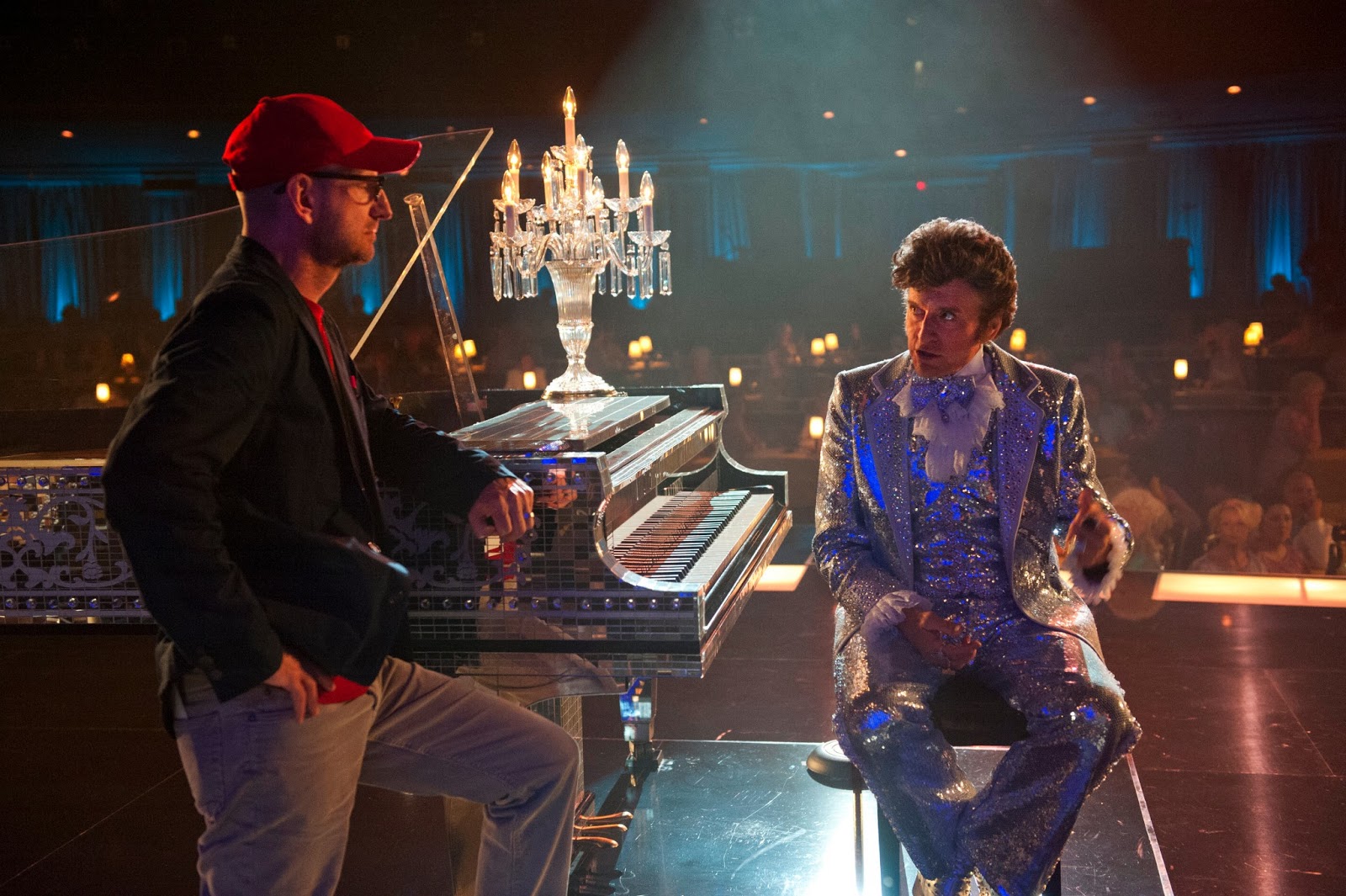
So when I heard that his last movie was going to be based on the true story of someone who is dead, my brain couldn't quite get around to imagining what on earth that would look like. Che, after all, was what all about being objective and marked the turning point toward futurism. Here he had to spell a few things out in a way he hasn't done in a while. Even if we understood what Scott Thorson and Liberace's relationship would turn into, with the details of its ups and downs the only real surprise, we couldn't exactly skip to the important part. It's all important or none of it is, by non-fiction standards. So what in the world was he going to do faced with ten years of detail he couldn't jog through to the ending? Well, it turns out that the saving grace here was that he had to make it for HBO rather than a theatrical release (cannes competition slot notwithstanding, though let's not forget that component just yet). TV is a medium that must be still. And this is a very specific kind of stillness. Often for budgetary reasons, only a few set-ups can be used to make shooting and editing a quicker and cheaper process, but also because a TV audience won't sit still if the camera's going to jerk around like Spielberg's D-Day footage, or totally lose subjects as he sometimes does with shallow focus and lighting. There are very few instances of the camera doing anything like this during Behind The Candelabra, and the most showy example is to communicate a paranoid, drugged-up breakdown, which an audience will appreciate and forgive if not expect. There's one shot of shallow focus where the actors have to walk into frame, and another where he can only see the dark outlines of actors in a well-lit room. Other than that, the camera has to be still, and thanks to the HBO broadcast, it will also take on the sheen of a TV show, which I can't help but feel like he expected, because it helps his cinematography mesh with the production design. 

Soderbergh, or Peter Andrews, as he calls himself behind the camera, usually shoots with cutting edge digital in very expressive lighting, meant to look both natural and unnatural, essentially showing the future of life in apartments by catching his actors in baths of primary and secondary colors, or in darkness against bright backgrounds. If it's not how they appear, it's how they are taken, by whoever would really be in the room. He's performing sleight of hand, in a way, by making us lose track of the subject of a shot. This has the effect of making his compositions look like they're rendered in still-wet water colors, and that if you touch them, they'll smear. With Candelabra, the particular stillness of television post-production, making them up-to-snuff for a home viewing audience watching on the small screen, and the film's interest in the era being a kind of prison, means that the paint is no longer wet. Instead, what Soderbergh achieves is a kind of stuffing, embalming and mounting of Liberace's 70s and 80s. Scott Thorson and Liberace themselves go through this with their surgical alterations, becoming trapped in their own glittery, kitschy homes, stuck in outfits tailored too tight and unable to recognize themselves. They're no longer people, they're dead foxes for the world to draw conclusions about. How did they live? Why couldn't Liberace find the right girl? The glamorous lifestyle is a ruse, like the open eyes of a stuffed animal. If the show they get to see is fame, money, drugs and sex, then the price of admission is silence, misery, aging and uncertainty. 

All that's fair enough; the performances are all genius, I enthusiastically believe Matt Damon as a 17 year old, I love Michael Douglas turning his back on the alpha male shtick he's famous for, Rob Lowe deserves an Oscar, the events depicted are so insane you have to believe them and it certainly makes for one hell of a ride, but I was beginning to wonder why in the world Soderbergh chose to do it. You can't broadcast with this story. Liberace's long dead, after all, AIDS the only secret he couldn't keep and Thorson's breaking the silence is the reason there's a story to tell. So after six films of cool detachment, could that be all there is to his final long-form offering? I thought so, until the last scene. At this point I could offer those with spoilerphobia the chance to look away and skip to a few lines, but there's really nothing I can spoil - it's all public record at this point. It's just how he decides to present the ending that provides the surprise. Thorson sits alone at Liberace's funeral and rather than hearing a eulogy, he hears an intro to the entertainer's final show, and then watches his lover fly in with wings to play one last encore. Suddenly you see what Thorson saw in Liberace, beyond the showmanship: someone with a gift directing entirely at him. He might have been a father, brother, lover, best friend, whatever, but what mattered was that Liberace made the world appear in front of him on a silver platter and he took all of that and gave it to Scott Thorson. The hands that made the name Liberace famous, moved just for him. And the tragedy, or perhaps the most fortunate part, was that he could never tell anyone what they meant to each other. He had to keep Liberace's legacy safe, like a fly in amber, and in doing so he would be the same thing. He'd never get to hear him play again, nor experience someone shifting an empire to make room for him. All that was private, just for him. And really because he'd spent so much time lying to himself and the world about his life and experiences, Liberace probably didn't enjoy those moments half as much as Thorson, who was, at the very least, much more aware of their situation and able to enjoy it as it happened. So the only person who could truly understand the great pianist's legacy sits, enjoying one last number while the world keeps on thinking what it wants to. 

And that's the only time a Soderbergh film threatened to make me cry (King of the Hill came close), which, considering my skeptical attitude going in, is something special indeed. His deciding to take a break from feature films is now not only the sadness it would have been, but doubly so because Soderbergh's pulled another futurist trick by showing us the direction his films might have taken in this last moment. Real closure is back. A little moment of reflection is back. The compositions and spot-on costuming, art direction and production design, suggests a kind of appropriation of classicism, if not a full return to it. From winning the palme d'Or for his first film, which is all about laying emotion bare using technology, to finally, through the most cheesy, obvious artifice, arriving at an emotional climax to his career and debuting his made-for-TV effort at the Cannes film festival, where it stood no chance of taking home the top prize; that's maybe not a happy ending, but I bet Soderbergh sees what a satisfactory, near-perfect cycle it's been. I'd have bet good money that his next feature would have marked a return to the his old method of filmmaking, pre-Out of Sight, mixed with his new understanding of storytelling and image making. The last few years would have been one more specific period in a career filled with them, and Candelabra would have been the turning point. From classical (sex, lies and videotape through to Gray's Anatomy) to post-modernist (Schizopolis to Full Frontal) to post-strucuralist (Solaris to The Good German) to structuralist (Ocean's 13 and Che) and finally this last mode, about to give way to something else. We may never get that next period, but I hope to christ Soderbergh understands how badly his fans want it, and want him to keep evolving. Because whatever my concerns about the relative strength of his work, there are few other major American filmmakers I love to discuss, analyze and think about as much as Steven Soderbergh. So perhaps, this isn't farewell. Maybe, it's just too much of a good thing. Thanks for everything, Steven. 

Blinded with Science

I'd like very much to go around calling myself a director, but the sad, shameful truth is that I work at a record store. Which is just as well because even if I were a rich and famous anything, I'd still be a record store geek. I'd debate the merits of proper hip-hop production (as I did just hours ago on Facebook with a friend who was bringing up a very funny point, not trying to start a fucking debate about goddamn hip-hop integrity), I'd sneer when people explained why I need to make room in my brain for whatever dubstep is (ed: this piece will be obsolete in six months. See, I'm doing it again!). If I discover something, I want it to be a proper discovery, not something some of my equally unhip friends know about and passed to me as cultural shrapnel, because if there's something worth knowing, no one will tell you about it. That's the Catch 22 of doing what I do. Incidentally, I'm not unhappy about working at a record store, but I did undergo a process of curbing my contempt for mass, split second culture. If someone asks if you like Amos Lee, I merely smile and admit that he's not for me. That's what a polite person does, or anyway, I think that's what a polite person might do. I have colleagues who'd do a little more or a little less. If I snorted derisively and rolled my eyes, I'd run the risk of being a giant, jobless asshole. So, instead I simply try to see things their way and ignore that my brain is a voracious knowledge monster with an impossibly fierce, snide and picky doorman. It's not fair to everyone else if I stand behind the counter and impose my tastes on customers for the seven seconds I have to perform a service for them that though I'm uniquely qualified for, can easily be taught to someone who is less mean-spirited and impatient than I am. I try to tell myself that in my defense I do seriously believe that consuming mediocre culture because it's around results in more of it. But I can't tell myself that people honestly don't like the music they buy, even if I try to justify that. We sell a lot of Gotye here. I don't know what he sounds like, but the bigger he gets the harder it is to convince myself it's worth listening to because the general impression I get from people buying it is that they have other places to be and this is something that has become mandatory to own and be able to talk about, so just sell it to me, already. But this is wildly unfair to the artist and his fanbase. I'm so far inside the world of labels and side projects and distribution and bands that broke up after one album released before I was conceived, that it's tough to remember that normal people don't care about that and just want to hear songs they like. They don't want to hear that the other side of me not liking something because it's famous is critics and listeners patting themselves on the back for choosing to ignore a band until a particular moment, before which they'd entertained me immensely.

All this brings me to a days-long project where I was asked to alphabetize our DVDs. For the sake of the children, I put the horror, cult and sexploitation films in one section high above the ground because I wanted it that way, and also because I didn't want kids to be able to look at the lurid covers of Suspiria and Friday The 13th, Part V and be scarred for life. Ok, maybe I do want that, but I also want to preserve some of the mystery. Plus, kids don't buy that shit. Next to horror is my newly minted Nicholas Cage section; small but growing. I put the TV and classics at a little below eye level so senior citizens have neither to crane their necks or bend over to reach it. Our meager Criterion section shares a shelf with the few foreign films we've accrued. Children's films are at kid height near the floor. Sports, exercise and documentary come after the large TV section stops. And then the other rack has everything else. I was going to put drama and comedy in separate sections, but why bother? They're utilitarian genres and if you put the comedy together, the combination of pinks and whites and sparkles hurts your eyes. Plus, how many of those films are actually funny? See why I keep all this to myself? Anyway, I didn't care about mixing drama with action or comedy because they all have mass appeal and it's easier to have them together where I can easily keep track of what we don't have. These used to be sections, but putting cards in to delineate doesn't make as much sense as we don't have the shelf space for it anymore. The one thing that gave me pause was Sci-fi.

What I discovered was that my definition of Sci-Fi clearly didn't match the store's previous definition based on everything that used to go in that section. I, Robot, Dark City, Aliens, Star Wars, The Matrix, etc. Ask anyone and they'll probably agree that this is normal, and as a blanket term, I took for granted that these films, whose DVD cases share dark background colors, sleek fonts and people striking fierce poses, earned the distinction of being called Science Fiction. And then I took the phrase apart. What exactly was the science in Aliens? Now, I love Aliens, but beyond the technology, which no one explains except where fire power is concerned, there's no science in this film. All of James Cameron's best known entrees into the genre are all noticably lacking in hard science. The Terminator writes it off with a line of dialogue. Avatar, which would probably be saved in most stores by the fact that Sci-Fi often shares a backslash with the word fantasy, is based in a scientific principle that no one bothers explaining except to say it's too technical and don't fucking worry about it, dipshit, just enjoy the scenery. Well, fine, but you don't deserve the Science Fiction mantle.

Science Fiction got the name because there used to be people with something like an understanding of the way the world worked. Granted there was far less to know back then, but you get my meaning. Paul F. Tompkins likes to joke that Jules Verne's writing is 99% science and 1% fiction. Fair point. The point is that the science needs to drive your plot, not simply inform it. H.G. Wells explains the mechanics behind his time machine, then fuses its inherent moral conundrums to the protagonist as he uses the device to learn things about himself and the way the world works. Verne's science is window-dressing; he's asking moral questions. The technology of the Nautilus or the fact that the center of the earth holds many wonders doesn't really do much more than give his characters something to bicker over. But it's fanciful, anyway, and one could and I assume that people frequently do argue that without a submarine capable of doing what no craft could do at the time could, the stories wouldn't have been written. My qualm with Sci-fi starts, but doesn't end, here.

To call Verne science fiction, nine times out of ten, is being rather more generous than I'm willing to be. If 20,000 Leagues was about specifically which mad scientist had been splicing genes to create the giant squid, and the lifelong process by which he achieved his goal, I doubt we'd be here. Not only because that wouldn't have entertained victorians worth a goddamn, but it would have been scientific. Nemo may be a scientist in Verne's backstory, but he's little more than Robin Hood with the power of a modern army at his command in action. Look at the many different cinematic interpretations of the character and you see what people remember; a sort of hard-nosed adventurer. His research is a means, not an end. Which is much more in line with the mad science that would reign supreme in horror films post-Frankenstein. Everyone had their reasons (ending world hunger, world domination), but the point was they'd used science to create a giant-ass insect or an astro zombie. Or invert that. An alien visits and it's sci-fi because there's a scientist present who pleads of the men of action to "Think of what we could learn!" before they destroy it. Could being the operative word. And that's science as most screenwriters know it. But eventually the science was overwhelmed. The Invisible Man the Wells story is called sci-fi. But there's a reason you could only find the DVD as part of the Universal Monster collection for many years. It was a horror film, or anyway, it was treated like one. The question I have is what criteria are people using to categorize something as Science Fiction? Because in the film adaptation of The Invisible Man, science takes a goddamn hike in favor of Claude Rains' world domination plot. He derails trains, robs people, and behaves rudely. We don't learn a single goddamn ingredient of his invisibility serum, do we? It might as well be The Horrors of Spider Island (a sleazy, sleazy film rightly placed in Horror, that nevertheless is fueled by scientific anomaly) for all the attention it pays to the details of its implausible plot. To further extrapolate; make your protagonist visible and what do you have? Basically The Public Enemy or White Heat. Take a look at The Amazing Transparent Man, which is a way-late-in-the-game Invisible Man rip-off, which is nothing more than a dime store heist movie with sci-fi trappings, placed there with contempt by ever-slumming genius Edgar Ulmer. It's a crime film by any other name, radium or not. The science is bullshit, and furthermore it's borrowed, and never leaves the lab, and could have been replaced with document forging. The point of the movie is to be a potboiler, and to warn about the dangers of fascism (long story). And there's the problem. Take the "science" away from so many of these films and you find another genre film is cheap masquerade. Star Wars was in the science fiction section of every video store I've ever gone into (sadly they've all but vanished), but where the fuck is the science? Put it on Earth and it's Kurosawa's shallowest post-war film in English, if you're feeling generous. If Lucas had an explanation for what makes up the fuel of an X Wing, that can propel a craft so small through the atmosphere of a planet... I assume the planets in those galaxies have atmospheres? Again, all questions we could have been addressing instead of trade routes and taxes. Take out space travel and I imagine you have something very much like Red Tails, a poorly written action-adventure movie with a facile understanding of history that Lucas produced to middling reviews earlier this year. Star Wars has zero interest in what makes it possible for these people to go from Hoth to Endor. Again, I get that that doesn't make for the most interesting viewing. What they used to call Hard Sci-Fi died because once you've been to space and dealt with the mundane truth of the matter, there isn't much left to do. Hence why films like Destination Moon and Riders to the Stars were replaced with The Angry Red Planet and Red Planet Mars, but even creature features and space operas eventually gave way to soberer fare like 2001: A Space Odyssey and Alien because of the infinite possibilities space travel presents for looking at the human condition under an advanced microscope. Leave it to the makers of Hard Sci-fi to tell us the how and the why, Ib Melchior and Sid Pink were going to show us fucking monsters and explore ideological problems. So, there's nothing like fact in Lucas' films (he can't even get the whole space is a vacuum thing right), but we forgive it because we want to. The spectacle is doubled (not only explosions, but on another planet) and so people get much more willing to forgive a film's core emptiness. It's so shallow it doesn't even match the philosophical content of something like Journey to the Seventh Planet, which is largely a vessel for blonde women and brain monsters. It is entirely what's in front of your face and there's nothing beneath it, at least nothing you couldn't get from a Commando Cody serial, which flies in the face of the idea of Science or Speculative Fiction. There ain't a fucking question when you leave Star Wars. Or I, Robot. Or Journey to the Center of the Earth. At least none that it's creators felt the need to pose themselves. James Mason or Will Smith will make some offhand comment about why X is Y, but it's an excuse to watch robots fight people or lizards fight each other. Speculative fiction is a much better term for the genre because a good 50% of the major films called Science Fiction don't have a care in the goddamn world for science, hard or otherwise.

And I can be forgiving up to a point. 2001: A Space Odyssey isn't really science fiction, when you get right down to it. It's much more interested in the idea of the coldness of space and of what technology affords rather than how that technology operates. When Keir Dullea disarms Hal, what exactly is he turning off? We get that there's memory in there, but what the hell are all of those things he's pulling out of the computer's hard-drive? No, Kubrick is much more interested in the chicken and egg question of inspiration and our never ending quest for technological advancement. It starts with a tool for hunting, but when we put our lives in the hands of machines, have we gone too far? Machines aren't programmed to reason like humans are. This is fascinating, even if its philosophical first and only scientific to a point. And furthermore I give him a pass because he gets the minutiae of space travel so perfectly. Look at the rules for the zero gravity toilet and tell me he doesn't have the makers of Destination Moon in his heart. He's using space travel to get at enormous philosophical questions, but at least he's not ignoring the facts. Ridley Scott's Alien gets the same pass. It asks so many questions in simply setting up the fact of interplanetary travel that I don't mind that it's a proto-slasher film at heart, Halloween or Jaws with a built in phallic death implement on the face of its killer. Alien makes you think without ever stopping you and asking you to do so. It's also one of the best films ever made, so don't think I'm setting the bar here simply to qualify as Sci-Fi. Though, frankly, look at The Day the Earth Stood Still; it's just The Next Voice You Hear inside out. Robert Wise is excused because, again, the ideas are there and it doesn't matter that this is basically a movie about a dictator holding the world hostage, and also he made one of the last hard sci-fi movies, The Andromeda Strain. But my point is, you don't have to be the most tactful or subtle artist to make what I'd call Science Fiction. Doug Trumbull's Silent Running or Saul Bass' Phase IV (both imperfect films) may be about fusing a hippie mentality to space travel and the mutant insect and asking whether one can actually live and let live when life has lost most of its meaning, but they at least try to get the facts straight. But does entry into the mean bug or space territory automatically grant you entry into the genre? What about The Beginning of the End or Assault on Dome 4? The former has large bugs and the latter is set in space and if you learned anything, you were paying much more careful attention than me. Why can't we see past generic trappings and see genre conventions? I don't think that simply happening in space means that a film should be called goddamn Science, especially because, in case you've forgotten, we haven't really made a lot of headway up there. Anyone living on fucking mars, yet? Anyone smoking a cigarette in a button down shirt up there, or polishing a shotgun or whatever the fuck? I didn't think so. If anything, they want audiences to take all of it for granted because not only do they not care about explaining it to you, but once you figure out that it has nothing to do with the plot, you're going to realize they took a boilerplate action movie and just threw it in space to get more money out of your wallet. And furthermore, it sells some films short. Dune is thought of as sci-fi, but that's more poly-sci. John Carter is a topnotch adventure yarn. Where exactly is the science in a man touching a magic stone and winding up on Mars? Calling it such cripples everyone's understanding of the film, which is based on a novel by someone who was much more interested in anthropology anyway (you don't write Tarzan without at least a passing interest in it), and whose grammar is much more aligned with the silly Verne and Wells adaptations from the 50s and 60s. Logic is gleefully thrown aside so that the film can soar on its own terms. Scientific this is not.

So what about Solaris? Or the films of Duncan Jones? Films that are grounded in scientifically sound situations (Space station? Legit. Human life support in whole buildings on the moon? Not impossible.) and use them to ask questions about our humanity. I have no problem with a film like Moon because though the science is fanciful and largely unexplained, it uses the cushion provided by the trappings of sci-fi to examine humanity in a way you can't down here, today, right now. Cloning and robots are funhouse mirrors, and if we have to define ourselves based on what we're not, then what are we left with? That's where the meat is. That's something you can sink your goddamn teeth into. Is it science? Only faintly. The science got us into the room and while there's no way a screenwriter in the early 70s or even now is going to have anything like the technical know-how to explain cloning or space travel, they don't push the boundaries of existing scientific knowledge any more than their predecessors. Other films and books have asked us to buy clones, so there's no need to do it in Moon. But that really only makes them heirs to the mantle of sci-fi in as much as the films that established the conventions deserved it. Moon leans on 2001, it becomes Science Fiction, so we don't look at the fact that the science, such as it is, isn't even remotely important to the questions posed. Yet, it takes place in space, so it's Science. I call bullshit. What the best science fiction comes down to, based on both my definition and the mainstream acceptance of the genre is whether it makes you think or whether it entertains you with spectacle not possible in the realms of the real. To put this in microcosm: A lot of people called Another Earth sci-fi, but no one calls Melancholia sci-fi. Another Earth is a widgety, twee nightmare over which hangs the idea of an idea. No one speaks for ten seconds about the mathematical probability of a planet that mirrors ours existing, let alone entering our fucking orbit (yeah, that's what I want to know about, how in Christ's Dick does a planet that's EXACTLY LIKE OURS just leave it's fucking orbit when our planet has never done that? Did they all goddamn panic when their planet just leapt out of its galaxy and ambled on over here? Screenwriters? Nothing?). Melancholia uses the same idea in a way that cuts down on improbability and amps ups its metaphor, by making its rogue planet an almost malevolent, empty rock, a much more potent reflection of earth, if you ask me. But the movie itself is about depression. The thing I love about Melancholia is that Lars Von Trier (who, in case you don't know, don't give a fuck) fills his film with scientific speculation, it just all happens to be wrong. And it's probably going to wind up in the drama section of the imaginary video store in my head because it's about people first and gets those details 100% right (this is if said fake video store doesn't have a Lars Von Trier section). Like Kubrick and Tarkovsky before him, he had other shit on his mind than what goes on in space, but paid lip service to actual fact, anyway. This is what real filmmakers do.

Look at any major publication's list of the best science fiction films of all time (fuck it, any blogger) and you'll probably run into a lot of the same titles. Total Film's list makes me furious not only because they consistently put terrible films above great ones but because there's nothing remotely scientific about the worst of them. First of all, don't tell me that
Robocop is a better film than Solaris (scratch that; first of all, don't compare them), and do not tell me Robocop's about the fucking science. It's called cocksucking ROBOCOP!!! It's about spectacle, and if you're a Verhoeven apologist, it's about satirically skewering corporate greed and the line between the public's approval of violence and its understanding of violence. If you want to be generous, it's dumbly violent because it's "about" dumb violence. I'd buy that if Verhoeven hadn't made Total Recall, which strips the science out of its source story by Philip K. Dick, to make one of the dumbest, most violent movies ever made (which, incidentally, also called sci-fi despite someone surviving on Mars despite having no helmet for...what, a minute and a half? Two minutes? I forget, because it's one of many scientific snafus in that very stupid movie still called Science Fiction). But anyway, the point of Verhoeven's films, at least his so called Sci-fi films, isn't the science, but the opportunity it grants him to poke fun at some aspect of American culture (and Fuck you, by the way, man; we've got problems but we don't need advice from the guy who made Showgirls, thanks. You contribute to the problem, you don't get to point fingers). Ditto The Matrix. There's only the dimmest scientific thought at work in that obscenely violent film. It's all about world-building and asking if...like...this is the real world...and shit. I'm being condescending because I hate that movie and don't find it entertaining or morally sound, but, anyone can tell you it's about consciousness, not physics, even if its the film's bending of physical reality that grants it its visual potency. The problem with arguing over its scientific relevance is that it ditches reality almost immediately. And yet there it is on the Science Fiction films list, next to 2001 and The Fly. Most of the films generally called great sci-fi, in fact, don't really belong here. Empire Strikes Back? Nope. Inception? Fucking hardly. Aliens? Would you stop. Entertaining films that can't exist in our modern reality, yes. Scientific? In what sense, I'd like to know. And I'd like to make it abundantly clear that I like those three films a good deal, Inception especially, but not because of the way they use the scientific method. Speculative Fiction is the better term for films like this, but we also need a corrective for a film like Aliens or The Deadly Mantis. You could call them horror films, but they want to be war films. Godzilla is a science fiction film. Its sequels are just monster movies. In the meantime we need a term that covers everything from Arnold Schwarzenegger tearing people's arms off on Mars to Mothra destroying Tokyo, because simply going to or coming from space does not qualify as scientific. It's just lazy writing. Furthermore, they're only scientific as long as the equation is new. An alien gets here, and yeah we'd study their anatomy, but then it becomes about anthropology. What is their culture like, how they perceive our lifestyles, etc. And after that, it's just Star Trek. Other planets exist and we can visit them, but soon it's just going to be about interstellar warfare.

I sincerely don't think this is a question of my being too inside of a particular argument. It's simple enough. If you watch a film and goddamn learned something scientific, I'd hear arguments for it being considered Sci-Fi. But my problem is that I think people think they're learning more than they are, which means they're being denied something more than what's out there. And this takes me back to working at the record store. Yeah, it's pretentious and mean-spirited of me to make fun of someone in my head when they ask if we carry One Direction, but only because I've seen just how truly brilliant music can be, and I know that it can be the most profound art and can alter your perception of what's possible in the medium and if you settle for what's on the radio or television, you are denying yourself the pleasure that can come from the greatest music and letting a few people decide your preferences for you. You aren't questioning, you aren't learning, and to my way of thinking, you're limiting how happy you can be. We can call any film that takes place in space Science, but we're limiting ourselves hugely. Break the limit, ask questions, don't believe something just because it's been told to you. It could just be fiction.