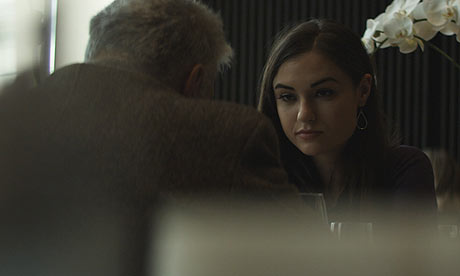
And so Steven Soderbergh bids farewell to cinema, not with "Goodbye" but with "Too much of a good thing is...wonderful." Why Behind the Candelabra makes for such a frustrating exeunt from the medium of film (or TV movies. Whatever) is that I feel like Soderbergh had just started making a full circle back to the kind of film he stopped making when he started shooting and editing his own work in the late 90s. Which, for me (and Keith Uhlich), is a good thing. If I have a complaint about late Soderbergh (specifically the futurist mode he's been in since The Girlfriend Experience) it's that he abandoned little moments. His films have lately been all meat. This didn't used to be the case, but when at first he drew out his narratives to be sprawling and inclusive (Traffic's divergent narrative threads, Che's grand historical scale), he had to justify each moment. Every second had to tell the story, rather than telling its own story. Not exactly a fault, because you never wonder why you're seeing anything. Look at Haywire. Lem Dobbs essentially gave Soderbergh a blueprint for inclusion to get from one beating or chase to the next. But the problem for me is that this doesn't give me much to bite into or care about. I liked the beatdowns, (I really liked them, actually) but at no point does Dobbs' script or Soderbergh's direction encourage me to know or care about who this woman is unless it has to do with her eventually killing the guys who set her up. And there's an awful lot of dialogue (and crucially, not character development) that needs to be spat out to get us there and it's all by people we don't know. It works in something like John Frankenheimer's Ronin because the action sequences take up huge chunks of the running time and make us forget to care who's who. It won't matter anyway because there's a Macguffin to forecast the eventual gap where there ought to be a satisfactory conclusion. Sodebergh, by contrast, just gives us a final beating, which, while certainly in keeping with the spirit of the piece, can only be as satisfying as the talking we've seen up until this point. We don't know her, so we don't really know what she stands to lose. Not enough, for my liking. Even Contagion, which is hands down my favourite of his late work, and in my opinion something of a minor masterpiece, lacks full emotional bite because we don't know everyone quite as well as we ought to. The bad stuff starts going down before they get a chance to show off who they are divorced of context.

A perfect Soderbergh little moment - 2/3 of the way through Out of Sight, Jennifer Lopez's federal marshall goes to question a known associate of a suspect. After finishing up her talk, the woman's boyfriend appears to shake Lopez down. After a suggestive threat, spoken spectacularly low and menacing, Lopez beats the man with a portable baton and leaves, tossing a one-liner over her shoulder as she goes. The man could have been trying to get her off the scent of the suspect she's chasing, or he could just be an abusive jerk. Doesn't really matter. The point is the moment works, has nothing to do with the story, and everything to do with letting us into Lopez's world and the world of the film. It's also one of the few times that the atmosphere of a scene isn't palpable. Whether it's a grimy boxing gym, a Florida prison or Albert Brooks' palatial manor, we always have a really clear sense of where we are and what it's like for the characters. That the house where the altercation takes place is defined more by the characters and a vague feeling of unease is a welcome break from the production scheme and it invites us to pay attention to just the behavior of the two characters.
Now look at Magic Mike, where everyone's in a perpetual state of "over it." It's accurate and thoroughly watchable, but there's very little opportunity for us to learn much about the characters or grow with them. We're a step ahead of them because we know what the narrative calls for. It's still a darker, realer and better film than most US films released in 2012. But it's missing shades of grey, and I don't just mean in the cinematography. The leaping from one 'important' scene to another is narratively efficient, but leaves me just the slightest bit cold. And rendered exclusively in Soderbergh's trademark tobacco brown, it all feels like just one color of the spectrum of experience. As soon as every piece is in place, we can guess how it will turn out, so it's up to our auteur to make sure that the puzzle will look unique when put together. It always does, but they used to be more intricate. Side Effects' greatest pleasure is in seeing just what the central mystery turns out to be and discovering it right along with our duped protagonist. Once it's been solved, the film ends, having done no more or less than a great job taking us from Point A to Point B, placing the low high and the high low, and depicting modern life in the few seconds between plot points. I can't help feeling like ten years ago, I would have gotten a better sense of what Rooney Mara, Catherine Zeta-Jones and Jude Law stood to lose, and sympathized with them more than I did. I do get a sense of where his characters will be, based on how we begin to see their evolution in the final act of the movie. In fact he's gotten very good at broadcasting final acts he doesn't deliver. Magic Mike ends just before a cathartic love scene, Side Effects before prosperity or insanity can fully take over, Haywire just before the final kill, Contagion before normality fully returns. Things move too speedily for the narrative to want to keep up, so the endings come before they've truly ended, allowing a fully formed idea of the future to be the true conclusion, as Soderbergh doesn't want to, or won't bore us with what we already know.
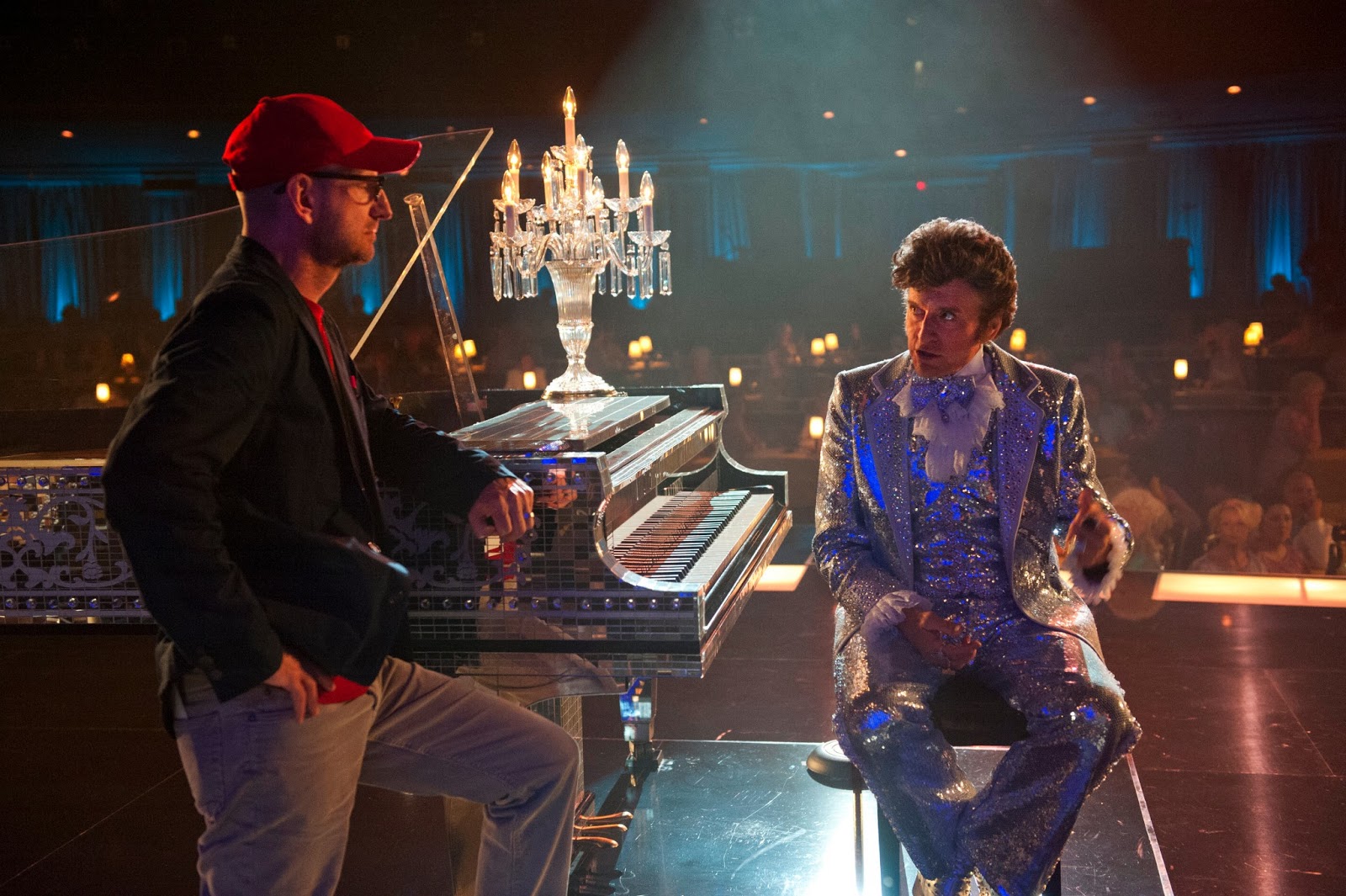
So when I heard that his last movie was going to be based on the true story of someone who is dead, my brain couldn't quite get around to imagining what on earth that would look like. Che, after all, was what all about being objective and marked the turning point toward futurism. Here he had to spell a few things out in a way he hasn't done in a while. Even if we understood what Scott Thorson and Liberace's relationship would turn into, with the details of its ups and downs the only real surprise, we couldn't exactly skip to the important part. It's all important or none of it is, by non-fiction standards. So what in the world was he going to do faced with ten years of detail he couldn't jog through to the ending? Well, it turns out that the saving grace here was that he had to make it for HBO rather than a theatrical release (cannes competition slot notwithstanding, though let's not forget that component just yet). TV is a medium that must be still. And this is a very specific kind of stillness. Often for budgetary reasons, only a few set-ups can be used to make shooting and editing a quicker and cheaper process, but also because a TV audience won't sit still if the camera's going to jerk around like Spielberg's D-Day footage, or totally lose subjects as he sometimes does with shallow focus and lighting. There are very few instances of the camera doing anything like this during Behind The Candelabra, and the most showy example is to communicate a paranoid, drugged-up breakdown, which an audience will appreciate and forgive if not expect. There's one shot of shallow focus where the actors have to walk into frame, and another where he can only see the dark outlines of actors in a well-lit room. Other than that, the camera has to be still, and thanks to the HBO broadcast, it will also take on the sheen of a TV show, which I can't help but feel like he expected, because it helps his cinematography mesh with the production design.
Soderbergh, or Peter Andrews, as he calls himself behind the camera, usually shoots with cutting edge digital in very expressive lighting, meant to look both natural and unnatural, essentially showing the future of life in apartments by catching his actors in baths of primary and secondary colors, or in darkness against bright backgrounds. If it's not how they appear, it's how they are taken, by whoever would really be in the room. He's performing sleight of hand, in a way, by making us lose track of the subject of a shot. This has the effect of making his compositions look like they're rendered in still-wet water colors, and that if you touch them, they'll smear. With Candelabra, the particular stillness of television post-production, making them up-to-snuff for a home viewing audience watching on the small screen, and the film's interest in the era being a kind of prison, means that the paint is no longer wet. Instead, what Soderbergh achieves is a kind of stuffing, embalming and mounting of Liberace's 70s and 80s. Scott Thorson and Liberace themselves go through this with their surgical alterations, becoming trapped in their own glittery, kitschy homes, stuck in outfits tailored too tight and unable to recognize themselves. They're no longer people, they're dead foxes for the world to draw conclusions about. How did they live? Why couldn't Liberace find the right girl? The glamorous lifestyle is a ruse, like the open eyes of a stuffed animal. If the show they get to see is fame, money, drugs and sex, then the price of admission is silence, misery, aging and uncertainty.
All that's fair enough; the performances are all genius, I enthusiastically believe Matt Damon as a 17 year old, I love Michael Douglas turning his back on the alpha male shtick he's famous for, Rob Lowe deserves an Oscar, the events depicted are so insane you have to believe them and it certainly makes for one hell of a ride, but I was beginning to wonder why in the world Soderbergh chose to do it. You can't broadcast with this story. Liberace's long dead, after all, AIDS the only secret he couldn't keep and Thorson's breaking the silence is the reason there's a story to tell. So after six films of cool detachment, could that be all there is to his final long-form offering? I thought so, until the last scene. At this point I could offer those with spoilerphobia the chance to look away and skip to a few lines, but there's really nothing I can spoil - it's all public record at this point. It's just how he decides to present the ending that provides the surprise. Thorson sits alone at Liberace's funeral and rather than hearing a eulogy, he hears an intro to the entertainer's final show, and then watches his lover fly in with wings to play one last encore. Suddenly you see what Thorson saw in Liberace, beyond the showmanship: someone with a gift directing entirely at him. He might have been a father, brother, lover, best friend, whatever, but what mattered was that Liberace made the world appear in front of him on a silver platter and he took all of that and gave it to Scott Thorson. The hands that made the name Liberace famous, moved just for him. And the tragedy, or perhaps the most fortunate part, was that he could never tell anyone what they meant to each other. He had to keep Liberace's legacy safe, like a fly in amber, and in doing so he would be the same thing. He'd never get to hear him play again, nor experience someone shifting an empire to make room for him. All that was private, just for him. And really because he'd spent so much time lying to himself and the world about his life and experiences, Liberace probably didn't enjoy those moments half as much as Thorson, who was, at the very least, much more aware of their situation and able to enjoy it as it happened. So the only person who could truly understand the great pianist's legacy sits, enjoying one last number while the world keeps on thinking what it wants to.

And that's the only time a Soderbergh film threatened to make me cry (King of the Hill came close), which, considering my skeptical attitude going in, is something special indeed. His deciding to take a break from feature films is now not only the sadness it would have been, but doubly so because Soderbergh's pulled another futurist trick by showing us the direction his films might have taken in this last moment. Real closure is back. A little moment of reflection is back. The compositions and spot-on costuming, art direction and production design, suggests a kind of appropriation of classicism, if not a full return to it. From winning the palme d'Or for his first film, which is all about laying emotion bare using technology, to finally, through the most cheesy, obvious artifice, arriving at an emotional climax to his career and debuting his made-for-TV effort at the Cannes film festival, where it stood no chance of taking home the top prize; that's maybe not a happy ending, but I bet Soderbergh sees what a satisfactory, near-perfect cycle it's been. I'd have bet good money that his next feature would have marked a return to the his old method of filmmaking, pre-Out of Sight, mixed with his new understanding of storytelling and image making. The last few years would have been one more specific period in a career filled with them, and Candelabra would have been the turning point. From classical (sex, lies and videotape through to Gray's Anatomy) to post-modernist (Schizopolis to Full Frontal) to post-strucuralist (Solaris to The Good German) to structuralist (Ocean's 13 and Che) and finally this last mode, about to give way to something else. We may never get that next period, but I hope to christ Soderbergh understands how badly his fans want it, and want him to keep evolving. Because whatever my concerns about the relative strength of his work, there are few other major American filmmakers I love to discuss, analyze and think about as much as Steven Soderbergh. So perhaps, this isn't farewell. Maybe, it's just too much of a good thing. Thanks for everything, Steven.