Showing posts with label vertigo. Show all posts

I think it would be fun to run the whole fucking world

There is almost nothing left to say about Martin Scorsese but lord knows we're all trying. Read a sampling of positive reviews of The Wolf of Wall Street and it becomes apparent very quickly that some of our best and brightest are having a heck of a time articulating why they liked it. We had a good year, hell, a great year, for film, but there's a difference in degrees between the purity of our cinematic experience. Let's turn to that other great capitalist Grimm fairy tale Breaking Bad, and equate Cinema to meth for a moment. Scorsese and his editor Thelma Schoonmaker, who always adds a little of the blue-eyed immediacy of her late husband Michael Powell to the proceedings, invented a kind of American cinema that essentially crushed up and snorted The French and Czech New Waves, Hitchcock, technicolor Hollywood musicals, Sub-saharan African & Middle-Eastern movies, Silent film, Italian Neo-Realism, German Expressionism and the political European cinema that flourished in and around 1968. Mean Streets, Taxi Driver, After Hours, The Color of Money and finally Goodfellas turned the 'American dream' and the experiences of immigrants, veterans and criminals into heart-attacks of diced genre tropes and smashed symbolism. The point was getting from the top to the bottom, missing and winding up back at the bottom. The journey consisted of any and every trick Scorsese and Schoonmaker were capable of trying, the speed getting faster and faster and faster until it can't possibly keep it up. Tellingly, he slowed way down after Goodfellas. Casino and Age of Innocence brim with similarly manic, passionate energy, but they're far more subdued. The heat and anger is below the surface where we can't always get at it. The way we think of the great man talking is a mile a minute because for years that was how he and his movies spoke. He'd learn to slow down and narrate his own story in a series of autobiographical essay films and prove to us that he hadn't strictly been making it up as he went. He had to slow down and take a breath. After all, how could cinema go much faster than Goodfellas?
Everyone tried to find out. It's almost impossible to name directors who don't owe him something, who didn't try to be him at some point. American Hustle, a smart, funny movie with, I would argue, a distinct voice is still basically a feature length adaptation of the famous Copacabana tracking shot from Goodfellas. Without his approach to soundtracks, his insane editing rhythms, meant to mimic the experience of addiction and intoxication, his use of cinema history as the real, ever-present backdrop of each of his stories, most major American filmmakers would never have had anywhere to take or foment their ideas. Looking at this year alone, it's less important to determine whether Spike Lee, David O. Russell, Alexander Payne, Andrew Bujalski, Paolo Sorrentino, James Gray, The Coen Brothers, Ari Folman, Noah Baumbach, Rob Zombie, Richard Linklater, Gore Verbinski, Paul Greengrass, JC Chandor, Johnny To, Neill Blomkamp, Jeff Nichols, Derek Cianfrance, James Ponsoldt, Alfonso Cuaron or David Lowery owe a stylistic or technical debt to Scorsese and more prudent to say that if Scorsese had never made his films or done what he has for film preservation, production and distribution, who would have their eyes cast in the direction of their movies? The presence of three film directors in the cast of Wolf speaks volumes about his influence. He set the stage in a lot of ways, even if he didn't do it alone. I'm glad as anything that he has because when you have a landscape shaped by the above directors, it becomes all too clear what Scorsese still brings to the table as an artist. If some of the smartest critics in the world have a hard time saying something distinct about his newest work it's because all year we've been given a steady diet of cinema ranging from 30-80% purity. The Wolf of Wall Street is 96% pure blue meth, Heisenberg levels. If it's tough to articulate why it's so good, it's because we're all still very fucked up. 

There are a few keys to Scorsese and Schoonmaker's success. Leonardo DiCaprio doing the best work of his career, for one. That movie star charisma is put to the ultimate test as he's seen doing everything from tossing dwarves to snorting cocaine off of multiple prostitutes to punching women in the stomach. It's, ironically enough, a complete go-for-broke performance requiring not just that he undergo physical humiliation but abandon all sense of himself, right down to his motor skills in the already infamous Lemmons scene in which he suffers indignities more closely associated with Daffy Duck or Homer Simpson than a heartthrob Oscar nominee. DiCaprio proves himself both one of the most attractive leading men and one of the most gifted physical comedians alive in this film. In order to not walk out of the theatre (and many did when I saw it), you had better be thoroughly intoxicated by his presence and he pulls out all the stops. Wolf is fittingly Scorsese's most frenzied film since The Departed but far more is allowed to transpire during the quieter moments. DiCaprio has an added challenge at his feet in that he has to do all the groundwork that he split with Matt Damon in The Departed (a lot of info and personality dumped in our lap in a very short amount of time), but luckily this means we get more opportunity to know and like him, as well as understand his circumstances when the film grants us a reprieve from the whirlwind rise to power at the heart of the story. Slowing down also means really thinking about what exactly DiCaprio's antihero, Jordan Belfort, is actually doing to himself and others. He gets divorced in the quiet moments, he misjudges people in the quiet moments, he tries and fails to explain himself, to justify his actions when he doesn't even believe what he's saying. When the drugs wear off, when the party stops for longer than a second ("Three years later he killed himself. Anyway..."), Belfort realizes how hollow life is. Consequently when the film slows down, something awesome happens. We start to miss the momentum of the drug-fueled orgies that Belfort orchestrates. We miss the chaos and debauchery. We miss the lies as much as he does, because it's rendered in the most seductive terms. It may be Goodfellas or The Departed multiplied by a few dozen, as far as the speed and the violent, bacchanalian highs (or lows, I guess) are concerned, but there's another reason it works. 

When Scorsese made Hugo in 2011 he used modern, shiny CGI-heavy grammar to pay homage to the birth of cinema and storytelling at 24 frames per second. He went to the future to write a loveletter to the past. Rewind a bit to Shutter Island, where he used the language of horror films from 1958-2008 to remake his favourite black-and-white horror films. He remade Bedlam and The Cabinet of Dr. Caligari using colours he borrowed from The Horror of Dracula and craft familiar to fans of Wolf Creek, Zodiac and The Strangers. The result was heady brew less concerned with selling its nonsensical story than in celebrating 80 years of horror. The Wolf of Wall Street walks down that same staircase in RKO studios where Cat People was filmed, back when it was the Magnificent Ambersons staircase. I like to think that Wolf was a response to Citizen Kane being knocked off the Sight & Sound best films of all time top spot, because Orson Welles' fingerprints have been planted all over the joint. This is, to me, the secret to the film's success. Scorsese occasionally apes some of Welles' off-kilter compositions and maybe he borrows some of his editing tricks but I was too close to the screen and too sucked in to really pay attention. What I do know is there's a beautiful crib from Ambersons when Kyle Chandler's FBI agent enters DiCaprio's house for the first time. Scorsese may still be a student but damn if he doesn't act like a professor when he wants to. As in the Copa sequence, here's the whole film in four shots. DiCaprio stands at the top of the stairs, a dutch tilt bridging the distance between himself and the FBI agents who've come for him. A close-up of an incriminating note, paper the cause of his downfall, a reverse shot of DiCaprio, completely alone, leaning on the bannister. Then the dutch tilt again as the agents ascend the stairs, obliterating the distance between DiCaprio and Chandler, the rich and the working class. His ivory tower is an illusion, penetrated, a staircase climbed in mere seconds.

Belfort himself is a mix of Charles Foster Kane as a young man (the glee, the twinkle in his eye "I think it would be fun to run a newspaper") and Professor Charles Rankin from The Stranger. Scorsese and DiCaprio fuse the two men, tearing the guts out from under Welles' dashboard and hotwiring the narrative engine. Like Kane, Belfort's corrupted by privelege and boundaries he can too easily cross. Like Rankin, he arrives with his ambition and we don't get much of a backstory to explain away his actions. We're not meant to necessarily approve of Kane, but we are supposed to like him until nearly the bitter end. We slowly learn to hate and pity him because everyone else does. Rankin, by contrast, is revealed to be the villain fairly early on and the only reason we want him alive is because he's interesting and poor Loretta Young, the character we identify with, is smitten (and yes, that does make us Loretta Young once Belfort's first wife exits the film). We don't ever see their humanity laid bare because our perspective is limited. What we see is what everyone around them sees. We can see Rankin from Young's perspective and get a good idea as to why she could have fallen for the man that Edward G. Robinson's Mr. Wilson sees as pure evil. Kane, meanwhile, is the ultimate exercise in perspective. We only get him as others see him and think they know him. Welles shoots himself perpetually observed; Kane never gets a POV shot because we're never meant to know him. Scorsese has crossbred the 'best' films of all time. In Vertigo, the film that knocked Kane out of the number 1 spot, the film is all told from the perspective of Jimmy Stewart's P.I. Scotty, until finally he leaves the room and we're left with alone with Madeleine, the object of his desire, obsession and scrutiny as she looks into a mirror and we fianlly see her as she sees herself, as Scotty wants to see her. Scorsese does the same thing, but he does it to his Charles Foster Kane/Henry Rankin stand-in. We look into the mirror with Belfort, but more importantly we look out at the world with him and see what he sees. If we couldn't, we wouldn't follow him. 

Kane is filmed like a monolith. Belfort gets those moments but the key to his success and his taking the audience with him are the reverse shots where he stand behind Belfort seeing what he sees. How do you say no to success when it's hundred eyes are staring at you, hanging on your every word. The film puts us behind the podium and looks out into the crowd that Welles didn't have the money to fill out with extras. We realize why, in those moments, he couldn't say no, he couldn't stop swindling, getting high, and ruining lives. Gods must rarely feel as high as Belfort and his maniac crew did at the height of their powers. They could buy anything and did because it made their reign more real than the last purchase. Scorsese puts the money, the drugs and the sex at our fingertips. I know I didn't want the fun to stop and I'm a fucking communist. 


I believed in all of it. Just as there's nothing Belfort can't buy, there's nothing Scorsese will spare us, no corridor he won't venture down for the sake of find some new thrilling piece of language. The best innovation, and the most organic outgrowth of his body of work: drugs, alcohol and women will combine, time will all but stop like one of Kathryn Bigelow's exploded microseconds in The Hurt Locker, and the blues that Scorsese has gone out of his way to become associated with, specifically the refrain from that shot of aural whiskey Howlin' Wolf's (who else?) "Smokestack Lightnin'" will echo like it's being played from the inside of a tornado. (Digression: Like Belfort, Wolf was as famous for his appetites as he was for his career and had a habit of letting his performances get out of hand. Scorsese does treat these men as hard-living rockstars and this film is a much better movie about what it must have been like recording hits for Chess Records than the movie Cadillac Records). I've been replaying those moments in my head every ten minutes since I left the theatre. A plane full of brokers having sex with a veritable armada of prostitutes aboard a private jet, sudden turbulence and like that the air is thick with cocaine and nude bodies careening into each other in the slowest slow-motion you can imagine. Until this moment in time such a feat could not have been carried out to this effect and it feels like nothing short of a curtain pull on a new age of art. One can argue cinema was meant for greater things but I hasten to remind you that Vertigo is about a man who won't let death get in the way of sexual obsession and Citizen Kane follows roughly the same trajectory as The Wolf of Wall Street, a rags-to-riches tale of a man discovering he has no time to cultivate a soul, leaving billions of dollars, useless possessions and defeated women in his wake. Perhaps there are nobler pursuits than getting us to identify with the worst people on earth for three hours, but nobody cooked purer cinema this year. Scorsese, like we happy addicts who gladly consume his product year after year after year, always tries to say something new and I'll be goddamned if he hasn't done it. 

Life and how to Die

I realized in my lists that one or more of these films needed qualification. I'm thinking specifically of my life-affirming films section. For years the notion of a movie that I was told, from the ads and promotional material and from the recommendations of friends I couldn't believe had actually seen the movies, was going to make me think about life differently. When I walked out of whatever movie it was, my life was going to be affirmed, whatever the fuck vague-ass thing that's supposed to mean. Seriously, there's nothing I hate more, especially today, of a consensus about a film's power to change lives. Lives, plural, cannot be changed all by the same repeated set of tragic/quirky circumstances that lead to the same heartwarming conclusion. The only thing more insulting than the idea that one film is going to have the same impact on everyone who sees it is the list of films who generally get stuck with the label 'life-affirming.' Think back to every movie that promised to change your life for the better. The ones that spring immediately to mind (Simon Birch, My Dog Skip, Pay It Forward) not only failed to change my life, but they also failed to not annoy the shit out of me. The one thing most of these falsely comforting movies have in common is that they all resolutely cheat you out of a real confrontation with death. Each has death in it, but the way in which they handle the subject is so nauseatingly earnest that it verges on pornographic. To address death is not enough and to treat it as the most profound thing in the life of a family (community, fictitious mob of candle-wielding followers, what have you...) is cheap. What of the survivors in the minutes that follow? The hours? Entire days with nothing to think of but what they've lost and what awaits them? That even in death they won't see those they've lost again. Death is a huge deal to everyone, that's why people have religious beliefs, but where movies supposedly about life fail is to treat that concern as anything other than internal and individual, to treat it as a spring board for discussion and box-office receipts. The reason I bring this up is to talk mostly about one of the movies toward the top of my Life movies list. Oh, and if I list a movie below and you haven't seen it, don't read on because I'm going to spoil it for you.

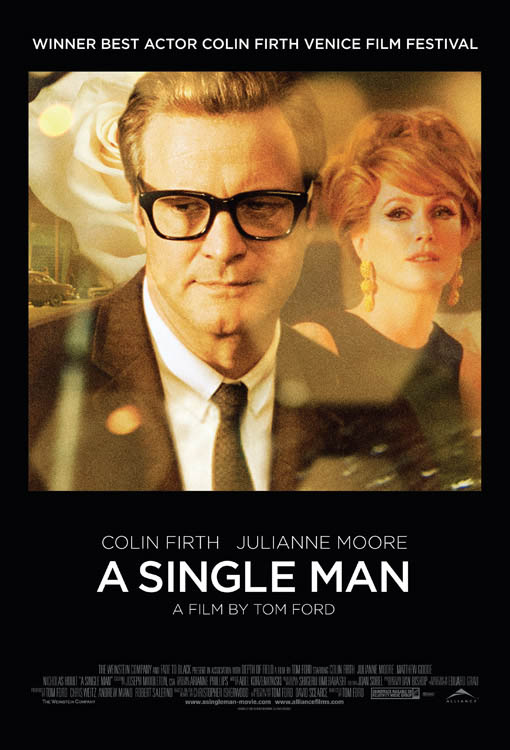
A Single Man
by Tom Ford
I knew as soon as it was done that it had an obvious kin-ship with the others on the list and then I started thinking about why it's so. Why should relative tragedies like A Single Man or The Diving Bell & The Butterfly be the ones that make us (me and a few other people I've spoken to about the films) appreciate life when they are ostensibly about death? Well I think it's because they're ostensibly about death. Diving Bell gives us life through one eye in the last months of its mind's life. Jean-Dominique Bauby knew he was nearing the end of his life but more importantly he knew that if he were ever to enjoy himself again, he would have to adapt to the shit hand he'd been dealt. Suddenly every detail becomes imperative, every second becomes crucial, every memory precious as gold. It took his death sentence to both see everything new as beautiful and everything he'd lived as really quite special and fulfilling. Stephen Soderbergh's Guerrilla or the second half of Che has a similar attitude towards death. In what amounts to no more than a minute of the film's 135 minute running time, Che, disguised for his trip to Bolivia, says goodbye to his children and then a wordless goodbye to his wife. Soderbergh does not make us privy to Che's inner-monologue (making Che almost certainly the first war film with a purposely objective view of its heroes) so we do not know what he thinks when in the end he is shot and killed, but I wouldn't hesitate to think it was the few seconds sitting wordlessly with his head pressed against his wife's. Soderbergh frames his death from his subject's point-of-view, the closest we get to being in his head, so that we can experience the man's passing first-hand. It is a grave and shocking moment that forces us to confront our own mortality and what must have been going through his head as he closed his eyes for the last time. It also takes about as long as the scene on the couch with Mrs. Guevara. But rather than tell us (Soderbergh 'just tells' us nothing), we are forced to think about his journey and our own.

Steve McQueen's Hunger (a film I might just have to start referring to with possessive adjectives, so frequently do I profess my love for it) goes the extra step in Bobby Sands, the movie's subject's death-throes. In much the same way as Soderbergh, McQueen sets up the dying moments of Bobby Sands in a piece of dialogue with almost no more importance than any of those surrounding it but when it appears just before Sands' death, it is clear that it does have importance for Sands. We are allowed in his head to see a vision of paradise before the nothingness takes hold of him. Sands spent his life as a violent, murderous revolutionary, yet McQueen posits (rightly, in my opinion) that what would come back to him, and to us, are little moments of personal significance. The memory Sands relives is one that means something to him - a personal victory and a time of sublime realization - and nothing of his struggle. Sands' life, though hardly as extraordinary, was certainly as colorful as Guevara's and that their deaths are the conclusions to their respective bio-pics is crucial. Suddenly every detail of the Maze prison becomes important because these are the last walls he'll see. And where should a boy like to be if he is to die in prison? Outside, free, a boy, innocent, the sun going down. Though the moment doesn't sound particularly heavenly, it is in its simplicity, it's every detail shining through like the last rays of the descending sun, that it becomes transcendent. Our lives probably don't flash before our eyes (Soderbergh and McQueen are in agreement here) because the cruelty of it is too sudden to be defended against. If we have time to approach it, we'll probably deny it out of fear or stubbornness. Sands is lucky enough to be visited by one final memory, a pleasant one. Guevara probably wasn't so lucky - he and Sands both lived in hellish environs before their deaths. With the memories of loved ones or incredible times in their heads Bauby and Sands pass easier than Guevara, whose head we're never privileged enough to see into. Soderbergh's ending is the most practical and thus the hardest but not the saddest of the three. Bauby has what he'll be leaving behind right in front of him so it's the most tragic when his world goes dark. Sands made a choice to die and though he attempts to escape his self-imposed death sentence in his final moments, his death isn't so tragic as Bauby's because McQueen's film is about fighting what's been given to you. Sands fights incarceration by killing himself and only fights death by putting himself out of the prison walls before it comes for him. Guevara fights death itself by swearing at his executioner. The tragedy is how unfair it is that this man, who we've lived with for the last several hours (if you've watched the whole movie, which you should have), who is so extraordinary, should be killed in so brutal and short a fashion. He was meant for more.

In A Single Man the end of life is the film's conceit, but really that's not what it's about. Based on Christopher Isherwood's novel, the story is simple enough: George Falconer, a middle-aged gay English professor loses his lover of 16 years Jim and decides to kill himself rather than fight the loneliness that's been plaguing him for another day. The film is set in the 1960s, which is important for a few reasons. Firstly it allows director Tom Ford to recreate a chic Los Angeles neighborhood in splendid and lush detail, and second it allows us to consider mortality and legacy from a time itself long dead. The details of George's day are simple and with good reason: He wakes, he eats breakfast, he teaches a class, talks to a flirtatious male student, takes all his money out of his safe-deposit box, chats up a young, Spanish hustler, sees an old-flame, a woman, goes out to buy a bottle of scotch before he kills himself but runs into the male student, they go swimming naked, then go back to George's house, they talk and appear ready to have sex but George passes out before they do so, then just after deciding not to kill himself succumbs to a heart-attack. Like Diving Bell, the movie is told through new observations and a few carefully chosen flash-backs but A Single Man is fueled by a sense of dramatic irony, that we know, because George puts a pistol in his briefcase, that he is planning to kill himself, though he never out and says it. So as we follow him throughout the day we see him really taking in, really relishing every detail of his otherwise very ordinary existence. Ford and cinematographer Eduard Grau hit upon an ingenious strategy to render their protagonist's mindset. In fact considering this is Ford's first film, the way he utilizes his camera is really quite impressive (though I understand he is a rather talented photographer, so I suppose it's not wholly unprecedented, but still...) George (played with wonderfully dry candour and tragic poise by Colin Firth) is usually framed in a dour grey, his surroundings apparently just as sad as he is. When George sees something that pleases him or engages someone and appreciates them (verbally or internally) and it brings him out of his depressed state of mind, the colors come alive too. Suddenly he's not grey and brown, but beautiful amber and flush reds and awash in heavenly hair-light. It's a brilliant technique and coupled with Firth's observations the viewer can't help but be staggered. Tom Ford makes George and us appreciate the little things.
A word about Ford. Ford is apparently a designer of some repute but such is my ignorance of that world I had never heard of him. Most commentators are wont to bring up his background as if to explain away the film's look and feel. I want to say first of all that one's background doesn't preclude you from being able to enter into any kind of discourse or a change of mediums with lessened success. Critics are the first to treat film like something sacred that bad directors or those who don't take it seriously are defacing when they throw their two-cents in. If you can make a movie as powerful as A Single Man it doesn't matter where you came from. Second of all, I do find it pretty interesting that Ford's background in fashion apparently led to some of the film's more striking visuals. Could anyone else have presented George's home (a thing of Sirkian beauty, the house I've wanted to live in since I was a boy) with such crushing simplicity and effectiveness? Well if they could, they haven't, so I'll have no disparaging talk about Mr. Ford's background. Until you people make a film as good as this, I think I'll take my movies from directors and leave prohibitive guidelines or pre-existing prejudices at the door. In fact, A Single Man makes perfect sense coming from Ford, because it cuts to the core of the things that surround us and what matters by the end isn't the stunning house or beautiful clothes we dress ourselves in, it's when we're naked and alone that it's people and our memories of people that matter.

What A Single Man does rather beautifully is to basically approach two different ends while pursuing the same thesis, that we don't appreciate life quite as much as we ought to and that surviving is the hardest thing to do. It's there everyday but when we take the time to tell people how beautifully they really look, we get strange looks because it's not expected, least of all in the conservative early 60s (free love hadn't yet arrived, though the threat of Elvis' hips do get lip service from professor Falconer). The style and design recalls Mad Men (as does an apparent cameo by Jon Hamm as Jim's brother) and the music strikes a terrific balance between the period and timelessness. Abel Korzeniowski and Shigeru Umebayashi's music is a heart-breaking entity unto itself and taken with Grau's camerawork, the lovely performances and Ford's all-seeing directorial eye, the movie is pretty flawless. There are moments in the film that make A Single Man not just a vital film, but also a key piece of motion picture history. Take the scene in which Umebayashi's variation on Bernard Herrmann's "Scotty Tails Madeleine" from Vertigo plays while George and the hustler/James Dean look-alike talk about Spain and broken dreams in front of the gorgeous blue Psycho poster in the grocery store parking lot. It's like a dream come true. One thing that is rather interesting and I don't know if this is Ford's meticulousness as a designer and director, but I found it very hard to find even the dreary scenes between each of Falconer's epiphanies to be anything less than gorgeous. More than once I was put in mind of L'Eclisse, which considering the importance of fascinating architectures and vast interiors to Antonioni's film is no mean feat. But I digress. George is in pain because Jim has died and left him alone - it takes the decision to follow him for George to realize that there is beauty all around him. Knowing he'll soon know nothing of it, he allows the scenery, the beautiful hustler and the cute boy in his English class enchant him. He does whatever seems a good idea because though he has resigned himself to death I think he's looking more for a reason not to. Even though reliving the memories he has of Jim seem designed to make him tighten his grip on life. Ford wants us to see that though George is careening towards a destiny he chose, he is open to life's little charms. He also comes to see the impact he has on the world he admires. When he visits his friend Charlotte (Julianne Moore, who I believe owns the rights to the 1960s because she seems to appear in every film that explores the underbelly of that decade. Don't get me wrong, she's excellent in these roles, and in this film particularly - who knew her posh English accent was so good? - but I do find it funny that no one makes a film about the sadness of the 60s middle class without asking her along) he sees that her happiness depends on him and though she has selfish motivations for doing so, cares for him deeply. Moore is pretty thrilling and nearly steals the movie with her maybe twenty minutes of screeentime. It is here that the film takes its most intriguing detour. As in L'Eclisse and countless other films about and during the early 60s, there is a break to dance. George and Charley dance to Booker T. & The MGs after dinner and like Marcello Mastroianni in La Notti Bianche, George abandons himself for a beautiful few seconds and I think it's here that he decides not to go through with his plan. Ford confirmed my thesis when we see the contents of George's troubled mind just before the end and we're given a flash of this scene. The scene is beautiful, not just in composition and photography, but in its showing George as willing to embarrass himself for his friend until it's no longer anything he has any self-consciousness about. This scene and George's last memory of Jim are the film's most beautiful moments - though the last conversation with Kenny the English student comes close.

Charlotte and George argue about George's inability to love her as more than a friend, but ultimately return to memories and in this become friends again. He leaves her in a haze of memory and promises to see her soon - the one place they can both hide is the past, though they know they need to escape it. Charlotte wants to use George as an escape, a new future, but George wants to believe she'll be fine without him given his plan. She is fragile and has been eternally good and patient with him and probably wouldn't survive his loss - it's a problem that could maybe be solved but not in the few hours he's allotted for himself. Their encounter takes it out of him - he needs scotch but he's out. He runs to the bar where he first met Jim, the most important thing in his life, and here he meets Kenny. Kenny had flirted with him and tried to enchant his professor earlier in the day; even bought him a colorful pencil sharpener, which George produces when they sit down to a glass of scotch each. "Enjoy the little things,” he says, placing it on the table. The film's thesis made concrete. Ford seems to be letting us know that someone as sly and sensual as George here couldn't leave behind a world he seems to know all the secrets of. They swim naked, George cuts himself somehow, and they wander back to George's home nearly naked. Here, in the firelight, is the beauty of two people together. George and Kenny never kiss or make love, but they hint at the possibility. George drinks himself quietly to sleep and wakes up a few minutes later. His flashback of his and Jim's last meaningful conversation is both a little too naked and terrifying in its frankness. Jim and George sit together reading, discussing plans, the neighbors, the upcoming trip, which will claim Jim's life. It's in the banality, the well-meaning back-and-forth, the freedom to read what they want, to love each other (to live in such a gorgeous house) to be, to exist, to do nothing with their days, that is most beautiful. Jim knows it and says so, sending ripples into George's future; it's why he has such trouble surviving, because Jim is gone. He gave so much of himself to the idea that he would be able to spend evenings with Jim, reading quietly and now he has to live past perfection. I think it's plainly those words that made George walk through his last day making sure to let every sensation knock him over with its very being. One fire-lit scene gives way to another and George finally sees what Jim meant for him - not to give up, but to find beauty in everything, to let the world in. Jim was able to find it in their simply existing in the same space, their lives wonderfully entwined. To leave it all behind would be to prove the love of his life wrong, which is the last thing George wants to do.

He burns his "read after my death" letters and prepares for another day but the only problem is how could another day be as precious as this. Jim is still gone but more importantly he lived today like it was his last, believing it was, how could tomorrow measure up? We only get one of these, Ford seems to say. By the time any of us thinks to live like George does, to find beauty in the everyday it is of course too late. Jean-Dominique Bauby, Bobby Sands, Che Guevara and George Falconer - the odd, fictitious man out - all see too late that life has all we're looking for. Jim steps out of his memory and kisses George's softly, as if to say that he had earned this gesture, that he had done all that Jim could have hoped for. His kiss and the last memory both resemble scenes in Solaris another rumination on love, death and loss. George's memory, something unreal and floating in his mind, and his dance with Charlotte both bring to mind the scenes of Kris and Hari floating above their bed in Solaris. They are out of time and out of place - memories come to life, like George's. When Jim steps out and becomes concrete for a moment, it has the same impact as Kris' final goodbye in Tarkovsky's sci-fi epic - they must escape the past to understand what it meant to them. George had learned and lived for his love, fulfilled his wish in death, and lived beautifully, even if only for a day. He finally learned what Jim meant that last night by the fire, reading together, living the same life. He learned to embrace life. His reward: one last memory, one final moment with Jim after the most beautiful day he had ever lived, the one he really been alive for. If he had seen it during Jim's lifetime, his death wouldn't have come so hard for George. Jim needed to die for George to see what Jim saw when he looked around the living room that night.
I'm a young person as I write this and though it’s safe to assume I do have a long life ahead of me, thoughts of dying are inescapable. I've been obsessed with death for much longer than is healthy or recommended for kids, but I don't guess I can help it. I do know that the times I'm in no danger of thinking about it are when I'm with people, specifically people I love. It seems every few months I see a movie that makes me take a long hard look at how I live (Time of the Wolf, Synecdoche, NY, Let The Right One In, The Road) and I encounter movies that always promise to do that and fail to by design. Yet this year especially seemed to produce an uncanny amount of films about how precious life is. No one else has changed - we're still ruining the earth and keeping marriage illegal, aren't we? I guess it would make sense for me to not change, to keep on, to not appreciate what I have until I die like the heroes of so many of my beloved films. But for once I feel like maybe I'm living like I should. I can't say I don't waste time - whole days, even - but I feel as if I get why movies like A Single Man are so absolutely necessary and profound and why they have the effect they do on me. There is no changing that it must happen or that I'm not wild about the idea, but I can see now (thanks in large part to films - call me what you will but it has to come from somewhere, doesn't it?) that shying away from it isn't the answer. It's time to start letting the little things become big things only when they promise happiness. I know that I have to let life and all its wonders wash over me. I'm lucky enough to be able to thank my friends for being that to me and letting me find meaning in their kindness and being able to take nice feelings away from their successes. I know I only have so much time and that I have to admire them and everything else I encounter before one of us disappears. This is why I watch films and why I want to make films - it might be meaningless, but there is so much to be loved and enjoyed that I would be stupid not to try to both see and capture it all. It's also why I take so much comfort in being able to spend time with some people, because I can just enjoy the best parts of the world by being with them. I may not be climbing the Himalayas or taking pictures of myself in front of the Eiffel Tower, but the beauty of people is the same everywhere. I don't have to go anywhere to know that - I don't even have to watch a film, though that won't stop me.