I thought I'd try to write up each of the film in my best of the 80s list. I've already done John Carpenter's masterpiece, The Thing, so I'm moving onto Russell Mulcahy's Razorback. This is adapted and updated from an earlier piece I wrote about the film, which coincided with the release of Bait, a film Mulcahy wrote and produced.
.avi_snapshot_00.47.24_%5B2012.04.08_15.08.20%5D.png)
The story of Razorback, is far less important than the way it's told. With the help of a grizzled hunter named Jake Cullen, an american named Carl Winters scours a piece of Australian desert to avenge the death of his pregnant wife Beth after she's killed by a giant warthog. It's clear from the first seconds of Razorback that this is a superior film - something wilder, more angular and stylish than nearly anyone in the genre game was attempting at the time of its release. Interrupting the first few credits is the image and sound of a windmill working at impossible intensity. The image is a familiar one - no one would be shocked to learn of Mulcahy's pedigree shooting music videos. Indeed he sort of coined the form when he shot the piece for "Video Killed The Radio Star" by the Buggles. The windmill's sound is huge; deliberately overpowering. Then we see the outback, we know that's where we are because of the kangaroo in the foreground - we're less sure about the red skies that corrupt the rest of the frame. Not even The Road Warrior himself rode under skies this gorgeously oppressive. Then we pan behind the figure of Bill Kerr's soon-to-be-disgruntled hunter, Jake Cullen. The orange sky and the motion of the camera strongly suggest Apocalypse Now - the synth score does too. Moments later Kerr puts his grandson to bed and starts hearing the sounds. Grunting, squealing, but the music tells us there's menace in these otherwise innocuous sounds. He steps outside and the thing that drew his attention, the boar, breaks through his paremeter fence then tusks the man's leg, destroys his house and carries off his baby grandson into the night. The boar is obviously an effect, footage of a proper animal shot in perspective mixed with an unmoving prop shuttled through the set on wheels. This is deliberate. When they gave Steven Spielberg a shark that didn't work, he hid it. When they gave the same thing to Mulcahy, the young punk made its fakeness an asset, sending it hurtling through his set at top speeds. It's not real, clearly, but that doesn't stop it from destroying a house and eating a baby. The lighting and sound design sell it even as we're more than aware that it shouldn't work. Kerr's reaction helps in no small part. When he discovers his lost charge, he wanders into the yard and falls to his knees screaming in agony to the heavens when the titles eat the rest of the frame. Whatever else is true of the film, I can bet that you've never seen anything quite like this. This is the monster movie to end all monster movies and unsurprisingly the genre didn't recover from its rampage for many years.
The editing is relentless, somewhere between Eisenstein, Dawn of the Dead's apartment seige and Richard Lester. The compositions and camera movements reference seemingly every monster/horror film that had come before it, not to mention most major australian productions; Mulcahy's entre into the world of big budget filmmaking was by all means a hopeless assignment, so he takes down the likes of The Race For the Yankee Zephyr, Mad Max, Gallipoli Wake In Fright, Patrick, The Last Wave, The Survivor, Walkabout, Stone and Long Weekend while he was at it. It's an upstart move, saying in essence "You loved all this shit, so, I'm sorry, but you're just going to have to endure this movie." He also anticipated The Coca-Cola Kid, but I'd believe that was a coincidence if anyone told me otherwise. If the powers that be wanted him to play in the mud like Brian Trenchard-Smith and Rod Hardy, then he was going to outdo everyone in the game. All the visual cues you recognize from those movies? That's Mulcahy saying "Yes, everything you've ever been told about this bloody country is 100% true. Animals roam freely in our houses, homeless natives hang out nearby, we drink constantly, murder those we don't care for, hunt kangaroos, tell off-color jokes, drive Road Warrior trucks and those who can't afford them ride camels." As if that weren't enough, he was also going to take the various styles shown off in Next of Kin, Patrick and Picnic at Hanging Rock and outdo them all! No shot would be wasted, no lighting set-up half-assed, no sound cue unaltered. He was going to out-stylize Richard Franklin, Peter Weir, Colin Eggleston and George Miller in one go.
And at the risk of deifying a man who has yet to live up to the promise of his debut, I say he more than achieves this feat. He may never have put all his energy to good use again but then how could anyone hope to recreate the success of a film like this? It shouldn't work (and as evinced by Highlander, it wouldn't under any other circumstances), as he appears to try literally every flourish and trick that he was ever taught, but it absolutely does. Frankly any gimmicky approach you tried but a straight-forward one could only elevate the material (is there a sillier premise for a horror film, even in Australia where no premise was too outlandish, than a giant pig eating people?) so when Mulcahy decides that every single object would have a big-ass stadium light illuminating it, that every single scene would contain something completely unreal and/or nightmarish, that every single character would be a stereotype that he was deconstructing as rapidly as he was building, he was making a judgment call - love or hate the film but you would never forget it once you saw it. Just look at his version of New York that we glimpse for seven seconds; it's the same city that Jonathan Demme would capture in Something Wild two years later: Outsized and silly. Who in their right mind would choose to show a black man with a ghetto blaster on a street corner rife with old-fashioned taxis instead of just the goddamn Empire state building? It's the most recognizable landmark in the world and it certainly would have been in keeping with his purposely-tourist's eye view of the outback - kangaroos, aborigines, drinking. But he was after caricature. And though much of the film is stereotypical in microcosm, he frames and presents them so that you aren't ever sure what you've just seen. "Was that a guy with a ghetto blaster? Was that a car hanging from a baobab tree?" His goal is to both toe the line of Australia as a hellhole as propagated by most accounts of the place in pop culture (not to mention shoe-horning wombats, pigs, camels and other animals into as many shots as possible) and then make it seem far, far worse. This film was his ticket out of the outback and he's never gone back (except, hilariously enough, to remake the nearly perfect, but geographically/culturally inaccurate On The Beach for TV with Armand Assante taking over for Gregory Peck). He's also never made a film as good.
Mulcahy is exclusively the reason the movie works as well as it does. Obviously the edit helps him greatly, but without his compositions, his bug-eyed imagery and the way he handles the creature, the film would simply not work. Despite being, like Ted Kotcheff before him, an expat, scriptwriter Everett De Roche was the Outback's answer to Dardano Sacchetti and had written a handful of the country's most beloved grindhouse films; there was almost nothing he didn't try at some point. Watching Mark Hartley's fantastic documentary Not Quite Hollywood! you could get the impression that unless Peter Weir was in town, De Roche was in some way responsible for any given Aussie horror film. That's not true, but I will say it's a damn good thing he got directors as game and skilled as Richard Franklin and Mulcahy because his insane ideas would have destroyed less capable and fearless hands. I'm not even sure that George Miller, no slouch, but with no distinct visual style from film to film, would have survived a De Roche genre exercise. In the B-picture game Franklin was Mulcahy's only serious stylistic competition until he made Psycho II and discovered his wacky sense of humour which put him in closer proximity to Philippe Mora and Trenchard-Smith. Watch Link sometime to see why he never quite made it to the big leagues. But between the breathtaking highs of Patrick and Road Games you can see a fantastic talent stealing bits of Hitchcock to craft taught, unnerving thrillers from laughable De Roche premises. Arch Nicholson, Mulcahy's second unit director, comes a close second with Fortress and Dark Age proving almost as grim and stunning as Razorback. Nicholson died shortly after completing Dark Age so we'll never know if he would prove capable of sustaining his vision. In that time and in the studio system everyone seemed to be clamouring to be part of, chances are slim. Mulcahy sure couldn't. But for one film he was king of the fucking world. Even if no one knew it.
Understandably what producers seized on was Mulcahy's ability to capture mood and so a stream of truly horrible action films like the first two Highlander movies, The Shadow, Silent Trigger, Blue Ice, Ricochet, The Real McCoy, The Scorpion King: Rise of a Warrior and Resident Evil: Extinction, a film which utilized none of his strengths, were in his future whenever he wasn't collecting money directing music videos and TV. Rarely has a director with such a thorough understanding of cinematic convention, not to mention technique, squandered his gifts quite so splendidly. Not until Greg Mclean would Australia see a talent as cunning and ferocious arrive sui generis to reinvent the possible in the midst of an over-saturated generic landscape whose well had run completely dry. Mclean's Wolf Creek had just as much as style and beauty as Razorback, despite being twice as bleak. His follow-up, Rogue, is the Eaten Alive to Wolf Creek's Texas Chainsaw Massacre, but it still gives me far more hope for Mclean's future than if he'd made Highlander. Rogue and Wolf Creek are just as knowing as Razorback and between them capture the earlier film's sensibility, but even Mclean doesn't have the Godardian sense of deconstruction and anarchy that Mulcahy favored. Razorback is a film completely alone in its use of popular style and convention; a horror film about horror films.
The images and individual sequences are first-rate, unmatchable. The film's centrepiece is also its high-point: Carl's trek through the desert. The attack on petpak during the finale has been compared in the past to Alien, and I'd add Texas Chainsaw Massacre, Blood and Black Lace and Blade Runner to that and it certainly is both thrilling and mesmerizing. But the desert trek is Mulcahy painting with his camera. Every new tableau Carl wanders into is distinct from the last, some looking like the hyberborian wastes of Conan the Barbarian (by way of John Milius or Frank Frazetta), others like Salvador Dali. In one he wanders under a blaring red sun and just to his right is a crack in the earth that looks like the edge of a film strip. The peculiar fuzziness these shots acquire in VHS format makes them seem even stranger, like they were spliced in by accident. Their progression only makes them even more post-modern and strange: Winters passes a dead horse arranged like a scarecrow then walks for most of a day, then suddenly he's back at the horse. As he crafts shoes out of scraps of his clothing, the horse breaks out of the ground to attack him. When he runs away, it's back where we first saw it, except now its nodding and laughing at him like a jack-in-the-box. The film's best scare and one of its most indelible images is clear evidence that Razorback is about the genre as much as anything. After waking from his walkabout in Sarah Cameron's guest bed, he sees her sitting on the edge of the bed. He gingerly lifts one hand to tap her shoulder and when she turns around, her face is replaced with that of an angry looking pig, squealing maniacally. We've all seen this scare before. How many times did Freddie Kruger or some other bogeyman or demon hide behind something ordinary. This is Razorback's version of the bathroom mirror scare or of Jason Voorhees/Carrie White's dream sequence coups de grâce. Again, it shouldn't work: is anyone frightened on paper of a warthog? Well first of all it's some kind of grotesque halloween mask, exaggerated and covered in hair. Second of all, it's so sudden that it could have been anything and worked. Then you have a moment where you realize you were frightened by a pig. This is his game. He will get you afraid or repulsed by his monster if its the last thing he does. Killing Beth Winters the way he does is pretty genius. Suddenly there's the whole fucking thing staring at her just outside her car window. Then it yanks the door off and begins eating her feet. Like the rest of the film, it'd be preposterous if it weren't so horrifying.

Now the plot mechanics, I suppose, can only be attributed to De Roche and the source novel he drew from (which...doesn't this sound like great literature?). But I'm going to give credit to Mulcahy for playing up the dynamics he does so well. Thanks to Jake Cullen's stoic single-minded pursuit of the beast, and Carl Winters' pregnant wife backstory, Razorback is both a pastiche/homage to Jaws, the film that started the mother nature's revenge film cycle once more and made it personal rather than epidemic, The White Buffalo, the most peculiar of Dino De Laurentiis' Moby Dick/Jaws riffs, and Orca, the Dino's Jaws rip-off that gave its antagonist not just a backstory but human emotions as well. Now the pig in Razorback's only real breaks from reality are its existence, its laying low between attacks and its only ever killing plot-specific characters; No Alex Kintner is sacrificed to this monster. He's not greedy. He just wants to set forth the chain of events that will lead to his demise. Fatalistic in a way that not even de Laurentiis' tragic orca whale managed. He doesn't have emotions and Mulcahy frames him like a phantom, almost like Michael Myers. The moments where we glimpse him in profile on the horizon are fucking priceless. His existence is never less than galling, but it's never played for laughs. If any other actor but Bill Kerr dropped to his knees and screamed to the heavens (three separate times, no fucking less), as action heroes always seem to, it wouldn't work, but Mulcahy knows that it will. Every convention is in play and delivered with a straight face - you accept it in literally every other situation, so why not a giant warthog? After all far more care went into this monster than anything in Frogs or Day of the Animals. This is fourth wall breaking of the highest order; so good that its seamless. And the pace makes it impossible to stop and ask questions. Everyone on screen buys it and so, too, do you by the end.
As we near the end of the year and the unveiling of our Best Of lists, we return to one of my favourite exercises around here, listing the films that almost made it, but for one or a few glaring issues. I like these because they get at what we, the amateur critic, look for in our films. They say as much about us as the films we love and offer insight into our expectations and biases so that our choices for what were great make more sense to you, the reader. I realize that posting this before the release of The Hobbit and Django Unchained is a mistake because I can almost guarantee they'd end up here, but we have to shift our focus onto the year as a whole and start constructing our lists. So, here are the almosts.
Noah Aust
 Cloud Atlas could have worked... maybe... but it's like the directors tried to compensate for their totally screwball narrative structure by making every mini-narrative really trite and concise. I didn't feel like they believed any of it. Cloud Atlas was built on a great idea, and part of me feels like that should be enough. These guys made a $100 million experimental film—that takes balls. My problem is that they stopped there. It’s like they didn’t want to go too creative so they backpedaled: they tried to compensate for their totally screwball narrative structure by making every mini-narrative really pat and concise. I didn’t feel like they believed any of it.
Cloud Atlas also fell victim to this emerging trend of information overload. Cinematic language has evolved so much that it’s possible to cram an insane amount of info into a couple hours of screen time. (Sherlock Holmes: A Game of Shadows is probably the best example I’ve seen of this. That should be required film school viewing—it easily uses every cinematic device ever created to cram a phonebook’s worth of action, character development, plot, dialogue, and historical theorizing into the confines of a popcorn movie.) But just because filmmakers can cram a lot more stuff into their movies doesn’t mean they should. Cloud Atlas offers tantalizing glimpses at six stories, but everything’s rushing by so fast that we don’t get a chance to live in any of them. The characters are Brechtian cutouts that only stick around long enough to promote a thematic idea, and then woosh—off to the next one. It’s like watching six trailers for really cool movies.
Every so often you get these “mainstream art-house” type pictures that have one progressive gimmick. They’re just experimental enough to make mainstream audiences feel sophisticated. “Oooh—District 9 is a metaphor for apartheid,” ignoring the fact that it’s basically just an alien shoot-em-up. Here’s an idea: try watching Cloud Atlas as a horror movie, where a global disease is gradually turning everyone into Tom Hanks.
Fox Johnson

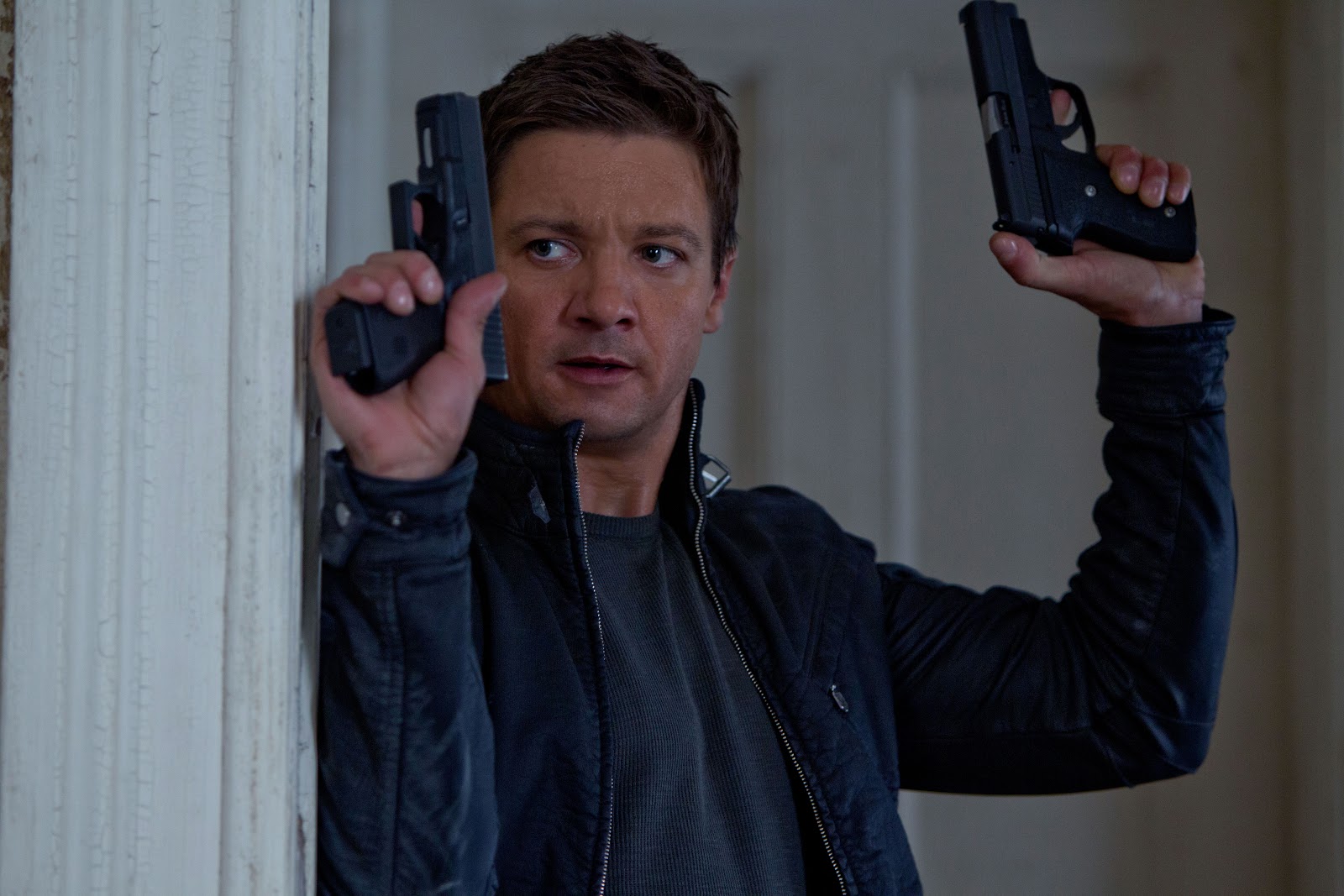
Alright lets see. Trying to remember the discussion on Bourne Legacy I had months ago with Scout, I'm pulling the larger points. I'm an enormous fan of the Bourne films so I rushed out for this one. I love the new actors they grabbed up to populate it's world and got ready for a new ride. Tony Gilroy gets the film about half right. Quite literally actually. About half the film is interesting. The other half, is too much information. The sequence where we follow Jeremy Renner over the mountain, having to deal with the elements, wolves, and even a new spy character whose scenes with Aaron Cross (Renner) are super stressful in all the right ways. The problem though is that they're cross cut with footage of government agents in their tiny, dark computer rooms watching his every move. At first it's a surprise and honestly an intriguing one. But the more they switch back and forth between the two timelines, each one loses it's power. If we were stuck sitting with the government boys, miles away, watching a situation that's almost entirely out of their hands (save the missile they fire at Cross later in the scene) that'd make for some really great stuff. Really wondering what this new Bourne-esque character is going to do next. And on the other hand, if we were stuck with Aaron through his journey and his white knuckle encounter with the wolf, the spy, and a missile that would suddenly appear rather than having us as the audience know exactly when it's coming, it'd be even more of a treat. In fact, it'd be much more like the first Bourne film where around every turn is a new surprise simply because the scope of the film limits itself to one person's viewpoint at a time. Basically this issue repeats itself throughout the film taking a lot of energy right out of it. And thats quite a strain when you're watching a film thats about 20 minutes longer than any of the other Bourne films and has less action than any one of them.
Also a quick aside about Hara Kiri: Death of a Samurai. I really did enjoy myself watching that film but I think with a few tweaks it could be legendary the way that 13 Assassins quickly became to me and everyone else who matters. It slipped under the radar for most of us I think. Mainly because its nothing like 13. Miike went for a much quieter and emotional film after creating one of the best action films I've ever seen. I'd be willing to put up with literally the entire thing if the ending were a little less anticlimactic. I won't spoil anything but there's a pretty solid sword fight at the end (duh, samurai film) but in my humble opinion not nearly enough people die. The story sets up a lot of people in your mind as perfectly evil bastards who quite deserve to lose their heads but you really don't get enough of it. Wanting violence at the end of the picture really defies what the message of the film is all about but goddammit I just wanted these people to die so badly!
Tim Earle

Skyfall may be one of the most beautiful films I’ve ever seen in my life. It also features an absolutely stellar performance from Daniel Craig, not to mention yet another instant classic in the expanding repertoire of Javier Bardem. It’s smart, witty, well-paced and thrilling. Unfortunately, the plot is really bad. REALLY bad. It’s tough to notice, your first time around, how bad the plot is because everything that’s happening is really awesome looking and Daniel Craig is staring at things and deadly lizards. But it’s terrible. The bad guy's master plan is to get captured so he can kill M even though he has already proven he can just blow people up with computers (which is a thing people can do, naturally). Bond Girl #1 is a terrific agent who decides to sit behind a desk, completely sabotaging her character for the sake of clinging to the franchise and being cute. Bond Girl #2 is entirely useless. And in the end, Bond’s master plan is to fight Bardem in a Scottish mansion with a shotgun and the car from another movie, and Albert Finney is there, because why not.
What I loved so much about Casino Royale is how it subtly referenced every Bond cliché while subverting them at the same time. I love the stripped down torture scene (get it), the “Does it look like a give a damn?!” approach to his martinis, and the devastated look in his eyes when he realizes the dead girl in the hammock is only dead because she slept with him. But Skyfall made explicit every implicit observation in Casino Royale. For example, Q and M, and Draco Malfoy’s mom all ranting about how the times are changing and technology has made old fashion spy craft obsolete over and over again. We get it. If we were paying attention, we would have gotten it while watching Casino Royale. And while Skyfall certainly has its delightful fan service, constantly nudging and winking while it shows you sports cars and Moneypenny, it makes no effort to subvert those tropes, or even play with them. Instead it just shows you the car so you’ll cheer and clap and maybe not notice how bad the plot is.
Hayao Miyazaki has at this point all but invented a genre. His odd blend of steam punk and fantasy, with elements of Japanese folk lore and a love of all things quaint was originally a slight yet excellent twist of traditional anime, eventually becoming a strikingly new force of artistic vision once it landed in American theaters. But as his films kept landing, each splash bigger than the last, his style became its own sort of brand. His later films (Howl’s Moving Castle in particular) found themselves recycling old ideas, visuals, even key plot points, for the sake of sticking within the wheel house. But, Miyazaki isn’t just original; he’s quite simply an exquisite director. His visuals - no matter how over-used - are completely riveting to watch. His characters are always superbly nuanced and his themes are timeless and touching, no matter how often he expresses them. The problem with The Secret World of Arriety is simple. It isn’t directed by Miyazaki. Yes, it’s a Ghibli production, and yes it’s penned in part by him. And, of course, it’s riddled with so many charming structures, and nature loving ideologies, but without Miyazaki’s graceful touch all these elements wind up a little awkward (sometimes bordering on creepy), and the emotional beats don’t hit home like they should. On top of all that, the ideas don’t seem fresh for the obvious reason that they’re not. I can’t say I’ll ever get tired of Miyazaki trying to tell the same story over and over again, but I can tell you exactly how quickly I’ll get tired of anyone else trying to tell that story. Five minutes. That’s how long.
The Bourne Legacy took me by surprise. After so many trailers and promos and BOURNE FIGHT FIGHT RENNER FACE images all over everything, I was pleasantly surprised that it wasn’t anything like I was dreading it would become: a rehashing of old ideas, once again, with a new face. Instead it was a true Tony Gilroy film. Gilroy has always had a hand in the Bourne films and his influence has always been clear, but not until this film was it clearly in the hands of one incredibly cynical artistic vision. I’m a huge Michael Clayton fan and I started having glorious flashbacks by the ten minute mark of this film. Gilroy’s love of making murder into a sort of bureaucratic nightmare, everyone coldly tallying numbers and sorting out the details as they execute their fellow man, it always makes me a little giddy. And then, when the actual Renner plot kicked in, it was such a tender new take on the classic super spy plot line. I was really moved. Gone was the confusion and the amnesia, and for the most part, the conspiracy. It was just about a man desperately trying to cling to the drugs that made him special, that made him intelligent. It was a story of a man trying to cling to his own mind. I was loving it.
But then, about three quarters of the way through the film, came the requisite small vehicle car chase, and building parkor fight scenes and it all became so stereotypically Bourne. Normally this isn’t so bad, except it felt like Gilroy wasn't that into it. It was by the books. No flair, no fuss. All the skill Gilroy possesses in the nuance of spy intrigue, he totally lacks in his ability to conduct a frantic action sequence. We expect certain amounts of action from a Bourne film, but in this film the action seemed far less to serve the plot and far more to serve the franchise.
Dan Khan
 You know you're in trouble when the short film at the beginning of every Pixar film is ten times better than the film that follows it. Brave is simply a mixed bag. The storyline is pretty thin, the movie shifts tones and the pacing is a bit slow not to mention a drag at times. The fact that there is no romantic element or a major villain is only somewhat of the problem. After the useless and awful Cars 2, Pixar is really losing its momentum. Of course Brave is watchable and at times quite fun, but I expect more of a studio that has given some cinematic treasures. Perhaps hype is maybe a problem, since Pixar seems to outdo itself nearly every year. Brave, I am not sure who will appeal to as it's too slow, too long and a bit dark for children, but it's a bit too well written and superficial for adults. It's just a misfire Despite some great voicework by using pretty much everyone in Hollywood who is Scottish or can do a good Scottish accent and some fun action scenes, this is a chore. In short, see the Pixar short, La Luna and skip Brave, unless you're brave enough to see it! Ha! [ed. the film punk staff are paid by the pun]
I agree with the above regarding Bourne Legacy. I think Gilroy is part of the problem really. Say what you will about Greengrass, but he at least brought some excitement to the proceedings. Not to mention he knew how to pace a movie.
Scout Tafoya
 Haywire just didn't have enough in it to justify its aimless rambling between breath-taking fight setpieces. Not with The Raid: Redemption practicing a much more muscular filler a few weeks later between its truly dazzling action sequences. Haywire has, I believe, six of these sequences, many last only seconds, and I just could not be bothered with Lem Dobbs' purposely exhuming the espionage thriller until all that remained were rags and bones. Mainstream comedies didn't have a great year and despite laughing quite a bit at The Campaign, Wanderlust and The Dictator (viva Jason Mantzoukas!), I can't say they were all that compellingly made. My vote for funniest film of the year would have to be Expendables 2, though not in the way Sly intended. Red Dawn and Stolen are nearly as good, and though I missed Atlas Shrugged Part 2, I feel like that one would have been a howler... Horror anthologies V/H/S and The Theatre Bizarre both had a few great segments sandwiched between some decent if forgettable ones. Props to David Gregory for his downright Kubrickian closer in the latter film, as well as Jeremy Kasten's pleasantly warped wraparounds, and in V/H/S David Bruckner's segment gets the most points for effectiveness and Radio Silence comes in second for actually sticking to the film's ostensible gimmick and doing so with charm to spare. And then there are always films that can't quite make my best of the year list and I feel duty bound to protect them. To Rome With Love was perfectly harmless and a lovely diversion which nevertheless some people seemed to really hate. Bait was a welcome return to Brecthian horror from producer Russell Mulcahy that I feel like no one saw/appreciated. Mary Harron's The Moth Diaries attempted to tell a YA story with a style and perspective befitting its intended audience and somehow got worse reviews than all of the Twilight films combined. It was a bold move that I respect greatly as my sister, whose own YA book is due sometime in the next two years, has given me a new appreciation for the whole genre, and to get the tone right while respecting the source and intended audience is tough. But I think for fans of the sort of novel she was adapting, it was perfectly on point. As was Jo Sung-Hee's A Werewolf Boy, which has to be Korea's answer to Twilight. If filmed on 35mm and with a little less reliance on cliche (and without that horrible soundtrack - even the best directors can't seem to shake the industry standard score) this could have been as effecting as anything I saw this year. Sentimentality alone, however, just isn't quite enough. So close to being great. I found myself wishing Bong Joon-Ho had directed, or Park Chan-Wook, but then I remembered they'd probably have added body humour and killed more people and it would have lost that mass market appeal that allowed it to play in an AMC an hour from my house, which has to be the wierdest premiere circumstances I've seen all year. In the theatre for a 10:00 showing were myself and two korean women. We all seemed to enjoy it.
Less great, so long as we're talking about Twilight also-rans, is Jack & Diane. Juno Temple and Riley Keough (who couldn't look more like her grandfather, Elvis Presley; perhaps you've heard of him as I believe he was a foodie of some note) star as two young women who fall in love in New York one summer, or as much in love as two girls who have zero interest in maturing past their stunted adolescence. And every once in a while one of them turns into a wolf. Or does she? It ultimately doesn't fucking matter. I have to assume that director Bradley Rust Gray's third film was meant as a Twilight corrective/alternative for the arthouse set, and though he does get some details of their courtship achingly right, the rest he botches with such panache, it approaches Twilight territory. For a start the music is distractingly terrible, a grey mix of boring techno music that was old when it was new. More damning is that the werewolf/sexual awakening metaphor doesn't go anywhere or do anything and seems nakedly like an excuse to hire the Quay Brothers to interrupt the narrative every few minutes. Their stop motion, while interesting and a hell of a lot nicer to look at than the scrappy puppet thing that occasionally shows up to gnaw on Keough's leg, serves zero function and it's never even entirely clear what we're looking at. It also changes from Temple to Keough whenever Rust Gray feels like scaring his audience - something a lesbian romance really oughtn't be so concerned about in this climate, what with the whole "most of America is full of hatred towards gay people because they're different" thing. It feels less groundbreaking and more reductive, which I get is unintentional, but seriously.
Also pretty unnerving is the fact that neither Rust Gray, Keough or Temple ever makes a visible effort to age the girls into adulthood, so their sex scenes lose their intimate charm and begin to feel exploitative and deeply uncomfortable. The moments that make the movie worth watching, the believably awkward and romantic meetings between Keough and Temple are surrounded by tonal shifts that go further than undermining the emotion - it makes it as pointless as any of the film's many, many aimless tangents and clumsy aborted motifs. In a film more focused, perhaps Jack coaxing Diane to admit she has to use the bathroom would register as cute and not bewildering. And I sincerely wish that Gray would learn to bring his camera closer than his medium shots because it keeps us at arm's length from two people we're never encouraged to understand. And so we sit, bemused, wondering when this is all going to make sense and though it's frequently too touching and real for words, it never gets around to doing that.

.avi_snapshot_00.47.24_%5B2012.04.08_15.08.20%5D.png)