Showing posts with label Writing. Show all posts

The Existentialist Noir Style Of The Third Man

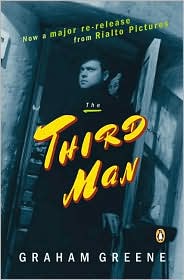
Graham Greene’s novella treatment for The Third Man has since its publishing fallen victim to the greatest eclipsing in history. Though Greene’s name is inextricably linked to the title The Third Man many of the details of his brilliant novel have been lost over the years. There are still many people who, in summarizing the book, use the changed names from the film’s final screenplay. Greene himself seems to have come to terms with the superiority of the film’s influence over his own comparatively small work, stating in the book’s prologue that it was only “written to be seen”. This sort of dramatic sigh in remembrance for a book, the world’s willingness to let it be forgotten like the protagonists of No Exit happens to be the perfect context to sum up the book’s great existential flavor, which time, a movie, a political theme overshadowed by that of pulp mystery, and Greene’s better known work have all overshadowed. The book seems almost destined to be the poster child for existentialist fiction, as the actions of each character fall squarely in line with Sartre’s treatment of existentialism, L'existentialisme est un humanism.

We open on Rollo Martins, a British dime western author, just off the plane from London. Rollo is in Vienna for the first time because he’s been offered a job from lifelong friend Harry Lime, whom Martins worships. Martins is shocked and dismayed to discover that Lime was killed only days ago and that the police, as represented by Sergeant Calloway our narrator, have him pegged as a racketeer. Martins, disappointed that his once and current hero could be so easily dismissed as a criminal makes like one of his western characters and starts looking for retribution for the libel of Calloway and for his friend’s supposed death. Thus we are introduced to the characters that help Martins and the reader get to the bottom of things.

The existential nature of the book comes out right away. “I’m going to make you look the biggest bloody fool in Vienna. There’s one dead man you aren’t going to pin your unsolved crimes on (Greene 32),” says Martins to Calloway, both men arrogant enough to believe he has the answers to both the racketeering and the murder without all the facts. In fact it is the initial impression of each character which determines their fate. As Sartre says “Man is nothing else but what he purposes, he exists only in so far as he realizes himself, he is therefore nothing else but the sum of his actions.” Everyone of Martins assumptions will be shot down piecemeal, and Calloway’s right with them. And for our deliciously noirish catalyst, the doorman who opens the investigation by explaining to Martins that Harry was killed on impact during the car accident is himself murdered by Harry when Martins sleuthing goes too far. This is but our first taste of the mammoth string of reversals about to take place.

Because Martins relies heavily on both his own nose for sniffing out facts and his love of the Harry Lime he thought he know, both will be proven dead wrong. After speaking to one of Lime’s associates, Cooler, he determines he’s on the level because of his impression of the man; this is wrong. When he meets Lime’s girlfriend Anna, he falls in love with her and finds himself bold enough to suggest he might take Harry’s place; this backfires. He comes to Vienna to begin a new life with Harry, and leaves only after having killed him and soiled his memory. This karmic irony is not limited solely to Martins, of course, nearly everyone gets a turn. Anna spends the length of the novel pining for Harry’s return from the afterlife to comfort her as he once did, “He used to look in, and when I heard your ring, just for a moment, I thought… (Greene 80)” When Martins finds that Harry is still alive, he couldn’t have less concern for her well-being, and in fact he all but gives her away to his schoolhood friend. Calloway, so happy to know that Harry is dead, doesn’t consider that it could have been a set up and has to tango with his nemesis once again. Harry, for all his cleverness in faking his own death, concludes the round of existentialist fate dispensing by attending his second funeral in casket.
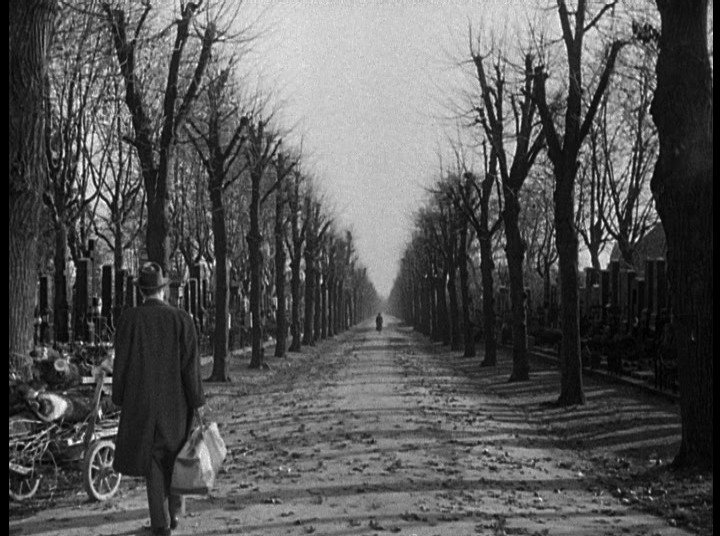
Sartre’s positing that “the coward makes himself cowardly, the hero makes himself heroic; and that there is always a possibility for the coward to give up cowardice and for the hero to stop being a hero (Sartre),” shows itself in the reversal of expectations on the parts of Harry, Anna, Calloway, and Martins. Martins has his expectations tarnished by all of the characters that surround him on his stay in Vienna. Calloway, the heel whom he takes a swing at and calls stupid, is his only friend when the curtain falls. Anna, with whom his only connection initially is a mutual love of Harry, turns the tables on his impression of her as a damsel in distress when she rebukes his advances and abandons him at Harry’s funeral (Greene 156). Harry, whom he freely admits to loving becomes an abstract murderer (in his remarkable speech about little dots, starkly reminiscent of Sartre’s allegorical military leader) and then a very concrete one when he shoots at Martins in the sewer during the book’s climax, misses and kills a police officer instead. Martins himself experiences a meta-theatrical version of this drop in expectations when he hilariously impersonates an author who shares his penname at a conference full of high-minded intellectuals. Though the host laughs at Martins implication that Zane Grey the pulp novelist is one of the greatest living authors and though they are shocked to learn he’s never heard of James Joyce, the audience hangs on his every word until they discover he is not who they thought he was (Greene 94). Everyone whom we are told will be ‘heroic’ will become ‘cowardly’ before too long, Martins himself included. As Sartre points out, “there is no God…which can adapt the world and all its possibilities to my will. (Sartre)” Everyone has to discover the cruel realities of the world by seeing their version of it crumble in their hands like the proverbial cookie.

The Third Man is full of twists and turns, action, political intrigue, romantic inclinations, militaristic confusion, and gallows humour and so it’s easy to let the book’s existential nature take a back seat to everything else. Greene’s tragic heroes fall neatly in line with many of Sartre’s claims about existentialism and go a long way toward proving the latter man’s claim that “the destiny of man is placed within himself (Sartre)”. Calloway gets the shot at proving his theories about Harry he didn’t have when his enemy’s death left it ambiguous. Anna really does find herself in the same dreadful state she imagined she was in, only after she comes to terms with what Harry really meant to her. Harry, the laid back murderer who believes himself the cool orchestrator of all things dies hopelessly by the one man he thought to include in his scheme; he abandons his friends for his murderous, money-loving impulses, and so is left with very alone in the end. Martins, who has set out to vindicate his friend and prove his own worth, (as he begins as the epitome of worthless (only five pounds sterling in his pocket [Greene 17])) must destroy what he loves. He must kill Harry, whose ambiguous actions Sartre explains simply “vanish like water into sand”, which Harry literally does in the book’s climax when he falls into the rushing sewerage. And so, too does Martins vanish, out of Calloway’s sight after Harry’s second funeral, and out of the book.

Sartre, Jean-Paul, L'existentialisme est un Humanism. Translation by Philip
Mairet, 1946. First appeared in Existentialism and Humanism, Meuthen & Co., Ltd., London. < http://jya.com/sartre-eih.htm>
Greene, Graham. The Third Man. 4th ed. New York, NY: Penguin, 1999.

Bráhman

There are a number of illusory, iridescent elephants dancing about in my brain.

There was an older woman screaming at me, because she wanted me to vacate a room that she had reserved the day before. Were she not screaming about my incompetence as a human, I may have done just that.

Eventually, I returned to my room. A tall boy was there, he was of a dark complexion and exhibited highly feminine mannerisms. Venting, I explained to him that the woman was completely out of her right to ridicule me as she did.

The boy did not entirely understand. He acted apart from himself, like an ideal not often reached by man.

"It is your fault for dwelling on her actions. It is your burden to bear, choose you to bear it."

The Election

No one's brought up politics for a good long while on these here pages, and so I thought a decent approach to this election season would be to draw everyone's attention to two things; one is a humourous anecdote about one of my favorite songwriters, and the other is something our good friend Nick Smerkanich pointed out to me.

First and foremost I'd like to start with a brief plea. To concert goers everywhere: stop being such a bunch of mean, noisy fuckheads. You people seem to come to concerts simply to muscle your way to the front and then spit beer at people. You don't care about anyone but yourselves, you're rude, you smell horrible, and everyone who likes music hates you. Get a fucking clue and never go outside again unless you can handle it. Humanity is innate, and so being around people isn't a right, it's a privilege. If you can't understand that you're hulking frames and unfathomable ignorance make people uncomfortable, including but not limited to the band, you don't deserve to be out among people.

I've seen Spencer Krug in concert twice in as many months. First with his collaborative project Wolf Parade, then with his own songwriting vessel Sunset Rubdown. Both times the seriously inconsiderate behavior of concert goers have made him too uncomfortable for words. At the Wolf Parade show, a group of Philadelphia-area yahoos rushed the front row and started slam dancing and pummeling each other and strangers. At first guitarist/vocalist Dan Broeckner and Krug, the keyboard player and one half of the vocals took a calm approach. "I don't mean to get all Ian McKay on you guys, but you should love each other", came Broeckner's mellow warning. Krug too uttered non-threatening advice a few times until the encore came about. When the reprehensible behavior of the boys in the frontrow would not let up, Krug looked at them from the corner of his eye and spat with as much seething contempt as could fit in his words "I don't know why you have to fucking hit each other." Being Canadians, I have to guess they aren't used to American views on concert going. I sympathize with Krug and his bandmates and I apologize on behalf of the rest of us; those who feel embarrassed to share concerts with these people.

The next time I saw Krug, he was clearly worn down by America. Tired, irritable, and a little red in the face, his Sunset Rubdown delivered a stellar performance. The energy and passion was there and I can't help but feel it was Krug's claustrophobic reaction to America that made him perform so well. This time the drunks were not in as full force as before, but that didn't stop a scene from breaking out. About 3/4 of the way into their set, a large man and his large girlfriend, beer in hand, waltz to the front row and begin making everyone uncomfortable with their obnoxious dancing and drunken logic. During songs they would shout and swear and dance and make out, "sometimes you just gotta dance." Krug made to apologize for his set starting later than anticipated when his animosity was provoked; Hyde stepped out.

"I'm sorry we took so long, guys."
"I'm sorry no one's dancing. I'm going to fix that!"
"That's not your responsibility."

Now, I go to concerts for moments like the wordless verse after the first chorus of
'Shine a Light' that I witnessed at the Electric Factory. That moment was for me the reason to see live music, when the band is so in tune with each other, and the groove so solid and undeniable that one has little choice but to bask in the power of music. This was a perfect 15 or so seconds in an evening filled with truly awesome performance. I go to experience moments of true artistic transcendence and to share these precious moments with like-minded individuals and close friends. Why, then, do drunken barbarians go to concerts? I cringe everytime I think about the fact that nothing will change the fact that I'm an American and so are all these fuckheads. Sorry for all the profanity, but understand that i don't take this lightly.

The real reason I bring up this Sunset Rubdown song is to illustrate that clearly everyone has an interest in how our election turns out.
Not quite verbatim Krug quotes from Sunset Rubdown's show at the Middle East in Cambridge:

"The name of that song is 'Don't elect Sarah Palin'"
"The real title of that song is 'Please don't elect Sarah Palin'"
"The long title of that, as it appeared originally was 'I don't neccesarily agree with all of Barack Obama's policies, but I'd vote for him just so that Sarah Palin doesn't get elected'"

Even Canadians hate American Republicans. I hope the first time John Johnson leaves the country, he has to explain to a group of Afghan refuges why America blew the shit out of their country and killed their relatives. I'm not taking this lightly. Party affiliation is one thing, but guess what doesn't mean shit if you don't have personal politics that extend beyond intangible concepts like 'the economy' and 'patriotism'.

Part 2 of this litany of liberal screaming:

It's no small secret that I'm an enormous fan of the critically acclaimed television series The West Wing. It's combination of perfect aesthetics and brilliant political dialogue were unrivaled during it's run, and Aaron Sorkin's writing was so forward-thinking and furious during a time when nightmares guided news cycles and wars were being fought on our behalf (oh, wait, nothing's changed). So here is a piece of Sorkin's writing, his two cents on the upcoming election. It is a trifle silly, but if you've been paying attention, we seem to all be living in a particularly frightening room of Willy Wonka's chocolate factory, so I find it comforting that Sorkin has taken the low road, as it were.

Here Sorkin reaches a hand into his bag of tricks and removes one final liberal cry of hope

If you're out there, are over 18 and think for a second that your vote doesn't matter, or worse that voting for Barack Obama is the same as voting for Mccain, you're wrong. This time, you're dead wrong. Please don't let Fascists win. Not again. I'm so tired of living in a Philip K. Dick novel.