Showing posts with label violence. Show all posts

The Existentialist Noir Style Of The Third Man

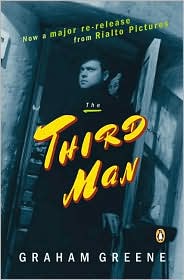
Graham Greene’s novella treatment for The Third Man has since its publishing fallen victim to the greatest eclipsing in history. Though Greene’s name is inextricably linked to the title The Third Man many of the details of his brilliant novel have been lost over the years. There are still many people who, in summarizing the book, use the changed names from the film’s final screenplay. Greene himself seems to have come to terms with the superiority of the film’s influence over his own comparatively small work, stating in the book’s prologue that it was only “written to be seen”. This sort of dramatic sigh in remembrance for a book, the world’s willingness to let it be forgotten like the protagonists of No Exit happens to be the perfect context to sum up the book’s great existential flavor, which time, a movie, a political theme overshadowed by that of pulp mystery, and Greene’s better known work have all overshadowed. The book seems almost destined to be the poster child for existentialist fiction, as the actions of each character fall squarely in line with Sartre’s treatment of existentialism, L'existentialisme est un humanism.

We open on Rollo Martins, a British dime western author, just off the plane from London. Rollo is in Vienna for the first time because he’s been offered a job from lifelong friend Harry Lime, whom Martins worships. Martins is shocked and dismayed to discover that Lime was killed only days ago and that the police, as represented by Sergeant Calloway our narrator, have him pegged as a racketeer. Martins, disappointed that his once and current hero could be so easily dismissed as a criminal makes like one of his western characters and starts looking for retribution for the libel of Calloway and for his friend’s supposed death. Thus we are introduced to the characters that help Martins and the reader get to the bottom of things.

The existential nature of the book comes out right away. “I’m going to make you look the biggest bloody fool in Vienna. There’s one dead man you aren’t going to pin your unsolved crimes on (Greene 32),” says Martins to Calloway, both men arrogant enough to believe he has the answers to both the racketeering and the murder without all the facts. In fact it is the initial impression of each character which determines their fate. As Sartre says “Man is nothing else but what he purposes, he exists only in so far as he realizes himself, he is therefore nothing else but the sum of his actions.” Everyone of Martins assumptions will be shot down piecemeal, and Calloway’s right with them. And for our deliciously noirish catalyst, the doorman who opens the investigation by explaining to Martins that Harry was killed on impact during the car accident is himself murdered by Harry when Martins sleuthing goes too far. This is but our first taste of the mammoth string of reversals about to take place.

Because Martins relies heavily on both his own nose for sniffing out facts and his love of the Harry Lime he thought he know, both will be proven dead wrong. After speaking to one of Lime’s associates, Cooler, he determines he’s on the level because of his impression of the man; this is wrong. When he meets Lime’s girlfriend Anna, he falls in love with her and finds himself bold enough to suggest he might take Harry’s place; this backfires. He comes to Vienna to begin a new life with Harry, and leaves only after having killed him and soiled his memory. This karmic irony is not limited solely to Martins, of course, nearly everyone gets a turn. Anna spends the length of the novel pining for Harry’s return from the afterlife to comfort her as he once did, “He used to look in, and when I heard your ring, just for a moment, I thought… (Greene 80)” When Martins finds that Harry is still alive, he couldn’t have less concern for her well-being, and in fact he all but gives her away to his schoolhood friend. Calloway, so happy to know that Harry is dead, doesn’t consider that it could have been a set up and has to tango with his nemesis once again. Harry, for all his cleverness in faking his own death, concludes the round of existentialist fate dispensing by attending his second funeral in casket.
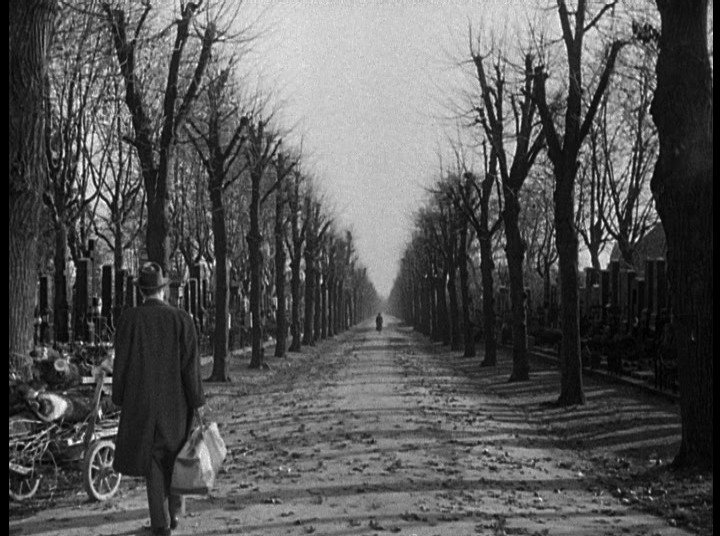
Sartre’s positing that “the coward makes himself cowardly, the hero makes himself heroic; and that there is always a possibility for the coward to give up cowardice and for the hero to stop being a hero (Sartre),” shows itself in the reversal of expectations on the parts of Harry, Anna, Calloway, and Martins. Martins has his expectations tarnished by all of the characters that surround him on his stay in Vienna. Calloway, the heel whom he takes a swing at and calls stupid, is his only friend when the curtain falls. Anna, with whom his only connection initially is a mutual love of Harry, turns the tables on his impression of her as a damsel in distress when she rebukes his advances and abandons him at Harry’s funeral (Greene 156). Harry, whom he freely admits to loving becomes an abstract murderer (in his remarkable speech about little dots, starkly reminiscent of Sartre’s allegorical military leader) and then a very concrete one when he shoots at Martins in the sewer during the book’s climax, misses and kills a police officer instead. Martins himself experiences a meta-theatrical version of this drop in expectations when he hilariously impersonates an author who shares his penname at a conference full of high-minded intellectuals. Though the host laughs at Martins implication that Zane Grey the pulp novelist is one of the greatest living authors and though they are shocked to learn he’s never heard of James Joyce, the audience hangs on his every word until they discover he is not who they thought he was (Greene 94). Everyone whom we are told will be ‘heroic’ will become ‘cowardly’ before too long, Martins himself included. As Sartre points out, “there is no God…which can adapt the world and all its possibilities to my will. (Sartre)” Everyone has to discover the cruel realities of the world by seeing their version of it crumble in their hands like the proverbial cookie.

The Third Man is full of twists and turns, action, political intrigue, romantic inclinations, militaristic confusion, and gallows humour and so it’s easy to let the book’s existential nature take a back seat to everything else. Greene’s tragic heroes fall neatly in line with many of Sartre’s claims about existentialism and go a long way toward proving the latter man’s claim that “the destiny of man is placed within himself (Sartre)”. Calloway gets the shot at proving his theories about Harry he didn’t have when his enemy’s death left it ambiguous. Anna really does find herself in the same dreadful state she imagined she was in, only after she comes to terms with what Harry really meant to her. Harry, the laid back murderer who believes himself the cool orchestrator of all things dies hopelessly by the one man he thought to include in his scheme; he abandons his friends for his murderous, money-loving impulses, and so is left with very alone in the end. Martins, who has set out to vindicate his friend and prove his own worth, (as he begins as the epitome of worthless (only five pounds sterling in his pocket [Greene 17])) must destroy what he loves. He must kill Harry, whose ambiguous actions Sartre explains simply “vanish like water into sand”, which Harry literally does in the book’s climax when he falls into the rushing sewerage. And so, too does Martins vanish, out of Calloway’s sight after Harry’s second funeral, and out of the book.

Sartre, Jean-Paul, L'existentialisme est un Humanism. Translation by Philip
Mairet, 1946. First appeared in Existentialism and Humanism, Meuthen & Co., Ltd., London. < http://jya.com/sartre-eih.htm>
Greene, Graham. The Third Man. 4th ed. New York, NY: Penguin, 1999.

My Favourite Film Number 7

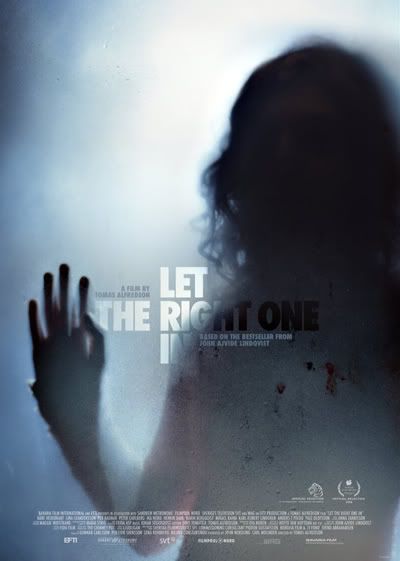
Occasionally you’ll know right off the bat that what you’re looking at is a work of art; sometimes it takes a while, sometimes it’s during a backward glance appraisal. Let The Right One In, a Swedish vampire film I read a tiny review of in some magazine or other, was quite clearly an overwhelming artistic achievement from the word go. With all the mishigas being raised over Twilight and the disappointing sting of 30 Days of Night still fresh in my mind, I’d like to choose my words carefully so that readers will understand that this movie is special in ways few horror films ever manage to be; I’d also like to sit the makers of both films down and make them watch this one and then smack their noses with a newspaper. I will say though that rather than read my analysis and take my word for it, you should stop now, drive the two hours to the nearest arthouse that’s showing it and see for yourself that there are still brilliant movies being made, and for the most part, if this and Joachim Von Trier's Reprise are any indication, they're being made in Scandinavia. Would you believe me if I told you it was about a cute 12 year old girl who was also a vampire?

Let The Right One In
by Tomas Alfredson
Open on a hopelessly beautiful, hopelessly middle class tenement building in a village outside Stockholm, Sweden. As 12-year-old child of divorce Oskar stands in his underwear practices his tough guy speech to a window, an old man and his young daughter unpack their belongings from a taxi cab and move into the apartment next door. Oskar is the victim of bullying and it’s not hard to see what makes him easy prey: he is pale, gangly even for a 12 year old, has long blonde hair his mother has clearly not looked at in sometime, he walks as if one leg were longer than the other, and his social weirdness manifests itself whenever he’s called on to talk in class. Clean cut bully Conny and his two not-so-brave cohorts Martin and Andreas make Oskar’s life as miserable as possible whenever they can fit it in. It isn’t until Oskar meets his new neighbor that things start to turn around for our young hero.

We know things aren’t right when, in what might be the most beautifully composed evisceration ever filmed, the elder of Oskar’s two neighbors drugs a passerby, strings him up on a lamppost and cuts his throat. This might be an ordinary killing save for one thing; he catches the blood in a plastic jug. The old man’s plan, whatever it may be, is ruined when a runaway dog brings its owners to the scene forcing him to flee. This doesn’t make his ‘daughter’ too happy, who after a stern talking to issues what sounds like a hypothetical warning “Do I have to do this myself?” Shortly after this botched incident, Oskar is outside after dark threatening a tree at knife point when he catches the young girl spying on him. It will take a lot of coaxing before he learns her name (Eli), but she wants to make one thing clear; she may be the same age as Oskar, but that doesn’t mean they’re going to be friends. This changes after they meet a few times and Eli develops a soft spot for Oskar; perhaps because she has a very adult secret that youthful playtime helps her forget. One night one of the neighborhood drunks stumbles home and Eli lures him under a bridge and savagely murders him with her teeth. Two significant developments then unfold; firstly is that after Eli does her victim in fully, she cries, clearly unhappy about her fate; secondly an old eccentric with a house full of cats happens to witness the murder. Eli’s father hides the body, but clearly things are about to change for the family.

Oskar starts seeing more and more of Eli; she teaches him to stand up for himself and soon he has a crush on her that takes up most of his attention whenever they’re apart. Eli is initially reluctant until the night her dad slips up and gets himself caught while trying to milk a neighborhood boy of his life essence; the old man chooses an incredibly painful method of concealing his identity and covering his tracks so that Eli is left unmolested by authorities. When she visits him in the hospital that night, he says farewell to her and gives her what he was unable to provide while they lived together. Eli visits Oskar that night and agrees to ‘go steady’ as he puts it. Because Eli has to do her own hunting and as she isn’t be as careful as her dad was, she leaves behind a calling card one night when she doesn’t finish off one of her victims; the poor woman’s drunkard boyfriend is understandably a little shocked when she becomes sensitive to daylight, is nearly eaten alive by cats and won’t shut up about a little girl infecting her with something. Time to do some investigating, eh? This guy isn’t any Van Helsing, but he has a pretty good idea who’s behind the whole mess. As if that weren’t enough problems for our heroes, Oskar manages to make yet another enemy. When Oskar takes Eli’s advice about not letting kids bully him anymore and lashes out at Conny with a stick at recess, the little terror’s older brother gets involved; I guess exceedingly stupid and violent behavior runs in the family.

If this movie has one clear precedent, it wouldn’t be Bram Stoker’s Dracula, either excellent Nosferatu movie, any of Bela Lugosi or Christopher Lee’s takes on the subject, nor that oft-referenced teenage vampire trainwreck The Lost Boys. It wouldn’t even be some of the more recent child-horror films: your 6th Senses, The Rings, or any of Guillermo Del Toro’s three elegiac fairy tales, The Devil’s Backbone, Cronos, or Pan’s Labyrinth. No, if I could point to one film most likely to have been an influence on this film, I’d guess it would be Lasse Hallström’s My Life As A Dog. Another famous Swedish export (in fact perhaps the most famous non-Bergman Swedish film yet made; notice I didn’t say infamous; that honor would go to Alf Sjoberg’s I Am Curious) My Life As A Dog has many thematic similarities including a weak-willed boy infatuated with a much stronger female, pubescent growing pains, a lovely romantic story between two youths of starkly different types, a town full of characters on the fringe of the lead's lives who play important roles in the story proper, parents incapable of understanding their children, and adults in general being powerless to put themselves in the mindset of that thing they’re now least like and most afraid of in the world – a child. The film's theme of childhood being as mysterious as supernatural behavior reminds one of Robert Wise's great Curse of the Cat People, only with roles reversed and modernized. The same shimmering innocence pervades both films and Alfredson has Wise's respect for the extraordinary power of the imagination.

Let me digress for a moment and say that if I had an inner child, she would look and act something like Lina Leandersson does here; this 12 year old first-time actress is my hero. Her Eli, on top of scoring points for being an unrelentingly cute murderer, is one of the greatest characters in film history. Oskar and Eli spend most of their time together asking questions typical of 12 year olds, and its clear that they both suffer from arrested development, albeit for two different reasons. Oskar has his absent parents to thank for his naivete (Oskar has ten times more fun with his dad, but dad still hasn’t come clean about his homosexuality and is clearly ashamed of it, which puts a strain on their relationship), Eli has the fact that her life stopped being that of 12 year old years ago. Between Eli’s lack of friends her own age or any other relationships beyond her male caregiver, she is just as clueless about socialization as Oskar. This is most whimsically demonstrated when Oskar buys Eli a bag of candy in a misguided attempt to be kind. Eli, not wanting to seem rude, eats one and promptly vomits behind the vender’s stand; Oskar panics and hugs Eli, something, I gather from her ridged posture, that no one has done in quite some time. Both Oskar's frightened expectations and Eli's confused detachment ring as true as anything I've ever seen on film. Moments like this are what separates Let The Right One In from all of its contemporaries. Alfredson proves himself capable of providing every facet of John Ajvide Lindqvist‘s source novel and screenplay with equal amounts of care and grace. Incidentally, Lindqvist should receive accolade for both staying remarkably true to vampire lore, while still delivering a unique scenario in which to play with it (for every Martin there's a Dracula 2000 waiting to make it irrelevant). I knew that this movie was not simply good but transcendent just after Eli says goodbye to her father. She comes back to Oskar’s room, her mouth still coated in her guardian’s dried blood, disrobes and climbs into bed with him (Maria Strid's costumes really make Eli's malaise and confusion all the more palpable). She has never known loss before and thus her turning to Oskar for comfort in her time of greatest need is beyond touching. They never face each other and Oskar is clearly out of his depth, but the two are completely in the moment and this scene’s tenderness is nearly unparalleled; rarely have child actors seemed so unapologetically, wonderfully childish. When Eli slowly takes Oskar’s hand, I nearly wept at the power of this movie and of cinema as an art.

Oh, and those of you who’re reading this going “it’s a love story, pfft! I’ll just see Saw V, thank you very much. We don’t need another Twilight!” shame on you. Please don’t misunderstand me, the movie works just as well as a horror film; Alfredson is just as at home melting a heart as he ripping one out. And oh, the horror! Let The Right One In is like the There Will Be Blood of horror films. It is quiet, unpredictable, wildly visual, gut-wrenchingly tense, and absolutely mesmerizing. So little actually happens, and what does is so masterfully understated that you can’t help but wait with bated breath from scene to scene. Hoyte Van Hoytema’s cinematography makes for one of the moodiest portrayals of cold weather in recent memory. As enthralled as I was by the awesomely beautiful story of pre-adolescent love and the search for understanding, I was absolutely spellbound by the scenes where the horror elements come into play. Watching Conny observe Oskar and plan his downfall internally is ten times as frightening because this is a film completely unafraid to put its heroes in danger. His classmates put Oskar in very real peril and it almost rivals the gruesome murders committed by his sunlight-fearing dream girl. Another point Let has in common with There Will Be Blood is it’s truly awesome and orgasmically violent climax. This and 28 Days Later now share the prize for greatest conclusion in any film. No other filmmaker has yet been brave enough to make its romantic peak coincide with the murder of children under 12 without losing any of his or the movie's integrity.

It’s funny to note how effortlessly a country enters a discourse and makes the homogenized major players seem like the big, monomaniacal teenagers they truly are. Go to netflix and look at their foreign horror; they have two categories: Italian and Japanese. You’ll find a French film and the odd Spanish production, but the point is that America’s scope is so narrow that it’s a wonder Let The Right One In got…well, let in (to use [rec] as an example, that film’s remake is currently making the rounds of multiplexes across the country, but it’s superior source film has yet to find an American distributor). Seeing as how Let The Right One In has exactly one historical precedent (Ingmar Bergman’s haunting and hallucinogenic Hour Of The Wolf), it could have been anything less than perfect and I would have been satisfied. In fact I probably would have sung its praises anyway seeing as how America’s idea of a good independent horror film is Teeth and it’s idea of a revisionist vampire movie ranges from the bad (Underworld, Interview With A Vampire, Lost Boys) to the absolutely unwatchable (Van Helsing, Bordello of Blood, From Dusk Till Dawn). However, not since Near Dark has there been so brilliant a vampire film; not ever has there been a better film about childhood. Let The Right One In is nothing short of perfect and will remain one of my favorite films for a long time.

My Favourite Film Number 6

This is part of my effort to write about my 100 favorite films in two pages or less. The new Format looks stellar, no? Shelly did a remarkable job.

The Wild Bunch
by Sam Peckinpah

“I believe in the innocence of Children,” said Sam Peckinpah, one of the most exciting men who ever lived. He was a womanizer, tyrant, alcoholic, bastard, and a film director. His films featured grit, violence and sex to a degree few commercial filmmakers have ever dared. His movies feature true vulgarity and bacchanalia, whether in the form of one of the most narrow-minded depictions of rape ever filmed, or of two men bathing in a vat of wine with three whores, or of Warren Oates pouring tequila on his penis to kill the crabs his prostitute girlfriend has just given him. He was a difficult man, but one with vision and guts. While others moved in progressive directions, leaving ordinary themes behind for more complex ones, some opted to ignore the change in the times and keep making the same manner of film they always had. Peckinpah decided to breathe life into a genre that nearly everyone had forgotten about. The biggest difference between his and most other westerns is simply in the way he fills the background. Shot on location with real Mexican people, magnificent costume and production design, his films brim with vitality even when nothing happens. His films have a naturalistic quality in their backgrounds that even the greatest of westerns lack. Lucien Ballard’s cinematography helped, of course, in bringing a new Mise-en-scene to a dying breed of film. Things move freely and wildly in Peckinpah films and Ballard’s camera caught it all magnificently (though it is impressive to watch the Director’s cut that has been shown in theatres in recent years, it hasn’t been digitally remastered and so the genius of Ballard’s cinematography goes somewhat unnoticed). His attitude toward children played a crucial role in this, his crowning moment as an artist, and it differs greatly from that of his many heroes and predecessors – Rene Clement, Vittorio De Sica, Carol Reed, Frank Capra, Robert Wise – in that he sees their innocence as something that allows them the greatest potential. They do not see their behavior as wrong and so they do what they feel is right, what gives them greatest pleasure. They act violently toward nature, respect what they please and act out of this sense of respect. Now who they respect is another matter entirely, as they get to choose who they feel responsibility towards; themselves or those with the power to reward them. The only film that really captures every facet of Sam Peckinpah’s beliefs, the one that changed his life, gave his career it’s direction and altered the lives of many, many people is The Wild Bunch.

Sam Peckinpah was an outsider to the world of film; his views on plot structure and his steadfast refusal to compromise had nearly succeeded in taking his one creative output away from him. When Hollywood recognized once again the magnitude of Peckinpah’s creative genius, the first shot they gave him was all he needed and it fit him like a glove. Westerns until the mid 1960s had always basically followed certain archetypes (Anthony Mann’s films obviously prove the exception, ditto Johnny Guitar). The element of westerns which had yet to be rewritten was that the lead characters always apostrophize about their ideals and what it is they’d be willing to die for; Peckinpah’s triumphant return to the big screen unflinchingly shows what it looks like when men decide to walk the walk. They do so in one of the screen’s most electrifying gun battles ever filmed. The scene, famous for it’s behind-the-scenes stores of limited extras and uniforms, makes perfect use of Sam’s feverish editing and his love of the squib (fake blood spurting from bullet-sized pockets hidden in clothing). The opening and closing orgy of gun violence will always be as exciting to me as the first time I saw it. On the big screen, it’s the stuff of dreams; so perfect is the montage of both gunfights that you’re unknowingly on the edge of your seat when they’re through.

The story concerns a gang of aging criminals around the time of the Mexican Revolution in 1913, led by Pike Bishop (William Holden in what has to be the finest performance of his career). The bunch, Dutch (Ernest Borgnine, his finest hour), Brother’s Lyle (Warren Oates, who steals many of his scenes with his demented anger) & Tector Gorch (Ben Johnson, who despite being covered in filth can’t help but look elegant), feisty new recruit Angel (Jaime Sanchez, who must be one of the first Mexicans to portray a heroic figure in an American produced film), and horse watcher Freddie Sykes (Edmond O’Brien, who should have won an Oscar for his Walter Huston act) drifts around Mexico contemplating their next move; they’re wanted by the law and by a posse of inept bounty hunters hired by the railroad headed by Pike’s former partner Deke Thornton (Robert Ryan in one of his best roles). It was Pike’s arrogance that landed Deke in Prison and now the railroad has bribed him with freedom into tracking his old friend down. Thornton and Pike understand that things can’t change between the two of them, and that they’ll never stop their game of cat and mouse. This dynamic is not uncommon in many westerns, but excluding Sam Fuller’s I Shot Jesse James, the feeling of romantic tension between these two men is unique to the genre. Indeed it is the shock in William Holden’s face when he thinks Thornton has been killed in the demolition of a bridge and the hangdog look on Robert Ryan’s face after the final showdown has claimed his erstwhile accomplice’s life that cements the other half of the story’s dynamism. If these men didn’t care, neither would we. Lawmen chase bad guys because they have to; Thornton and Bishop have reason enough to get quit of the whole business, but it would almost certainly mean abandoning the other, which neither can face.

The two men share the same haunted flashbacks, but it’s the memory of the past that keeps them going. In fact it’s the memory of the past that keeps everyone in the film’s universe going. The story takes Pike and his men from a botched railroad heist into Mexico where they agree to steal guns for a General combating Pancho Villa. During a brief stop in Angel’s village before meeting the General, Pike and Sykes talk to an old man who helps the revolutionaries fight local oppressors who wish to steal their land. Watching Tector & Lyle dancing and acting foolishly, Pike says how funny it is that grown men can act like children when they want to. The old man tells him that even the worst men pine for their childhood. The end of the road is not too far for Pike and he knows it, so even if it isn’t childhood he wants, he’d take his earlier years, when he could get on his horse without stumbling that he wishes to relive. He could act as ruthlessly as the children who torment scorpions with fire ants that they pass on their way to rob the railroad. Sykes, Deke, Pike, and Dutch all see that their tenure as gunmen is coming to a rapid close, the only question is “how’s it going to end?” In a traditional western, the ending would look something like the departure from Angel’s village (a scene Peckinpah improvised): everyone gathered in the main drag to see these men off.
In Peckinpah’s world of absolution, they must give their lives for the one thing they have left to believe them. Interestingly, it wasn’t until seeing this movie on the big screen that I thought about what gunfighters must think of death. When each member of the gang is laid down, they seem to come to rest more than being torn asunder. Is death so unyielding a possibility that when it finally arrives is it simply the anticipated arrival of an inevitable step (is it welcome?). These men don’t seem too bothered about their own deaths; it’s the falling of their brothers in arms that gets them.

When Angel decides to steal a box of the General’s guns so his people can defend themselves, he is caught and punished by the general. With Thornton and the army waiting for them, they have little reason to leave town, but with Angel being towed behind the General’s car through the town square, staying feels just as bad. The scriptwriter Waylon Green commented that Pike’s last words to his men before they stroll, bold as brass through town, their guns in their arms, to go meet the General, were not enough. Pike simply barks as he has throughout the entire film “Let’s go,” and the message is clear; everything he says is completely unambiguous whether his words are makes no difference. Peckinpah, as his daughter Sharon has noted, clearly modeled Pike Bishop on himself, mannerisms and all. So what we have is a man searching for a time when he could be as bold and free as he could be, as a child is. The Wild Bunch was simply a movie with great dialogue and two of the best gunfights in history until very recently. There’s a recording of Peckinpah where he talks about something he used to do as a child. He was infatuated with Tennyson’s poem “Charge of the Light Brigade” and so memorized it and then started acting it out. Soon he had as many as 50 kids involved in helping him recreate the scene from Tennyson’s work. On this recording beautifully sums up his filmmaking career in so concise and pure a way that I was floored by his simplicity: “I guess I’m still doing that.” Never before had The Wild Bunch or it’s creator seemed so human. I was reminded of Arthur Lee of the band Love who received a premonition that he would die at age 26 and so strove to make his next (and presumably last) record show the contents of his soul; the result, Forever Changes, is one of the greatest records of all time, but it’s not without it’s dark and strange moments. Sam Peckinpah was, unbeknownst to audiences, baring his soul to the world. Pike’s dilemma was his dilemma: where do you go when the world has refused you? When all you want is to be able to be free again? He was a monster and mad scientist on the set because he needed the movie to be perfect, he needed the world to see what lay within him and could not be hemmed in by a script. When The Wild Bunch wrapped, Sam left his technicians, found an empty corner in the shooting space and wept like a child. This was it, his one chance and it’s perfect. It says everything Sam Peckinpah could not. He drank himself to death in 1984 leaving a lot of friends, a lot of enemies, a host of memories good and bad, and at least one legendary film behind.

My Favourite Film Number 2

This is part of my effort to write about my 100 favorite films in two pages or less. This film is important to me for a lot of reasons, as evinced by my naming the place after it. So I only hope my words help you seek it out and uncover its mysteries. 

Apocalypse Now
by Francis Ford Coppola

“You Americans are fighting for...the biggest nothing…” That’s how artists must have felt all throughout the 1970s. A friend of mine who was around for it told me that people had been predicting a progressive era before the early 60s happened. They killed everyone…the peace movement became a joke…no one seemed to believe in love anymore. The films of the 1970s all had that feel, that joy was on it’s way out. Bertolucci, Scorsese, Coppola, Makavejev, Godard, Peckinpah, Bergman; it was a tough love the great directors gave to the world in the 70s. Film theory was being tested in a big way; the old ways of the studios was essentially abandoned, and vision was now dark, elaborate, and unfathomably long. The ways of the peaceful artiste, the harmless beatnik were gone in favor of the colorful realist. The idealist was dead; murdered like the ridiculous protagonists in Easy Rider. The centerpiece of the beautiful banquet of morbidity and lost love was Apocalypse Now.

Three hours long, darker than noir and twice as violent, and astoundingly beautiful, Francis Ford Coppola’s Apocalypse Now long went unseen as he intended it (and unlike more zealous epics like 1900 or The Last Emperor, it does benefit from it’s length), and so the breadth of Coppola’s disdain for America/organized humanity was long unknown. The movie is not a war film as had ever been done before. It’s a message, an elegy to peace and love, written backwards. Based on Joseph Conrad’s Heart of Darkness, Apocalypse follows Captain Benjamin Willard on a mission up the Nung River into Cambodia during the Vietnam war to kill a renegade colonel called Kurtz. He’s asked to do it by dry higher-ups in olive fatigues, and we will slowly learn the metaphor, the real nature of the mission as Coppola and co-writer John Millius envisioned it. Williard, the hero, has been sent to murder an idea, the innocence of America. Kurtz is an affront to order, standing in the way of the tidy military operation the men in green wish they were running. He is the free love that turned sour when Charles Manson started killing people (Manson’s face makes an appearance in a newspaper that the high-strung Chef reads in the mail). He is the irony of sending a pot-smoking 17-year-old African American to murder families to make his own family proud. The politics I suppose couldn’t be more clear-cut, the recurring musical theme is a Door’s song for pete’s sake. This is a movie that fed hundreds of cynical teenagers who’d missed 1968 by a few years.

“He dies when it dies”. Dennis Hopper’s photojournalist, the last jabbering follower of the dying colonel squeals when Willard finally arrives to do the deed. When Willard kills the man (an act just as inevitable as the one in I Shot Jesse James), his armed followers, his children, throw down their guns and obey the conquering soldier, just like the baby boomers threw away their ideas, put suits on, and started their own wars. Murder is literally everywhere and men are supposed to function as people, let alone as soldiers. Kurtz’ retreat into his own world would make sense to any bored basement-dweller today, and so the legacy of the late 70s lives on. Will they act when the time comes? The Iraq War continues. During the late 70s the young mavericks were getting to use old Hollywood stock players they had so long worshipped. Wim Wenders got Nicholas Ray, Roman Polanski got John Huston, Bernardo Bertolucci got Sterling Hayden and Burt Lancaster, and Coppola got Dennis Hopper and Marlon Brando. Brando’s first appearance in the film is not unlike a child’s nightmare. Martin Sheen, the man we’ve been pulled into complicity with, our guide through the horror of war, is a man of average height. The photograph we’ve seen of Kurtz makes him look like a beast; sasquatch or a serial killer. He lies, bathed in shadows, his enormous head and hands looking inhuman next to Sheen’s. His face is always partially shrouded in shadow, just like the mission. Of course Brando is almost no match for Sheen who gives one of his strongest performances. He wears every second of combat on his face, and I feel no one else was quite capable of taking this journey from weary GI to bleary-eyed killer and staying in control.

And what a journey. This film is as much Coppola’s as it is Walter Murch and Vittorio Storaro’s. Murch, the chief editor and sound designer gives this movie it’s frantic, combat-like pace. All war films that followed were in his debt. The sounds, breaking from the background and raging to the foreground, is riveting. Like the characters, it moves in and out of fog, becoming warped here and crystal clear there. He went to great lengths to let us know the difference between the ending throws of Ray Manzarek’s organ and the guitar solo on the small tape player at the Do Lung bridge. Storaro, already one of the greatest working cinematographers, paints the most vivid picture of his career. The last trick the movie has up its sleeve is the change in color scheme. As Willard nears his objective, the danger heightens, the death toll rises, and the colors become lush and tropical. I’m always stricken by the difference between Martin Sheen’s sweating figure and the serene water behind him. Every set piece and symbol comes in colors; the purple flares, the blood, the pink tracer rounds fired from the jungle, the deep greens that constantly surround the boat. Smoke, haze, fog, rain, fire, layer upon layer, each ignited by the ferocity of their context. It is a brilliant, bold color scheme, one that is wonderfully dissonant with the muddled humanity on display. The movie tries repeatedly to evoke the feeling of a drug-induced state; I surmise that the vividness of the color, and the incredible soundscape were attempts at recreating both the feeling of war through the filter of an acid trip.

Part of the reason I love this film as much as I do is because of the history I’ve had with it. In the sixth grade, when my dreams were still hazy, I was eyeing my first electric guitar, my love for film already cemented, my teacher, a 30-something ex-soldier, used to talk to me freely, unlike the rest of my class. We would discuss music and film (I bought him a Grateful Dead bootleg for Christmas, and he lent me The Doors greatest hits), and he suggested I watch Apocalypse Now. The sound and the color were not given justice on the warped VHS tape I rented, and there were many Americans who had never heard the word Redux, but I knew this wasn’t like anything I’d ever seen before. “Do you think Kurtz was right to do that?” My teacher asked me the day after I watched it. He clearly considered doing something similar, fed up as he was with my classmates. I had no idea; I still have no idea. At the start of my senior year, after my initial foray into foreign cinema, I found it playing, heavily censored, on network television. They began running it once a week, and I made a ritual of watching it (always with guacamole chips and black bean salsa). The place where I usually tuned in was when the boat stops at a French plantation. Willard listens in a daze to the noise of an entire family (the conversation is a marvelous insight into colonial mentality, but that’s not what did it for me). After dinner Willard and Roxanne, the only member of the family not related by blood retire to the deck of the house. Her silky French tongue and the swelling synth music prepared me for something that never came; a tender love scene. Instead Roxanne takes Willard to her bedroom, gets him high like she would her deceased husband, and then undresses, a scene made more haunting in the TV edit as her naked body would become a dark blur in the lowlit room, a nightmare in the middle of a rapturous dream. The scene isn’t tender or romantic, but overpowering and urgent. Her words to him make perfect sense, more sense than anything about the Vietnam War, “All that matters is that you are alive.”

Guns kill people when people fire them

Yes, it's a cheap, low thing to poke fun at the recently deceased, and for that I apologize to the surviving members of the Heston family. I will however use this to talk a minute about Gun Rights. In 2004 29,569 people were killed by guns in America. To say nothing of the deaths of Iraqi civilians by American soldiers or other Iraqis, or the countless deaths at the hands of militaristic third world governments run by pugnacious religious regimes. I'm not suggesting repealing the 2nd amendment (though revision wouldn't be out of the question) though I am suggesting that more than any other constitutional amendment, it has been the cause of death and injury. The others were essentially designed to keep violence from ever becoming a part of American society. People seem to cling to the second amendment, kind of the same way they hang on to that passage from Leviticus. Maybe the rule made sense at the time, but, right now, it's killing kids on the street, murdering civilians, empowering convenience store crooks, and helping the government prove that it needs to exist. In 1923 a former head of Scotland Yard told the United States to ban firearms, as they were the thing causing most violent crimes. That was three quarters of a century ago; In the meantime, five wars, countless midnight seizures of power, dozens of assassinations (most, if not all of which, happened to equal rights advocates), millions of armed robberies, friendly fire, shoot-outs with the police, accidental deaths and gang violence. No one's given an inch because of something decreed in 1776. Here's the thing, I can see people wanting guns to protect themselves, but they wouldn't need guns if there weren't armed criminals to defend themselves from (or tell themselves they need protection from). In reality, it just makes everyone feel nervous, prejudiced, and invincible. This country doesn't need guns, neither does the planet. Nobody needs a gun.