Showing posts with label
close encounters of the third kind.
Show all posts
Showing posts with label
close encounters of the third kind.
Show all posts
 Indiana Jones and the Last Crusade manages to reclaim much of the adventurous spirit that Temple of Doom tried to strangle and bury in a shallow grave. It was great watching this trilogy almost entirely at once. I got to watch Spielberg treat a storyline with almost the exact same style of filmmaking throughout. Generally when a series of films is being made, the director (assuming it's the same one throughout) grows as a filmmaker. I'll never say that this is a negative though there are plenty of film series that change dramatically in visual style and tone as they go on. Generally it fits in with the tone of the story being told. Spielberg becomes a nice exception to the rule. All three Indiana Jones films are treated very similarly in terms of production style. Though they do get bigger and better in the traditional sense they look and smell the same. As if they were all made at once and cut into three sections much later in the creative process. Even a series like Peter Jackson's Lord of the Rings shifts dramatically in presentation from film to film. Color schemes and even lighting and camera style are all over the place in that series. Now I'm not calling it a detriment to the films but to people who cut apart cinematography in their spare time (i.e. the people who write for this blog) it makes that element of production seem like an afterthought. What I'm trying to say is that Indiana Jones doesn't do this at all. All the films have a great look and feel that carries over between entries. And why shouldn't it? These films are an homage to a bygone era of storytelling. Spielberg and Co. weren't reinventing the wheel with these films. They were using a pre built template to tell a new story in an old medium. Still with me? Good. Let's roll.

Steven Spielberg took five years to decide exactly what kind of film Last Crusade needed to be. As I wrote in my review of Temple of Doom, Spielberg wasn't the biggest fan of his contribution to that film and took a much more assertive role in the production of the third installment of this franchise. The film's many script and story ideas rival that of Alien³. Spielberg was hellbent on making an enjoyable film to apologize for the last outing.
His big push was to include Indiana's estranged father as a major story arc. This is where Spielberg's tastes really begin to appear. Close Encounters, Hook, E.T. and even future films of his like Catch Me if You Can and Minority Report deal in one way or another with a strained relationship between fathers and sons. Though Spielberg's treatment of the issue is fairly lighthearted in this film he's still using it as a powerful tool. The climax of the film sees Indy and his father Henry finally reuniting for a common goal and admitting their true feelings for one another. It brings a sense of heart to the trilogy that it had been missing before and it really helps to conclude a great adventure story. By adding this element to the series, it forces an audience to care about the characters in a way that the previous entries had never done before. Spielberg achieves the impossible by very realistically portraying a working relationship between father and son in a fantastical adventure story. As a son there is hardly a more powerful drive in life than not only impressing your father, but surpassing him and being told you've done well by him. It seems trivial but it's an incredibly important element in a young man's life. Spielberg's choice to include it in Last Crusade , even in the scenes you may not always remember when discussing the film with friends, brings the film from simple adventure territory to a film that can safely reside close to home.
Up next:
Close Encounters of the Third Kind is a film about a lot of things. It's about aliens, family, government control, and obsession. I'm sure there's more but we'll start with broad strokes. This film went through an extremely troubled writing process with plenty of big name screenwriters turning in drafts. (Paul Schrader and John Hill to name just a pair). Ultimately though, Spielberg hated almost every treatment and script he received and ended up taking on the task of writing the film himself. This marks one of the very few films he's received a writing credit for.
Viewing the film this close to Jaws and E.T. was a learning experience. Spielberg's definitive theme, and it's evident in all of his films, is the importance of family. I could go on all day about the wonderful special effects, the now famous yet utterly simple score by John Williams, or even the complete and utter badassery that is getting François Truffaut to head up a committee of eager scientists but the film starts with two families and so then will this article.
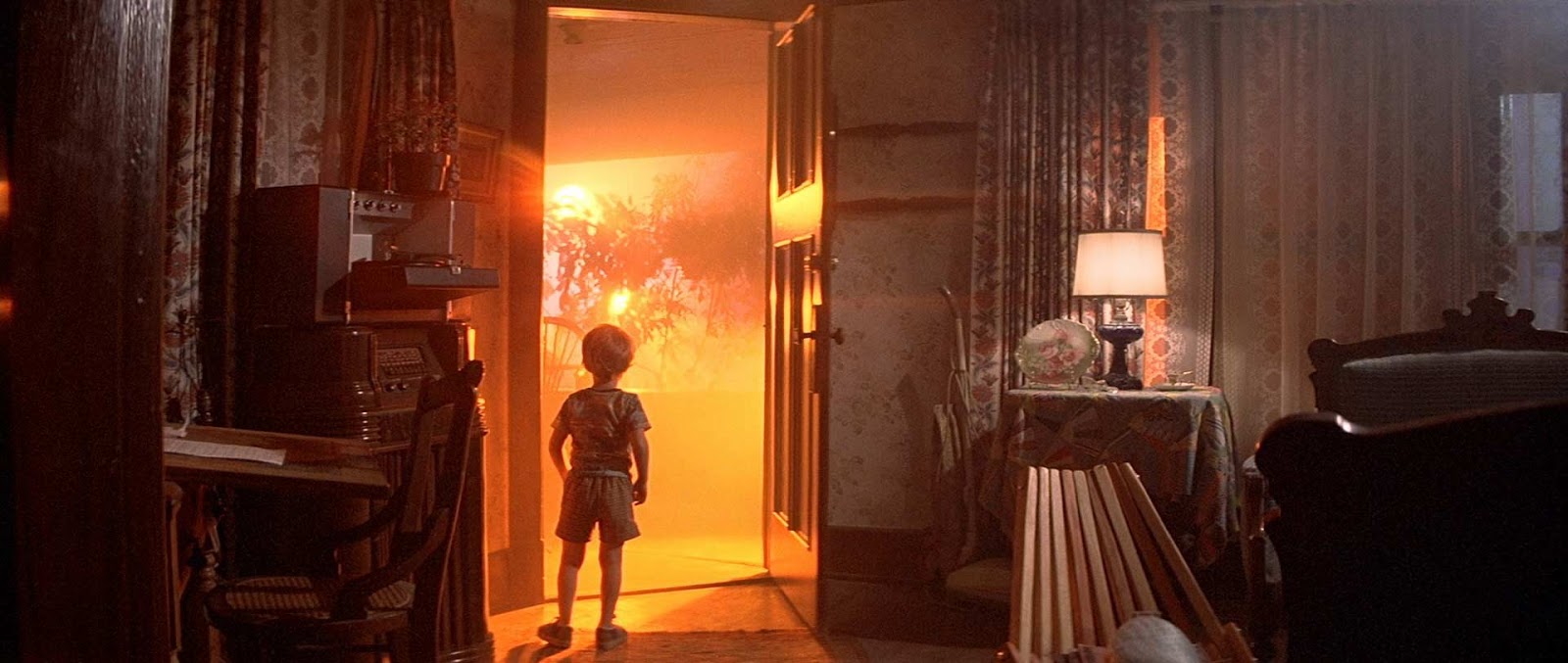
Without explaining too much of the plot, Close Encounters is about two families. Both these families have members that end up having a 'close encounter' with an unexplained force. Barry Guiler (a 3 year old) and Roy Neary (Richard Dreyfuss) are the two most affected by them. Barry is abducted by aliens early in the story while Roy becomes obsessed with a number of images that have seemingly been burned into his brain. These images drive him throughout the film and wind up taking him and Barry's mother Jillian (Melinda Dillon) to Devil's Tower in Wyoming. It's here that humankind makes official contact with these aliens. In a quick summation there's nothing overly jaw dropping about this film. We've seen this story before (often as a result of parody and emulation of this film) but Spielberg takes a fairly pat science fiction story and turns it into a classic with the same methodology he used on Jaws. The early scenes show two families simply living their lives. I don't know what Spielberg does but he has a way with child actors that I've never seen with any other filmmaker (save maybe J.J. Abrams in Super 8). He manages to capture children as they are rather than children trying to act like children. Watching Barry's face light up with excitement or confusion as he encounters otherworldly beings is something we've all seen a thousand times when interacting with little cousins or siblings who discover something new. Spielberg's family dynamics are the same way. They ring true in a way that forces the viewer to drop what they're doing and get completely sucked into the film. I can't imagine a film like this being made today with the same patience. The first time we meet Roy Neary he's using model trains to try and help his son with his math homework. They spend the next ten minutes arguing about the family's plans for the evening. There's no hurry to get to the titular event. For all we know it may never come. But with how well these household situations are handled I really didn't mind waiting. Spielberg does this same thing in Jaws.
It's been a great experience watching all of Spielberg's early work so close together. Close Encounters is a healthy marriage of Jaws and Raiders of the Lost Ark. We've got the great family dynamics and story I just mentioned and we've got these wonderful supernatural elements that help drive the framework of the film. The World War II era planes that suddenly appear in the Sonoran Desert is the opening of the film could be a story set up taken right out of an Indiana Jones film. And the story is built in such a way that anytime you start wondering whats going on with the scientists behind the scenes you get a scene switch and you're with them finding a tanker ship plopped down on a sand dune or one of my favorite sequences in the film, listening to hundreds of Dharmsala Indians singing the five tone musical phrase of the film's theme and pointing toward the sky. To borrow a phrase from J.J. Abrams, these elements create a "mystery box" that do wonders to push the story forward. Spielberg dangles just enough information in front of his audience to keep them wanting more without ever revealing the film's ultimate secret. He also achieves the delicate balance of giving just the right about and never too little. Time and time again, mystery films use too many clues that don't mean anything to keep people on the edge of their seat and it generally has the opposite effect.
The film's final act is a long one. The "contact" sequence is one of the most famous in American film history but what's interesting is that out of context it's completely underwhelming. Close Encounters is sewn together in such a great way that even though the ending might appear slow or anticlimactic, to the audience it's completely wonderful. Many of the films questions are answered and the dazzling natures of the colors and sounds used in the alien ship's design is nothing short of awe inspiring.

And it's this ending that sets Close Encounters apart from so many other science fiction efforts. There's no battle. There's no threat. Instead there is hope. A hope for humanity I've never seen in other films. There's a wonderful quote from a film critic named Charlene Engel that says that the film "suggests that humankind has reached the point where it is ready to enter the community of the cosmos". Doesn't that just reek of Carl Sagan? And rightly so. It's a beautiful notion. Sure, plenty of sci-fi films present aliens as villains but its even more easy to believe that we'd be the aggressors were we to ever actually encounter an otherworldly force. And the idea that they allow a human chosen team aboard their ship only enhances the idea of an open dialogue between worlds. It's a wonderful ending to a great film and I give Spielberg a lot of credit for making it.
Next up:

 Indiana Jones and the Last Crusade manages to reclaim much of the adventurous spirit that Temple of Doom tried to strangle and bury in a shallow grave. It was great watching this trilogy almost entirely at once. I got to watch Spielberg treat a storyline with almost the exact same style of filmmaking throughout. Generally when a series of films is being made, the director (assuming it's the same one throughout) grows as a filmmaker. I'll never say that this is a negative though there are plenty of film series that change dramatically in visual style and tone as they go on. Generally it fits in with the tone of the story being told. Spielberg becomes a nice exception to the rule. All three Indiana Jones films are treated very similarly in terms of production style. Though they do get bigger and better in the traditional sense they look and smell the same. As if they were all made at once and cut into three sections much later in the creative process. Even a series like Peter Jackson's Lord of the Rings shifts dramatically in presentation from film to film. Color schemes and even lighting and camera style are all over the place in that series. Now I'm not calling it a detriment to the films but to people who cut apart cinematography in their spare time (i.e. the people who write for this blog) it makes that element of production seem like an afterthought. What I'm trying to say is that Indiana Jones doesn't do this at all. All the films have a great look and feel that carries over between entries. And why shouldn't it? These films are an homage to a bygone era of storytelling. Spielberg and Co. weren't reinventing the wheel with these films. They were using a pre built template to tell a new story in an old medium. Still with me? Good. Let's roll.