George Lucas' dream was to create a modern version of the serials of the 1930's and 40's even though he'd basically already done that in 1977 with Star Wars. It was while trying to escape the madness that that very film created that Lucas and Steven Spielberg discussed the notion of directing a James Bond film. Lucas convinced Spielberg that he'd invented a movie hero that was better than Bond but just as adventurous. After the premise was explained Spielberg said he loved the idea: "Bond without the hardware". Lucas' original name for the character was Indiana Smith. Spielberg flexed his creative control right from conception and made him change it to Jones. Thank our stars. Spielberg also had some interesting ideas for the character himself. Mainly that he'd be a drunk like Bogart's character Fred Dobbs in The Treasure of the Sierra Madre. This idea fell away as the script was developed by Lawrence Kasdan and after five drafts they had what we now know as Raiders of the Lost Ark.
I didn't grow up with the Indiana Jones movies like most of my friends. I'm not sure why. They just never made it into my house. So by the time I was introduced to them I honestly found them underwhelming. But the more I watch them the more I love the effects and silly nature of a lot of the combat. Looking at the films production there's some great stuff to be learned. All of the silliness in the movie was done entirely on purpose. Every major studio rejected Raiders thinking that it would be far too expensive to make as well as too over the top narratively. Paramount pictures finally stepped up to fund the project but layed down the law in the process telling Spielberg the film had to stay on budget and schedule. Spielberg pre-pro'd like never before, hiring four illustrators to storyboard every scene as much as possible. Spielberg also took it upon himself to shoot the film "quick and dirty" as was the style of the Saturday matinee serials he was emulating. All the effects were all done practically using puppets miniatures and in camera tricks to keep costs down. The time and money crunch definitely aided the success of the film. Spielberg himself even said "Had I had more time and money, it would have turned into a pretentious movie".
All the background info aside I like this film more and more every time I see it. It's nothing if not a blast. Especially in a world where films that should be fun end up taking themselves too seriously. Knowing Spielberg meant to make the film look over the top allowed me to turn my head at some of the campy effects the first few times I watched it. But now I embrace the film's presentation with open arms. It's interesting because I used to find the Indy films artless but it takes a serious filmmaker to make a movie thats so reminiscent of a bygone era of storytelling. It's funny how often the film comes off as an indie production with bare bones costuming and sets. It never hurts the movie but it's great to see a film that's so highly regarded have a few budget moments. Aspiring filmmakers need to take note of things like this in huge feature films. It's a glimmer of hope.
I really don't have anything negative to say about this film. Spielberg's technique is hidden behind emulation but if you make yourself familiar with old serials both narratively and visually, you can see how great a job Spielberg and his team did on Raiders. I'll take a just a second to recognize John Williams for creating yet another amazing musical theme. Where would great American films be without his musical touch?
Up next:
Showing posts with label john williams. Show all posts
Ramblin' 'bout Amblin: Close Encounters of the Third Kind
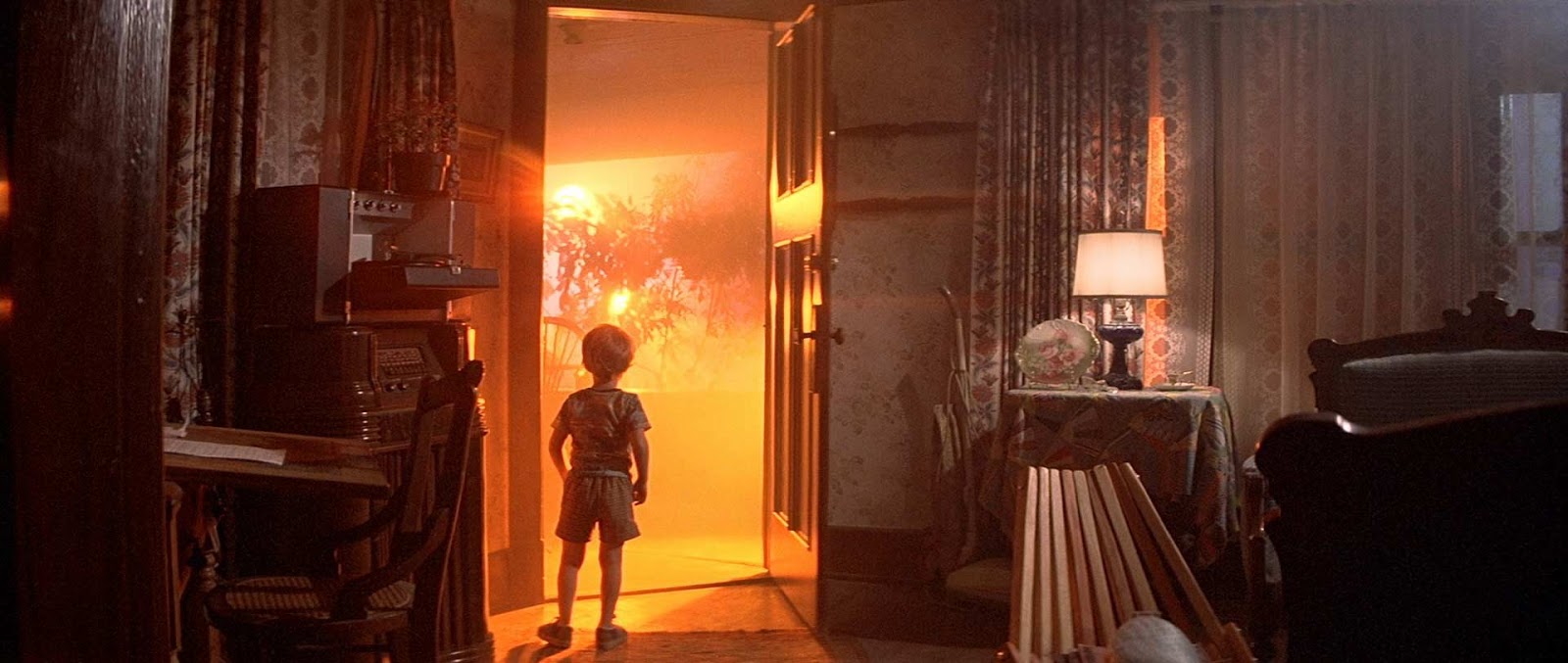
Close Encounters of the Third Kind is a film about a lot of things. It's about aliens, family, government control, and obsession. I'm sure there's more but we'll start with broad strokes. This film went through an extremely troubled writing process with plenty of big name screenwriters turning in drafts. (Paul Schrader and John Hill to name just a pair). Ultimately though, Spielberg hated almost every treatment and script he received and ended up taking on the task of writing the film himself. This marks one of the very few films he's received a writing credit for.
Viewing the film this close to Jaws and E.T. was a learning experience. Spielberg's definitive theme, and it's evident in all of his films, is the importance of family. I could go on all day about the wonderful special effects, the now famous yet utterly simple score by John Williams, or even the complete and utter badassery that is getting François Truffaut to head up a committee of eager scientists but the film starts with two families and so then will this article.
Without explaining too much of the plot, Close Encounters is about two families. Both these families have members that end up having a 'close encounter' with an unexplained force. Barry Guiler (a 3 year old) and Roy Neary (Richard Dreyfuss) are the two most affected by them. Barry is abducted by aliens early in the story while Roy becomes obsessed with a number of images that have seemingly been burned into his brain. These images drive him throughout the film and wind up taking him and Barry's mother Jillian (Melinda Dillon) to Devil's Tower in Wyoming. It's here that humankind makes official contact with these aliens. In a quick summation there's nothing overly jaw dropping about this film. We've seen this story before (often as a result of parody and emulation of this film) but Spielberg takes a fairly pat science fiction story and turns it into a classic with the same methodology he used on Jaws. The early scenes show two families simply living their lives. I don't know what Spielberg does but he has a way with child actors that I've never seen with any other filmmaker (save maybe J.J. Abrams in Super 8). He manages to capture children as they are rather than children trying to act like children. Watching Barry's face light up with excitement or confusion as he encounters otherworldly beings is something we've all seen a thousand times when interacting with little cousins or siblings who discover something new. Spielberg's family dynamics are the same way. They ring true in a way that forces the viewer to drop what they're doing and get completely sucked into the film. I can't imagine a film like this being made today with the same patience. The first time we meet Roy Neary he's using model trains to try and help his son with his math homework. They spend the next ten minutes arguing about the family's plans for the evening. There's no hurry to get to the titular event. For all we know it may never come. But with how well these household situations are handled I really didn't mind waiting. Spielberg does this same thing in Jaws.
It's been a great experience watching all of Spielberg's early work so close together. Close Encounters is a healthy marriage of Jaws and Raiders of the Lost Ark. We've got the great family dynamics and story I just mentioned and we've got these wonderful supernatural elements that help drive the framework of the film. The World War II era planes that suddenly appear in the Sonoran Desert is the opening of the film could be a story set up taken right out of an Indiana Jones film. And the story is built in such a way that anytime you start wondering whats going on with the scientists behind the scenes you get a scene switch and you're with them finding a tanker ship plopped down on a sand dune or one of my favorite sequences in the film, listening to hundreds of Dharmsala Indians singing the five tone musical phrase of the film's theme and pointing toward the sky. To borrow a phrase from J.J. Abrams, these elements create a "mystery box" that do wonders to push the story forward. Spielberg dangles just enough information in front of his audience to keep them wanting more without ever revealing the film's ultimate secret. He also achieves the delicate balance of giving just the right about and never too little. Time and time again, mystery films use too many clues that don't mean anything to keep people on the edge of their seat and it generally has the opposite effect.
The film's final act is a long one. The "contact" sequence is one of the most famous in American film history but what's interesting is that out of context it's completely underwhelming. Close Encounters is sewn together in such a great way that even though the ending might appear slow or anticlimactic, to the audience it's completely wonderful. Many of the films questions are answered and the dazzling natures of the colors and sounds used in the alien ship's design is nothing short of awe inspiring.
And it's this ending that sets Close Encounters apart from so many other science fiction efforts. There's no battle. There's no threat. Instead there is hope. A hope for humanity I've never seen in other films. There's a wonderful quote from a film critic named Charlene Engel that says that the film "suggests that humankind has reached the point where it is ready to enter the community of the cosmos". Doesn't that just reek of Carl Sagan? And rightly so. It's a beautiful notion. Sure, plenty of sci-fi films present aliens as villains but its even more easy to believe that we'd be the aggressors were we to ever actually encounter an otherworldly force. And the idea that they allow a human chosen team aboard their ship only enhances the idea of an open dialogue between worlds. It's a wonderful ending to a great film and I give Spielberg a lot of credit for making it.
Next up:
Viewing the film this close to Jaws and E.T. was a learning experience. Spielberg's definitive theme, and it's evident in all of his films, is the importance of family. I could go on all day about the wonderful special effects, the now famous yet utterly simple score by John Williams, or even the complete and utter badassery that is getting François Truffaut to head up a committee of eager scientists but the film starts with two families and so then will this article.
Without explaining too much of the plot, Close Encounters is about two families. Both these families have members that end up having a 'close encounter' with an unexplained force. Barry Guiler (a 3 year old) and Roy Neary (Richard Dreyfuss) are the two most affected by them. Barry is abducted by aliens early in the story while Roy becomes obsessed with a number of images that have seemingly been burned into his brain. These images drive him throughout the film and wind up taking him and Barry's mother Jillian (Melinda Dillon) to Devil's Tower in Wyoming. It's here that humankind makes official contact with these aliens. In a quick summation there's nothing overly jaw dropping about this film. We've seen this story before (often as a result of parody and emulation of this film) but Spielberg takes a fairly pat science fiction story and turns it into a classic with the same methodology he used on Jaws. The early scenes show two families simply living their lives. I don't know what Spielberg does but he has a way with child actors that I've never seen with any other filmmaker (save maybe J.J. Abrams in Super 8). He manages to capture children as they are rather than children trying to act like children. Watching Barry's face light up with excitement or confusion as he encounters otherworldly beings is something we've all seen a thousand times when interacting with little cousins or siblings who discover something new. Spielberg's family dynamics are the same way. They ring true in a way that forces the viewer to drop what they're doing and get completely sucked into the film. I can't imagine a film like this being made today with the same patience. The first time we meet Roy Neary he's using model trains to try and help his son with his math homework. They spend the next ten minutes arguing about the family's plans for the evening. There's no hurry to get to the titular event. For all we know it may never come. But with how well these household situations are handled I really didn't mind waiting. Spielberg does this same thing in Jaws.
The film's final act is a long one. The "contact" sequence is one of the most famous in American film history but what's interesting is that out of context it's completely underwhelming. Close Encounters is sewn together in such a great way that even though the ending might appear slow or anticlimactic, to the audience it's completely wonderful. Many of the films questions are answered and the dazzling natures of the colors and sounds used in the alien ship's design is nothing short of awe inspiring.
And it's this ending that sets Close Encounters apart from so many other science fiction efforts. There's no battle. There's no threat. Instead there is hope. A hope for humanity I've never seen in other films. There's a wonderful quote from a film critic named Charlene Engel that says that the film "suggests that humankind has reached the point where it is ready to enter the community of the cosmos". Doesn't that just reek of Carl Sagan? And rightly so. It's a beautiful notion. Sure, plenty of sci-fi films present aliens as villains but its even more easy to believe that we'd be the aggressors were we to ever actually encounter an otherworldly force. And the idea that they allow a human chosen team aboard their ship only enhances the idea of an open dialogue between worlds. It's a wonderful ending to a great film and I give Spielberg a lot of credit for making it.
Next up:
Ramblin' 'bout Amblin: Jaws
Fox Its release was a watershed moment in motion picture history. In 1975 Steven Spielberg was a relatively unknown filmmaker. He was 26 and had one theatrically released feature film under his belt, the neo-noir The Sugarland Express. Dick Richards, who'd just put out his own debut The Culpepper Cattle Co. had slotted Jaws to be his second film but the producers dropped him for Spielberg.
I think they chose correctly.
Jaws became the first summer blockbuster in history and it's a bit of downward spiral from there as far as popular American film is concerned.
I've seen this film plenty of times but only in this most recent watch did I take a hard look at it for Spielberg's touch. And even so early on in his career he'd developed some of the key traits we associate with his shooting style. The full dolly pushes forward on characters at moments of revelation, really realistic performances despite the fact that Jaws is essentially a monster movie, and, probably the oddest touch for me, an overwhelmingly classical view towards the titular man-eating shark. Robert Shaw's Quint rapidly becomes Captain Ahab but at no point in the film does the viewer worry about Brody or Hooper's exposure to the man. Instead we're treated to a lot of laughter and camaraderie, accompanied by John William's oddly upbeat score as they chase harpoon-led barrels around the Atlantic.
Two main things stood out to me on this most recent viewing: John William's score and the narrative's focus. Williams is arguably the greatest film composer of all time. Almost every single theme known by the masses belongs to the man and Jaws is the birth of the legend. Many times I've heard anecdotes about how Spielberg laughed with incredulity at William's when he came to him with the theme to Jaws. "That's it?" was Spielberg's reply. Whether it's true or not is beside my point though. What got me about the score on this viewing was how jovial it is. Most of the film utilizes a really upbeat classical sounding score with very lively string arrangements. The famous theme makes plenty of appearances but Spielberg uses it the same way he uses his reveals. Most of the time the theme is used instead of the actual shark (Though this is due mostly to the malfunction of the shark prop). The first time you really see the shark is about an hour into the film. Spielberg plays it close to the chest and it makes the film so much better. And that's where the narrative comes in.
Now Spielberg didn't write the screenplay but his love of the novel was what got him into the film in the first place. And it shows.
The film's opening is mighty famous. Skinny-dipping teenager gets eaten by an unseen monster. With horror we watch as this girl gets dragged every which way through the water as her too-drunk partner passes out on land and can't possibly help her. The sequence is horrifying, though I couldn't help but laugh. The three minute sequence was definitely shot during at least three different times of day. The quality of light ranges pretty greatly throughout the scene. In fact this kind of error happens quite a bit throughout the film. Hardly an unforgivable mistake but it's interesting to think of films as legendary as Jaws having these kinds of continuity errors. And since I'm thinking of it the best error comes once the final trio are on the Orca late in the film where Roy Scheider is talking and the scene quite literally fades out mid sentence. It's hysterical.
What's interesting though is after this initial attack the film goes quiet. We get a really close look at the town on Amity Island and learn quite a bit about its economy and lifestyle. This is where the film shines in my opinion. Because of Spielberg's patience, this thriller's punches end up really packing a wallop. Spielberg makes sure there's real heart in this thing. Whether it be Roy Scheider's sheriff's son being in danger or the mother of one of the shark's victims slapping him in front of the whole town, Spielberg makes sure that at the heart of this film there's a real town with real people in it. This allows for him to not only stave off seeing the shark for so long but also to truly give the film weight that lasts long after people have left the theater.
I'll probably end up having more to say about Jaws when I take a run at Spielberg's earlier work (especially Duel). For now though I'll say that its a great flick and a perfect jumping off point for this project.
Emily D Tucker and I have recently been discussing what makes a good horror movie 'good'. We keep coming back to the same popular opinion that, of course, what makes a horror movie work is for the creator to remember that the film still needs to adhere to the standards of any other movie genre. It must have a fully developed story with equally developed characters; the horror element can’t be expected to carry the film alone. (I’m looking at you, Candyman).
One of my favorite ways that some horror films carry this out is to emphasize a character’s life outside of the main plot. This not only creates a more interesting and three-dimensional character, but also ensures that the character is not simply a vehicle for the plot. The Exorcist, for example, begins by showcasing Regan and her mother under normal circumstances before their new demon friend comes to town. As Regan begins exhibiting signs of trouble, Mom handles it in a realistic way by taking her to various doctors and psychologists, but their lives are not put on hold by Regan’s “illness.” Mom even holds a dinner party for her colleagues during which Regan takes a turn for the worst and pees on the carpet in front of everyone (come on, R, Get it together). By this point, we’re invested, and our understanding of the characters ultimately heightens the eerie sequences that infuse the remainder of the movie.
Jaws handles this technique pretty well. We first meet the main character, Brody (who I’m going to call Danny Tanner for the rest of this review), as he begins his new job as sheriff of a hip beach town. He’s got a cool house, a wife with fabulous hair, and two kids that are surprisingly not annoying. Things are looking up for ol’ Danny Tanner. Just as he's getting his feet wet (!), he and his deputy find a dead body on the shore. In this initial investigation alone, we learn about the main character’s moral code, his logical approach to solving problems and his primary obstacle in solving those problems: the mayor. What we gather about the character here informs our viewing of the rest of the film, as we’re not just watching a shark killing kids or whatever, but a man trying to keep those kids or whatever alive. In subsequent conversations with other characters, like his wife, we see the effect that the shark situation is having on his life. The shark isn’t just a menace, it’s an imposition.
We have a similar opportunity to get to know Danny Tanner’s entourage, Captain Ahab and Mr. Holland. Captain Ahab, though the most two-dimensional character of the three, has a clear motivation and strong sense of self throughout the film. Mr. Holland, after explaining his reasons for assisting with the hunt (science!), even has to call out of work in order to keep helping Danny Tanner. A small detail like this really lends some realism to a creature feature, particularly after seeing the clearly-rubber shark flopping up and down the boardwalk.
Parceling out time to explore these characters at the beginning of the film pays off, as it amplifies the suspense of the boat trip in the second half of the film. This would be the most boring movie ever if we didn’t care about or understand the characters, regardless of the fantastic boat attack during the climax. This part of the film is pretty much just a war monologue, a weird fade, and a lot of waiting – risky, but it works.
Though I’m not in love with this movie overall, I certainly respect and appreciate its storytelling ability. The main thing I want a movie to do is get me to care about what it’s telling me, which Jaws actually did. Although I could have used at least one urination scene. Maybe next time, Spielberg!
Next up:
I think they chose correctly.
Jaws became the first summer blockbuster in history and it's a bit of downward spiral from there as far as popular American film is concerned.
I've seen this film plenty of times but only in this most recent watch did I take a hard look at it for Spielberg's touch. And even so early on in his career he'd developed some of the key traits we associate with his shooting style. The full dolly pushes forward on characters at moments of revelation, really realistic performances despite the fact that Jaws is essentially a monster movie, and, probably the oddest touch for me, an overwhelmingly classical view towards the titular man-eating shark. Robert Shaw's Quint rapidly becomes Captain Ahab but at no point in the film does the viewer worry about Brody or Hooper's exposure to the man. Instead we're treated to a lot of laughter and camaraderie, accompanied by John William's oddly upbeat score as they chase harpoon-led barrels around the Atlantic.
Two main things stood out to me on this most recent viewing: John William's score and the narrative's focus. Williams is arguably the greatest film composer of all time. Almost every single theme known by the masses belongs to the man and Jaws is the birth of the legend. Many times I've heard anecdotes about how Spielberg laughed with incredulity at William's when he came to him with the theme to Jaws. "That's it?" was Spielberg's reply. Whether it's true or not is beside my point though. What got me about the score on this viewing was how jovial it is. Most of the film utilizes a really upbeat classical sounding score with very lively string arrangements. The famous theme makes plenty of appearances but Spielberg uses it the same way he uses his reveals. Most of the time the theme is used instead of the actual shark (Though this is due mostly to the malfunction of the shark prop). The first time you really see the shark is about an hour into the film. Spielberg plays it close to the chest and it makes the film so much better. And that's where the narrative comes in.
Now Spielberg didn't write the screenplay but his love of the novel was what got him into the film in the first place. And it shows.
The film's opening is mighty famous. Skinny-dipping teenager gets eaten by an unseen monster. With horror we watch as this girl gets dragged every which way through the water as her too-drunk partner passes out on land and can't possibly help her. The sequence is horrifying, though I couldn't help but laugh. The three minute sequence was definitely shot during at least three different times of day. The quality of light ranges pretty greatly throughout the scene. In fact this kind of error happens quite a bit throughout the film. Hardly an unforgivable mistake but it's interesting to think of films as legendary as Jaws having these kinds of continuity errors. And since I'm thinking of it the best error comes once the final trio are on the Orca late in the film where Roy Scheider is talking and the scene quite literally fades out mid sentence. It's hysterical.
What's interesting though is after this initial attack the film goes quiet. We get a really close look at the town on Amity Island and learn quite a bit about its economy and lifestyle. This is where the film shines in my opinion. Because of Spielberg's patience, this thriller's punches end up really packing a wallop. Spielberg makes sure there's real heart in this thing. Whether it be Roy Scheider's sheriff's son being in danger or the mother of one of the shark's victims slapping him in front of the whole town, Spielberg makes sure that at the heart of this film there's a real town with real people in it. This allows for him to not only stave off seeing the shark for so long but also to truly give the film weight that lasts long after people have left the theater.
I'll probably end up having more to say about Jaws when I take a run at Spielberg's earlier work (especially Duel). For now though I'll say that its a great flick and a perfect jumping off point for this project.
Emily D Tucker and I have recently been discussing what makes a good horror movie 'good'. We keep coming back to the same popular opinion that, of course, what makes a horror movie work is for the creator to remember that the film still needs to adhere to the standards of any other movie genre. It must have a fully developed story with equally developed characters; the horror element can’t be expected to carry the film alone. (I’m looking at you, Candyman).
One of my favorite ways that some horror films carry this out is to emphasize a character’s life outside of the main plot. This not only creates a more interesting and three-dimensional character, but also ensures that the character is not simply a vehicle for the plot. The Exorcist, for example, begins by showcasing Regan and her mother under normal circumstances before their new demon friend comes to town. As Regan begins exhibiting signs of trouble, Mom handles it in a realistic way by taking her to various doctors and psychologists, but their lives are not put on hold by Regan’s “illness.” Mom even holds a dinner party for her colleagues during which Regan takes a turn for the worst and pees on the carpet in front of everyone (come on, R, Get it together). By this point, we’re invested, and our understanding of the characters ultimately heightens the eerie sequences that infuse the remainder of the movie.
Jaws handles this technique pretty well. We first meet the main character, Brody (who I’m going to call Danny Tanner for the rest of this review), as he begins his new job as sheriff of a hip beach town. He’s got a cool house, a wife with fabulous hair, and two kids that are surprisingly not annoying. Things are looking up for ol’ Danny Tanner. Just as he's getting his feet wet (!), he and his deputy find a dead body on the shore. In this initial investigation alone, we learn about the main character’s moral code, his logical approach to solving problems and his primary obstacle in solving those problems: the mayor. What we gather about the character here informs our viewing of the rest of the film, as we’re not just watching a shark killing kids or whatever, but a man trying to keep those kids or whatever alive. In subsequent conversations with other characters, like his wife, we see the effect that the shark situation is having on his life. The shark isn’t just a menace, it’s an imposition.
We have a similar opportunity to get to know Danny Tanner’s entourage, Captain Ahab and Mr. Holland. Captain Ahab, though the most two-dimensional character of the three, has a clear motivation and strong sense of self throughout the film. Mr. Holland, after explaining his reasons for assisting with the hunt (science!), even has to call out of work in order to keep helping Danny Tanner. A small detail like this really lends some realism to a creature feature, particularly after seeing the clearly-rubber shark flopping up and down the boardwalk.
Parceling out time to explore these characters at the beginning of the film pays off, as it amplifies the suspense of the boat trip in the second half of the film. This would be the most boring movie ever if we didn’t care about or understand the characters, regardless of the fantastic boat attack during the climax. This part of the film is pretty much just a war monologue, a weird fade, and a lot of waiting – risky, but it works.
Though I’m not in love with this movie overall, I certainly respect and appreciate its storytelling ability. The main thing I want a movie to do is get me to care about what it’s telling me, which Jaws actually did. Although I could have used at least one urination scene. Maybe next time, Spielberg!
Next up:
Labels:
ahab,
horror,
Jaws,
john williams,
ramblin bout amblin,
Spielberg,
The exorcist
Subscribe to:
Posts (Atom)