Showing posts with label to the wonder. Show all posts

Noah Lyons on the changing face of Cinematic truth/faith, circa 2013

Noah Lyons gave me a list of the best films of the year when I asked him too but he did so with the understanding that if he caught up with better films I'd allow him to update the list. So when we posted our favourites of the year, he endured a marathon watching bout and revised his list. Here are the awesome results. Noah's got one of my favourite brains currently at work, so enjoy!
-Scout

1. Act of Killing – Representing the trend of inevitability, boundary-pushing, and end-game aesthetics this year in film, this documentary/horror story makes us question the ethics of filmmaking and storytelling, the relationship between media and actions, and the power of self-deception. The final vomiting sequence is the most real, satisfying, and ghastly scene I saw all year. Is the film ethical? Yes, because it tosses aside status quo ethics to plunge into a world otherwise inaccessible by a camera – the evil soul.  

2. Night Across The Street – Take the best elements of Lynch, Fellini, and Jodorowsky, and you get this pitch-perfect surrealist adventure through the memories and brain of a dying man. Ruiz manages to capture the mood and style of Eugene Ionesco better than I have ever seen in a film; the non-sequitur logic, the inversion of spatial coordinates, the exploration of the liminal space between the screen and the body. I laughed and applauded more than anytime else all year. “Why do you come to the cinema, if you don’t even know anything about the film you’ve just seen?” asks Beethoven. The boy/us: “We came to have fun, not to learn anything.” The magic of the moving image again becomes joyous and miraculous. 

3. Leviathan – This is what I mean by an end-game aesthetic. As Scout has pointed out, there is really no way to make a documentary now that we have been witnessed a pure embodied POV that challenges our notions of documentation and the abilities/limitations of the camera. With no real plot or characters to speak of, Leviathan is pure visceral experience of slaughter and the sea, colored by rust and blood, free from the laws of gravity and photographic restraints. 

4.  You Ain’t Seen Nothing Yet – Resnais’ Last Year at Marianbad changed everything I thought I knew about film; again, Resnais blows the mind with another challenge to the aesthetical ontology of the silver screen, and our relationship to it. Theatre, movies, remakes, adaptations, the dialogue backstage and onstage, all interweave into a funereal fugue which speaks to the ghosts of past loves and words. I am astonished by the envelope-pushing of 2013; just when I think there’s no space left to challenge and unravel the structure and ontology of film, I’m reminded by the great auteur that indeed, “you ain't seen nothing yet”. 

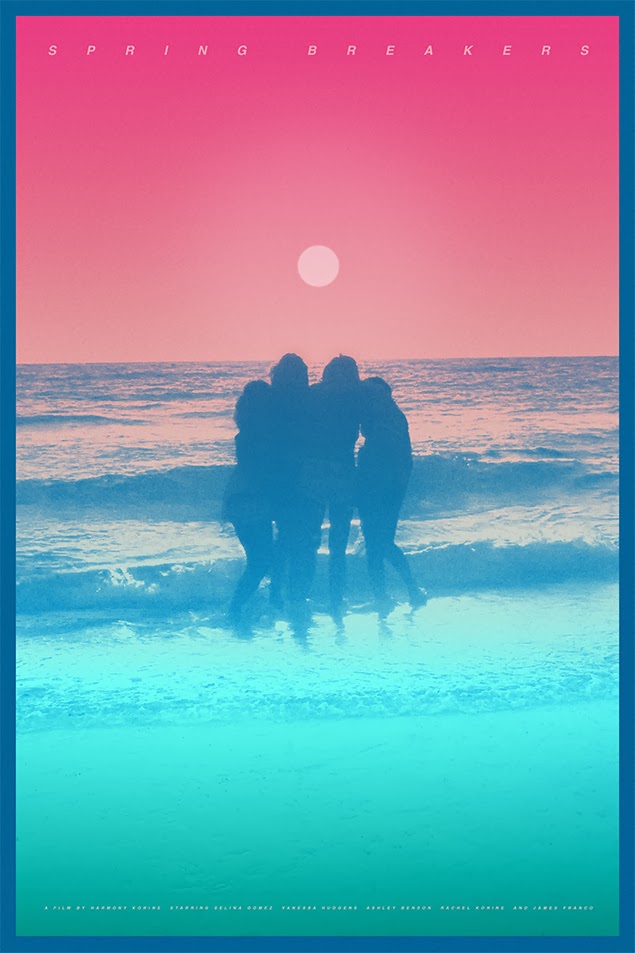
5. Spring Breakers / The Bling Ring – I will defend these two films to the death. I include them together because they are two sides to the same coin. Like a bloody car crash, I could not look away from these piercing cuts into the American teenage myth/dream of the modern era. Few have yet to truly examine these myths of celebrity and college escapism with a critical eye. Ironically, Korine, who usually has as his subject spheres of Americana that go unnoticed here looks at the most obvious representation of ‘Americana’, and blasts it with so much ironic satire that it somehow morphs into concern, rather than fatalism and absurdity. And it looks good. Sadly, it suffered from a terrible mismarketing campaign that turned off pretentious critics and high-minded individuals in lieu of attracting the very types the film is critiquing, who of course hated it. Same with The Bling Ring, which also examines a seemingly obvious slice of the American pie but manages to transcend the banality and strike terror into our hearts as we realize that this is not fantasy. There is a difference between reality and truth; these films are true. And what else more can we really say, now? These films had to happen, and did. 
6. Computer Chess – Refreshing and revitalizing, despite the fact that this is an aesthetic and cultural throw back to 1980. It caught me off-guard countless times with its brilliant genre twists and arid humor. The dramatic irony of knowing where technology will lead us in regards to dating and connectivity makes it all the more enjoyable and poignant. 

7. Vanishing Waves – Disclosure: one of the two films this year that made me cry. I admit I am a sucker for movies about the retrieval and/or destruction of memories; nevertheless, this romance (in the skin of sci-fi) strips away all conceit and plot contrivances to reveal what it looks like and how it feels when two hearts fall in love. The montage of the comatose woman and the doctor rolling naked in a Malick-lit wooden room is exactly that. The Antichrist-esque/Cronenbergian [the man himself wishes we'd say Cronenbergundian, ed.] image of nude limbs and flesh crawling in and out of each other manages to avoid horror/sci-fi shtick. Forget Eternal Sunshine of the Spotless Mind. 

8. The Past – If this was an American film, it would win the Oscar for best picture without a doubt. This is how drama is made, and a case study for any aspiring actors. There’s really not much more to really say; it’s tight and fully packed (as Lynch says of his singer/muse Chrysta Bell). I include this, and no other “perfect” films, on my list because it reaffirms the power of a story told well without the bells and whistles of star power and Hollywood. 

9. To The Wonder – I read somewhere that Malick is to light what Welles was to shadow; whoever said that is correct. While shadow is usually the optical and aesthetic frame and delineation of a form, for Malick light is the frame, the line, the ray, the alien force descending upon the earth. This film is also about silence, and the invisible currents (of toxic waste, bleeding hearts) that flow through our time here on this beautiful earth. 

10. Dormant Beauty – The other film that made me shed quite a few tears. Much could be said about Bellocchio’s excellent use of topical politics as a backdrop for his drama; however, I was more intrigued by the theme of faith that underscores the four plots. Faith in God, faith in The Resurrection, faith in the Revival of the comatose, faith in the Rebirth of love. Faith supports us, but it is also alienating. Should I abandon my faith in Jesus Christ and the miracle of the resurrection, for faith in the love of a stranger? The faith that my heart is still capable of feeling? Should the cross lie across my breasts or turned around, invisible, to lie on my backbone? Does God desire life or death, joy or pain? Despite all of these questions, I never questioned the foundation of my faith but the way in which I express it and when/if I recognize other faiths in other people. Connectivity and love require the faith that when they die, we will move on. Also, I could stare at Alba Rohrwacher’s face for aeons. 

11. A Field In England – A Shakespearian tragedy translated by Jodorowsky and performed by Samuel Beckett ghosts under the influence of mushrooms. This is the weirdest film I saw this year, and I loved every minute of it. When the alchemist begins gobbling mushrooms, my head truly felt like it was crackling and spewing lava. It is hard to “do weird” these days; this is how it’s done. 

12. Blue Jasmine – This slot also includes the likes of 12 Years a Slave, The Great Beauty, American Hustle, Her, Inside Llewyn Davis, etc. That is those films that are extremely well executed but offer nothing to the future of cinema. All of my ‘best’ or ‘favorite’ films would more accurately be described as the most important ones; importance is when a film closes, with a to-be-continued, the chapter on a movement or style or technical achievement or reveals the potential of future explorations. Or it begins blazing a new path. Blue Jasmine does not do any of these things. Woody, I’m tired. I’m tired of the same shit movie after movie. Woody, you are a perfect director. There is nothing wrong with this film and that’s why I hate it. Not only is it a carbon-copy of your other films, with new brilliant performances, it does not innovate or challenge or even have a hint of imagination. Woody, return to experimentation of form and genre, rather than creating perfect cinematic ice cream cones. 

Honorable Mentions: Fruitvale Station, Post Tenebras Lux, Upstream Color, Lords of Salem, We Are What We Are, Gravity, Side Effects

Hearing Voices: Thoughts on To The Wonder

I'm in exactly the same theatre I was in when Tree of Life had its first public screening in the US, the basement of a Landmark. I remember the anticipation then, of everyone, including the ushers, being nervous about what we were all about to see. This was an event and the sold out theatre proved it. A man came out ten minutes before the film started and reminded us we could buy concessions upstairs. No one had ever and no one has yet to do that again before a movie screening. Ned Hinkle used to remind Brattle patrons that they could buy beer, but that was because they'd only just had the bar put in. This was different, the man in front of me was shaking almost imperceptibly, as if his job were on the line and this movie's performance was what was going to make the difference. Two years later To The Wonder is about to start and the theatre is all but empty. 

It's a little earlier in the day this time, and there are more screenings planned later today (shorter runtime, more daily showings) and finally I see a man walk down the aisles. He isn't nervous. There having trouble with the DCP and would we go upstairs to wait for the next screening. Sure. I have a half hour to kill now and I'm running through all the pressnotes I've read in my head. I'm remembering Dan Kasman and Fernando Croce's correspondences about it, their measured praise. And then I remember Darren Hughes; "Where's all the shit?" The film was too clean, too pretty, too itself for Darren, who still didn't hate it. But then, even if you go in with the wrong mind for it, as Stephanie Zacharek did, and find it obnoxiously self-indulgent and embarrassing, you can't hate all of it, right? It then occurs to me, Zacharek is changing publications. So is Scott Tobias. Will this be the last film they review before the move? Like all Malick, it's a road film, so this would be a fitting departure for them, but I won't know that til later. The movie starts and I can't give this another thought.  

It begins with digital. Digital images, no mistaking them. Has he embraced this? A small camera wielded by a character, man-made creation, as opposed to universal creation. But they rarely resurface. The first real shot is perfect: a woman crossing a train's tray table to be literally on the lap of and in the face of the man she has a crush on. Shot in that improbable, incredibly defined, wide angle that Malick and Emmanuel Lubezki mastered for The Tree of Life. These are people. They're in love. They effortlessly reign over the frame, divine to their director. The france stuff is new for Malick. His previous films start with undeniable force and assertion. This is about a boy who changed my life, a man who murders his boss, an American on an island he clearly doesn't belong on, a ship discovering america, a cosmic whisper and the death of a boy. Here, just people, if the most well dressed people in his canon. Clearly just people: their footprints vanish in the mud in Normandy. They soon leave France for America. A mistake. 


Affleck is Gary Cooper. Maybe his best performance. He isn't speaking, and Malick knows if he talks too much then he's Ben Affleck, moviestar, and not a man with problems. His posture is different, haunched, tense and masculine, but it's a perfectly forced masculinity. It's not his, it's borrowed. Affleck gets so much right. He's a real person. He reminds me of someone I know, right down to his trouble with women. First Brad Pitt, now Ben Affleck. In remaking movie stars in the image of people he knew, Malick's finding people I know, too. People, not characters. It's Malick who makes them human, and then Lubezki makes them gods. In Tree of Life, the two men were god, looking at creation and its most insignificant organisms. There, they observed. Here they worship. The people are titans. Affleck as Cooper is a monument. He can't say anything to Kurylenko's face; he's spent years not being able or feeling welcome to articulate feeling like this. Kurylenko is a marvel. She, like Affleck, has never been better and she's a fine addittion to Malick's voiceover artists. Maybe my favourite. I think about Matt Zoller Seitz' essays on Malick, and his talking with Peter Labuza about voiceover. Did he use the word contrapuntal? Or am I imagining that? Does this count? I suppose not as they do compliment each other, the voice and the images. Except... except for the subtitles. When Rachel McAdams and Ben Affleck join the unconscious fray, their words float as well as anything, but Javier Bardem's beautifully lisping Spanish and Kurylenko's otherworldly French have to show up on screen for us to see. Does this interrupt the images. Do they pull you away from the rhythm? I wonder what Matt makes of it? 


Then the film breaks. It's digital, so it doesn't really, but the technology is so new that we don't even have words for when it breaks down. That's a troubling thought and I fear for the future of film, fleetingly. We see Affleck pick Kurylenko up and swing her once, twice, then the all the colors turn a different shade of red and he keeps on swinging. Then the screen goes black. I go to get someone but another patron beats me to the projectionist whose down in the lobby. I think about Mark Kermode and the way he talks about projection. An artform. No, a performance, that's what he calls it. I think about his friend Dave Norris, the last projectionist standing. He surely wouldn't have let this happen. The audience is awfully quiet. This is clearly not the event that Tree of Life was if the audience is ok with the projector shutting off twenty minutes into the film. Or maybe...maybe the film has calmed them. I know it's done as much to me. How could I be mad? I'm watching To The Wonder. It occurs to me that this has everything to do with the voiceover and Bardem's sermons. Choice. Avoiding choice is a sin, he says. I like to think this makes our auteur pro-Abortion, but that's just me bringing that to the film. It'd be easy to make the case but who knows? No, what's clear is the answer to Hughes question. Where's all the shit? Why does no one do anything ugly in Malick films? Because we're ugly, foul things, people, we kill, we conquer and rape and steal and and piss and shit and drink and do hard drugs and hurt the people we love. But he doesn't have to show those things because those urge don't come with a lot of choice. Everyone has to relieve themselves, no different than a horse, the horses that made a mess of Hughes' property. Nothing dynamic in it. No chance of being a better person for it. No discovery. If someone decides to drink themselves to death or be violent, it's the easy choice, like peeing against a tree if you can't find a bathroom or don't feel like walking to one. It's easy to be cruel to whomever, it comes naturally in many cases. I think Morrissey said something similar. 

Malick was raised by parents who split the difference between our worst urges. His dad, or what we gather of him through Pitt in Tree of Life, was a man dangerously consumed with anger. David Cairns hypothesizes that our anger comes from our having had the American Dream to fall short of. We're supposed to succeed and we don't. Because we believe in the Dream, same as we believe in a god whose looking out for us, we get real mad when our great loves look elsewhere. Here's Bardem and Affleck going into slums and seeing the lives of the unfortunate, proof that God isn't looking out for us. We have to do that. God's whatever makes you leave the comfort and security of doubt and gets you out into the world helping those to whom you can make a difference. 'God' is why Affleck remains mute for most of the film. He goes to church, same as Kurylenko, but neither of them seems to get what Bardem discovers. Going to church doesn't mean shit if you don't let it help you be the version of yourself you keep locked up: "an avalanche of tenderness." Movement. Evolution. We have to choose to evolve. Biological, behavioral theology. Finally something contrapuntal. 


Kurylenko says that Malick's one consistent direction on set was that everyone had to keep moving. If you stop, he urges you on. Because the one thing he hates is when people stop, when they refuse to think for themselves, to make choices, to examine our lives and make them better. Affleck makes for a compelling addendum to the male in Malick. A 21st century update of Badlands' Kit or Days of Heaven's Bill, with a fresh sense of willful blindness. Kit and Bill were outlaws, so had no real room to consider the feelings of their women, what they want, let alone need, but they did show them a certain level of tenderness and understanding. The Farmer in Days of Heaven came at the problem from a different angle: his heart was full of love and cared only about Abby. So when things go south he reacts violently. Affleck's too full of hang ups to quite be The Farmer, he won't give himself fully to love. What would the neighbors think? But he's a far cry from the soldiers of The Thin Red Line and The New World, always considering their place in the world, aware that they're insignificant. So there's precedent, but he's an old-fashioned male given a new coat of paint, fully in keeping with how men behave today. More evolution. 


And then leaving it strikes me that the last thing Roger Ebert ever wrote was a review of this film. Which means that there's a chance it was the last movie he ever saw. I have no proof, but I'm comforted by the thought. Here are people making boundless use of their bodies, the landscape, their homes, their minds. Their thoughts and desires are laid bare for us. Roger couldn't speak any longer, but his thoughts were just as available to us, just as rich, and full of love; accepting and appreciative of life's rich details. Bardem's prayer, his interpretation of God seems perfectly in keeping with Roger's attitude toward the end of life. I thought about Roger Ebert hearing the prayer that closes the film. And it becomes more than art. It's an experience, a continuation of a man's life, and maybe the comfort another found at the end of his. It's proof of the power of film, at least to me. Proof that film criticism is part of my religion, the son of film. Or maybe if film is a religious event, then criticism is my bible, recording and interpreting the events that change our lives, like Malick does when he puts biographical info in his dreamy narratives. And just as we hear the voices of his characters in his movies, I hear film critics wherever I go. He's clearly got something there. Watching this film my brain swelled with the different takes I'd encountered, of the words of critics, of possibilities introduced by people who do little else but consider what film means, making it richer. Even if I disagree with a review it make the film richer because it stands in opposition to one reading. We can't and won't all agree, but our disagreements make us better, they help us understand what we prize about works of art. That's why Terence Malick is so important to me and his films so close to my heart. He lays everything on the table so we can do the same in response. He knows we're not perfect, but he loves us anyway and no one makes even our worst impulses beautiful like he does. Maybe we're not God, but we're the closest thing we've got.