


It's alright! It's alright! It's all been approved! I'm an American!

The band, a group of funny and welcoming southerners who’d relocated to Brooklyn around the same time, gave me a lift to the venue, The Middle East in Cambridge from their in-studio at Emerson College’s radio station. The staff informed them as they unloaded that their set had been pushed to midnight. The bill was full. Paper Birds, a shoegazer band from the area with a crush on David Bowie, went first. Sounding like Low meets Band of Horses, their half hour set passed neatly. Cambridge based crooner Ryan Lee Crosby filled the small room with his uncomfortably specific songs of lovemaking through his Lou Reed-esque nasal voice. When Carter Tanton from the band Tulsa took the stage, I was elated, if sleepy. It was roughly 11:00 when Tanton took the stage and Jeff Bailey, the bass player looked ready for a nap; he wasn’t alone there. Not having expected Tanton, another Cambridge based singer-songwriter who cut his teeth busking in the New York Subway, I was pleased to see him perform again. Tanton’s voice seems flush with natural reverb no matter the setting. Switching between the silky softness of Tulsa songs and his solo material, Tanton captivated everyone in the room, including most of Phosphorescent. When he picked up a banjo, he really shined; his voice seemed to come from some place in a Cormac McCarthy novel, complimented by the haunting timbre of his banjo strings. Tanton is not a voice to be missed. Of course, when Matthew Houck began singing 10 minutes later, it was a whole different ballgame.
Originally from Atlanta, GA Houck has garnered a pretty astonishing critical reputation in the last three years. Since the release of Phosphorescent’s third record Pride, journalists have been lavishing him with praise and superlatives waiting for his next move. When he announced that his band would be releasing a Willie Nelson cover record, the buzz wasn’t exactly overwhelming. Perhaps that’s because the music press hadn’t heard the band play the material from To Willie live. When Houck recorded To Willie he brought on some of his friends and then kept them for the tour. Guitarists Jesse Anderson Ainslie and Dan Weber, bassist Bailey, pianist Scott Stapleton, and drummer Chris Marine turned the songs from Houck’s early records into real rock songs, the kind your dad listens to and that you always wished you knew how to. With it’s roots in the south and current home in Brooklyn, Phosphorescent sound like Grizzly Bear playing Emmylou Harris on a regular day, and with the chugging energy of the Willie Nelson tunes to propel them, they’ve become a beautiful maelstrom.

Their first song, “A Picture of Our Torn Up Praise” started their full-band reimangining of Houck’s best solo material. Stellar run-throughs of “Praise”, “Wolves”, “At Death, A Proclamation”, all from 2007’s Pride made up the first part of their set, and though Houck’s songs sounded huge and intense thanks to his band, they seemed almost small when the band started up the Willie Nelson songs. It’s no secret that Houck’s voice is one of the most compelling in modern rock, but you really don’t get it until you’ve heard him in person. Backed by the harmony of Ainslee, Bailey, and Stapleton, Houck’s voice roars out, never cracking, never wavering, stunning the audience. Phosphorescent ran through a handful of Willie Nelson songs, “Reasons to Quit,” “I Gotta Get Drunk,” and “Can I Sleep In Your Arms” and there was much dancing, drinking and merriment. Marine’s drums and Bailey’s bass tuck the songs into an unshakable groove; Weber and Ainslee take turns leading, and Scott Stapleton’s piano is never at rest. With the combined harmony of his three band mates and a full sound people typically take for granted, Houck went from introverted songsmith to convulsing rockstar, carried away as he let out one soulful howl after another; he never seemed to run out of breath, spurred on by some unseen force. Having seen Willie Nelson live, I can say that Houck is both a worthy adversary to the old rebel though he’d never admit it and a sonic descendent rife to step up and take over where our country giants left off.
After a few perfect songs from To Willie they returned to their own songs, giving heartfelt iterations of early Phos tracks “I Am A Full Grown Man,” “Joe Tex Blues,” “(South Of) America,” and “Cocaine Lights”. By now it was 1 in the morning, and the fatigue that seemed ready to take hold of both band and audience was long gone. The encore came and Matthew Houck had a rowdy glint in his eye. “We’re open to all forms of flattery. We could just keep doing this.” And so as the audience let them have it, they went right back to the Willie covers. “Pick Up The Tempo,” “Permanently Lonely,” and “Too Sick To Pray,” got everyone feeling sentimental, but it was the last song that made this a show no one would forget. Houck’s full-throated whisper started “The Party’s Over” and his three harmonizers were quick to follow. Nelson’s words through Houck’s throat rang out like the hopeful, drunken promise of a better tomorrow, “Turn out the lights, the party's over,”

Houck’s band goes wild, taking the rhythm all over the place; Ainslee and Weber trade licks like a couple of Storyville bluesmen; Stapleton pounds the keys like his life depends on it; Marine and Bailey anchor the song while still going hogwild. “They say that all good things must end.” Houck lets the band play on while he leaps off the stage, finds his girlfriend in the audience and he takes her dancing on the crowded beer stained floor of the middle east; his boots and her blonde hair whipping about like the limbs of a black alder tree caught in a hurricane. “Put out the light, the party’s over,” The band seems unwilling to let the groove come to an end even though everyone knows it can’t last forever. Finally things slow, Marine puts a few extra snare drops in, Houck and his lady stop their dance. “And tomorrow we’ll start the same old thing again."
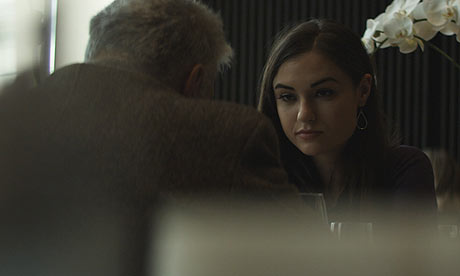 Christine is a high-priced escort. Her boyfriend Chris is a personal trainer. They both work in glamorous, glossy environments making rich people sweat for criminal sums of money. Christine is into Astrology and one gets the notion that she puts a lot of faith into fad spirituality; her beliefs lead her to think about leaving Chris for a client who shares her birthday and zodiac sign. She and Chris have a real relationship despite her flakiness and they do seem to genuinely care for each other, even though they live and work in an almost entirely superficial world. Most of the time they spend at work revolves around the economic crisis; everyone needs money and can't really afford the luxury of a personal trainer or an escort anymore. Christine gives a free evening to a reviewer in the hopes that it will bring her clout and expand her business; this backfires spectacularly, causing her incredible distress. The ending is ambiguous, but there seems to be hope for the two protagonists.
 The fact that the film is one of Soderbergh's least expensive may have been purposive rather than out of necessity. He may be the only living filmmaker who intentionally limits himself, and he's a better filmmaker for it. Made for under 2 million dollars, the film is what I'd call meta-cinematical in that it pays attention to people whose money has been dripping away and it features a pornstar playing a prostitute who takes her clothes off exactly once in near-darkness. The publicity the film's been getting (not to mention the garish poster art) will probably give you the wrong idea about what its like (I know it did for me). It is one of the only presentational American fiction films I can remember seeing that wasn't made in the 60s and is incredibly interesting to dissect. The negative space forces us to load them with our own conceptions, made easier by the offscreen meaning burst of casting a pornstar. Soderbergh has basically given critics a blank canvas and they're totally squandering the oppurtunity. I've yet to read a positive review. I get that this isn't exactly Amelie or Pretty Fucking Woman but come on, it's a beautifully shot objective character study. How many of those do we have right now? Anyone been to a movie theatre recently who doesn't live in Chelsea? Would you guys prefer X-Men Origins or Transformers 2? I had to drive an hour and some to see Tulpan the other day, I'm not exactly swimming in options. So while I see that the film has only so much to offer, I liked what I got. Ignore the poster (but damn it' good...), ignore the trailer, just see it.


A bit of my ignorance shows through with my next question, but I'm hoping for a certain kind of answer and so I chance it anyway. “I spoke to Brendan Canning of Broken Social Scene a few months ago and he seemed very optimistic about the election of Barack Obama. Have you seen a change in Canada? How does that affect you guys?”
“The fact that Obama got elected has affected people everywhere. Every country around the world is going to be benefit from that. We as Canadians are so closely connected to what happens here that it’s almost like an elected official in Canada. The president has that much influence over the course our country takes because we’re inextricably linked, economically, culturally, socially with the path the United States chooses. And under the Bush administration…well, at first it was great cause we had this prime minister who, while Bush was overturning all the things the Clinton administration had done in favor of his neo-conservative, religious…I don’t know what to call it really....something else…we had this prime minister who was legalizing Gay marriage and marijuana. He was on his way out, too, he had been prime minister for a long time. So he basically went around doing all these things…abstaining from sending Canadian troops to the Iraq War. There were all these things where as Canadians we felt this real separation, a sense of standing up for ourselves and for what we believe is right in the face of an enormous amount of pressure coming from the US, especially Post 9/11 America, to take a course we did not feel was right for Canadians, nor should it be right for Americans. And then he left and everything went to shit. Now we have a prime minister who is basically a lackey tagging along with every decision the Bush administration made. So to have a new leader in America, one who has finally managed to capture the people’s imagination and to do a politicians duty, which is to elevate the spirit and elevate our potential…that to me is what you hope every leader would aspire to. We hope for the same in Canada, but we’re glad that there’s someone setting the pace in Washington and our prime minister is going to have to navigate his way through disagreeable waters for his philosophical stuff. I think we’re all really happy about that. But we keep electing him, so I don’t know…(laughs)”

“Despite the political climate, and despite everything really, there’s always been this sense of brotherhood amongst Canadian musicians. Everytime you’d buy a Canadian CD there’d be all these amazing collaborations and everybody would thank each other and just about everyone in Toronto wound up on Broken Social Scene records.”
“Just about. I think about half the population of Toronto has been on a Broken Social Scene album in some way.”
“What’s it like to be in the thick of this sort of community?”
“It’s wonderful. It really is. I mean we have some truly great friends who just happen to be very talented musicians who are making music that the rest of the world is finally paying attention to. It’s inspiring to us. It pushes us. We quickly learned, as of say 2002, 2003, when Broken Social Scene really cracked through and all the other bands started to make their mark as well that there was no just sitting around and resting on whatever laurels we managed to attain for ourself. It became very clear that to survive in the Canadian musical climate you had to be creative, you had to be ambitious, but not in a cutthroat way, just ambitious in the true spirit of what a musician ought to be; which is to feel that urge to do something and share it. And I think we’ve all benefited from that friendly competitiveness that’s come out of it all. To see that it’s possible. Because before, the only people breaking through were the Bryan Adams and the Celine Dions and none of us could relate to them in any way. There was very little to tell you that it was possible to come out of Canada. And that’s not even taking the music out of Canada. The most impressive thing has been the support we all get in Canada, as well. The fact that we can now go…cause Canada’s a big place and there’s a great deal of geographical separation and ideological separation as well between the west coast and the prairies and the east where we’re from. So the fact that we can travel coast to coast and find acceptance among Canadians and not have to be a glitzy American band in order to fill up a venue obviously means a lot to us. As Canadians, but it also means we can have a career. Which is good.”
“Talk to me about your collaboration with Angela Desveaux.”
“Yeah, she’s a great singer. She’s the Emmylou Harris of Montreal. She makes great records on her own and has a wonderful voice. She was singing on her own and in a band called the Sunny Best Band, playing country, both kinds of music, country and western. And so she was singing in that band and I always just loved her voice, so when I was working on “Words & Fire”, I could just hear it so clearly, you know? And she was kind enough to oblige.”
“Are there other musicians in Canada you’ve always wanted to work with, but haven’t yet?”
“I have to be very comfortable with somebody in order to want to make music with them. Theoretically there are a lot of people I know that are talented that could bring inspired ideas to a recording session, but I really have to feel…When we were making Chemical City, my friend Matt Mays came down, and he’s a friend of mine. We’ve been on tour for many, many nights together, and we’ve played music together. So when he was in Australia, we would sit around on the veranda playing the guitar, and I was working on this song “Uprising, Down Under” and it felt very, very natural. But if I were to say I want to work with this person or that person, it would take a lot…for me, anyway. I’m not really a collaborator. I like having the band and we all know each other. There’s nothing to inhibit the sharing of ideas necessarily and I like that. There’s no fear or self-consciousness. Cause music is a very personal thing and as much as we do it in a public forum, there are parts of it that are very private. And for me songwriting is still very, very private.”

“Talk me through your songwriting process.”
“It takes years. It really does. From the time that the idea first appears, the riff…it used to be much more instantaneous. I’d have an idea, I’d sit down at the four-track, buy a new high quality metal cassette and go. Nowadays, because I’m on the road so much, and I don’t write on the road, I don’t demo in the road, so I have an idea and it remains an idea. It’s a stem, a fragment. I’ll have a line I’ve written in my notebook, and I don’t even bother to try and make any sense of it. So there’s this marinating period that usually lasts the entire duration of the tour, a year, year and a half, and when I get home, I have to recuperate from the physical wear-and-tear of life on the road, and then, it just starts to come out. I used to do it in…well I still do it in my apartment; I go to a room in the back with some very minimal technology to get the ideas down and what I hope for more than anything is to just get the fever. Where I sit there and work for ten hours and it feels like five minutes and afterwards there’s this thing that didn’t exist before. I usually wait for that feeling. If I’m not feeling it, I don’t write.”
“You mention priests in your song lyrics in a few different contexts. Are these direct religious references; are they metaphors for something else? Where does that come from?”
“I went to Jesuit high school. So did James our Bass player and Eric our keyboard player. And actually Dave Nugent our guitar player went to a catholic high school so I think [priests are] just ingrained in our psyche as an authority figure so to speak, that we’ve always had in our lives and ultimately grown up with. Again, like a surrogate parent in a way that I’ve always had in my life. As an academic figure, I’ve been educated by priests, beyond the dogma of religion as well, so as with any authority figure there’s tension there, too. There’s always the doubting, calling somebody on their bullshit, and also trying to accept the lesson. I’m sure there will be more references to priests in the songs I write, I haven’t quite exorcised that.”
“Do you still stand by the sentiment of the line “Been dying since the day I was born?” [From the song “Hard Road” on We Were Born in a Flame]
“Yeah, It’s a physical truth, you know. It’s not necessarily up for debate. There’s different kinds of death, of course. In terms of the decaying of the spirit, no. That’s still alive and well and hopefully eternal. That’s what I’m trying to put into the music is the idea of the eternal spirit. But, uh, physically…we all know where we’re goin’. We try it to fight it off with good moisturizing cream.”
“And vodka?”
“And Vodka”
I get the wrap-it-up from Denton, the helpful, road weary tour manager; Denton did his best to make me, a perfect stranger, feel welcome. I chance one last fanboy question in closing. I get an inspired answer.
“How did you get the piano tone for “A Stone Would Cry Out” [the closing track on Chemical City]. I’ve tried to reproduce it and can’t”
“And you never will. There’s a very specific set of things that has to happen to a piano to get that tone. We were in Australia and there was this very old Australian guy who lived out in the middle of the bush and owned a piano shop. And we went up there one day and picked out a piano that sounded perfectly fine. He put it on the back of his delivery truck a week later after tuning it, supposedly. Then he brought it by one of the bumpiest roads you could imagine and dropped it off and the thing sounded the way that it did. It went from being a very normal piano to being a very irregular piano, but to me that is what gave the song it’s personality. That sound just kinda came out. A lot of times the instrument influences the way the song turns out. You could sit down with three different guitars and draw different things out [from each one]. We could have turned that song into an up-tempo, boppy whatever but the sound of that piano gave off…there was no question what it was going to turn into.”
“Well, I’ve tried and failed.”
“Yeah, you could perhaps try that. Take a normal piano, put it on the back of a truck, drive it down a bumpy country road for about 100 KM or so and see what happens.”

And there it was, the lesson I’d hoped to have taught to me without asking for it. Take a rock band, drive it down 100 kms of bumpy road, and you’ll get something much different from when it started. You’ll get something worn, unique, beautiful, and full of love. In essence, The Sam Roberts Band.
I ask Sam about something I'd always been curious about: the difference between fame here and fame in the states. “Has that ever fallen by the wayside when you’ve played Lollapalooza or Austin City Limits, big festival crowds?”

“It’s a great feeling. In our minds it reveals the potential of what could happen down here if a few chips fall into place. Because the crowds at ACL and the crowds at Lollapalooza have been as responsive to what we’re doing as any of our fans up in Canada. It just goes to show that there’s not a vast cultural divide that’s preventing us from making a connection. I think all the ingredients exist for that connection; I think it’s just a case of opening a few doors. I don’t think we ever expect anyone to open them for us. That’s what we’re on this tour for and all our tours we’ve had.”
“There’s definitely that wistful Canadian edge to a lot of your music, but, it feels like, and correct me if I’m wrong, but there is a lot of American roots in a lot of your music, a lot of that golden age rock and roll.”
“For sure. Like you said, the golden age, the roots of rock and roll comes from down here and we are all borrowers. The English took it and made it their own and sort of repackaged it and sent it back. The Canadians have done the same thing. This is a pilgrimage to come down here and see the places where rock and roll music was born and the culture out of which it grew."
“What sort of music did you listen to, if not necessarily as a child, than while you were planning your musical take-over?”
“Well, my dad was a big Bob Dylan fan. Really big Bob Dylan Fan, die-hard fan, and he had me listen to that from a very young age and he was also really into blues and I guess the blues are the real roots here, especially for the kind of music we play. So I’d listen to anything from Muddy Waters to Chuck Berry and Little Richard and onwards to Bob Dylan. And he had me listen to Peter Green Splinter Group and (Paul) Butterfield Blues Band. A lot of Americans. Tom Petty, a lot of Tom Petty. So all that has found it’s way into our music.”

At this point, the man with the beer arrives, and Sam’s joviality takes over. Sam and the band have an undying sense of family. Everyone, myself, their wives, children, Mother Mother, the opening band, beer guy, everyone is a part of a family. After he leaves, we pick up again with a loaded question that I'm pretty pleased with myself for asking.
“Did you ever listen to the Flock?”
“My dad listened to the Flock.”
“I hear a bit of that in some of your music.”
“Well, his record collection, which I’ve now stolen from him, is all in there. There’s another band, a British space rock band that my dad ran into, under whatever kind of circumstances he was living under when he moved from South Africa to England for a couple years, he got into this band called Hawkwind”
“Love Hawkwind!”
“And I really like Hawkwind, too. And I think a lot of our psychedelic side to our band has been influenced by that.”
“There seems to be less of the psychedelic stuff on Love At The End Of The World. It’s a more concise vision, there’s a less of a runaway feeling.”
“In a way, yes. In a way I wanted the songs to be songs that I could strip down and play acoustically and then play with the band, have them somehow still find a way to relate to the other material on Chemical City and We Were Born In A Flame and whatever else. But at the same time I did want them to be just a bit more concise and to the point. A lot of that is a product of how you’re recording the record. Chemical City; it was inevitable that it was gonna come out like that. We were in a church in Australia on the edge of a coffee and macadamia plantation with chickens in our kitchen and frogs in the toilet. It was surreal and the music takes on some of that quality. ”
“How did you get there?”
“We just decided to go. It was literally just “spin the globe and point a finger.” And I think we realized that this was probably the last big budget record we ever gonna get based on our old record deal that we had; that this was gonna be the last time we were ever gonna get to pull a stunt like that. And we went for it. I also felt like that I needed to move again. That travel and adventure has always been a part of my relationship to making music. So, we went to Australia. And this record [Love At The End Of The World] we were at home and somehow trying to draw inspiration from this place you’ve lived in. And it inspires you in such a subtle way that it’s hard to tap into this blinding, lightning bolt style inspiration that you may be looking for. We had to refocus the lens a bit, see things differently; see the same things from a different angle. And that’s what this record ended up being. For me it was very new, unique and ultimately rewarding way of recording songs; Being in Montreal instead of the panic-and-flight reaction I’ve always had before. Get the hell out of there as quickly as possible. ”
“That makes sense, because here more than anywhere else, you talk about permanence….”
(I lose my train of thought here and come dangerously close to revealing myself to be the ultimate amateur; calling attention to my feeling so small in a room whose sole occupant may as well be ten times the height he is. He is a giant filled with love and he sits not feet from me, making it hard to focus and pretend that I’ve done this before. He steps in, ever willing to say something insightful)
“The whole idea of permanence, when the times are changing faster than you can keep up with. You start to look for the things that can anchor you in some way. This record is trying to acknowledge both of those things. The unpredictability of the world we live in and the few things we can hold on to. To give you some kind of frame of reference to keep things in a more manageable sphere.”

“Is that what you meant when you said “Can anyone here tell me what they felt like” (a line from Detroit ’67, the final song on Love at the End of the World)”
“Yeah, cause I don’t fuckin’ know. The more you can kind of go out and learn from other people and take other people’s experiences and co-opt them or at least learn from them….That statement is me saying, “I know that they were good or I think that they were good. There was something there we need to hold on to. But I wasn’t there myself so please share it with me." Tell me what it was so I can take those lessons and apply them to my own life and take the solace and the comfort they may have provided and incorporate them into times when I need that. The whole idea, especially of this record, is that we seem to constantly be pulling back to the past for those lessons to help us correct our course. And it’s not even up for debate. There are ways that we’re clearly going wrong. There’s almost comfort you can take from that; we can see it so directly. Everything seems pretty black and white in 2009.”

“If there were one or two things you could change right now, what would they be?”
“First, for me…but again, all of this is connected. So I can’t just say I want us to take a far more serious look at our environment and the way we co-exist or choose not to co-exist peacefully in the world we live in. That to me is the most irrational human endeavor at the moment. The destruction of the light source…it’s mystifying to me. Again, why is that? Why is it like that? And I think it winds up tying into the greed and censorship that’s led the economy to collapse. It really is our fault – it’s our incredible, incredible ability to wreak havoc on the world that we live in. There’s such a great opportunity to do something better. And there is good. That’s why the record is called Love at the End of the World. There is good. There are those selfless act that inspire you and give you hope. The love and altruism that do make the world a better place to live in wrestling with the self-destructiveness, selfishness instead of selflessness. And it’s a tug of war really.”
February 20th, Burlington, VT. I’d walked through a lot of bad weather and traffic to get here, as the bus doesn’t go all the way to Higher Grounds, the venue that Sam Roberts will play in four hours. Seeing the marquee is like finding manna in the desert – a godsend. I’ve never interviewed a band before and the guy behind the plastic ticketbooth window seems to smell that on me.
“I’m Dave Tafoya, I’m here to interview Sam Roberts.”
“Hang on.”

He disappears. The venue is clean, and big. Not what I was expecting. Higher Ground’s been around for a few decades and appears to have at one time been a ballroom. There are two stages, Sam and his band only take up one tonight. The door swings shut behind me and there go Dave Nugent, Josh Trager and James Hall – Roberts’ rhythm section. I open my mouth but find no words. I’d met Sam and the band last year when they tried unsuccessfully to sneak me into the Lizard’s Lounge in Boston after having met me earlier in the day. Eric Fares, the impossibly tall keyboard player, had helped me out greatly and made me feel like a part of the band. When he came in the door after his bandmates, I chanced asking his help.
“Eric!”
“hey.”
He’d admit later it took him a little while before he remembered me, but, his character hadn’t changed. While trying to remember who I was, he still offered to take me to the tour bus and sort me out. There I meet Denton, Roberts' tour manager. The band filters in and out of the common area of the bus while some horrid American news show tells us the bad word. Dave Nugent and I had a lengthy chat last time around and his greeting is comfortingly amiable – he remembers. This band is unfailingly nice.
“Is the news in Canada this harrowing?”
“Toronto’s got its own problems,” Denton assures me.
I sat there and wondered, for the hundredth time since setting up this interview, how it was going to go. I hoped upon hope that Sam would need very little of my nervously compiled prompting questions. I live under the impression that Canadians have things to say that make the world make sense, and I’m hoping for a minor miracle – Sam will say something, and I’ll get his experience with the band in a nutshell.
When Sam arrives, I get treated to one of the funniest soundchecks I’ve ever seen. James Hall’s comically distorted bass overpowers everyone at first and he knows it. He wears a big grin as the soundman galumphs across the floor and yells the word “down!” to him over the din. When Sam takes the stage, his wife and daughter stand nearby. His daughter, Miriam, is given a pair of cute, pink headphones to cancel the sound of her father’s band. She dances around in her fluffy boots like an Eskimo child, grabs at her father’s guitar strings and makes liberal use of the many stomp pedals at his feet. Eric takes his microphone and lets her sing an emphatic “yeah!” after Sam gives one himself. The spectacle is enough to melt your heart even in the frigid Vermont weather. An inspired version of “No Sleep” later and Sam is off the stage. They will not play this during the set, allowing me to feel like I’ve witnessed something unique. Mother Mother, the eccentrically dressed opener from Vancouver unloads during the soundcheck. A few words with their singers lets me know that I’m not alone in my thinking. Sam and the band have been unendingly kind to them as well, and the whole tour looks to be incredible. Mother Mother had only been to the states a few times, but never in a professional capacity; Sam Roberts made the trip possible. This is truly a miracle band.
Before the interview starts, I’m briefly mistaken as a member of the band by one of the club’s staff members who delivers beer and vodka to the band room where our interview will take place. Sam, in his flannel and intoxicated with the love of his family, opens up to me with no problem. His answers pour out like thawing ice and the interview goes terrifically considering I’ve never done this before. I break the ice with a question I’d been dying to ask ever since I’d first heard about Sam Roberts, the band that had captured the heart of Canada in 2004. The question is a joke, but his answer is real, and he makes it all make sense.
“I have to ask, is it mandatory for guys in the band to have bad-ass black jackets and rugged facial hair?”
“I think it has something to do with just being on the road, you know and the materials you need to survive on the road and the look that seems to coincide or be an outgrowth of just living day to day at a hotel…out of your suitcase. Shaving is just not a priority...”
“Goes right down the list…”
“...nor does it have to be. I’m sure if most bankers or lawyers didn’t have to report to the office every day the way they do, there’d be a lot more beards out there, anyway.”
“I think it should be, as it is.”
“We’re bringing back 19th century beard growth.”
“You gonna do the full length mustache and no beard?”
“You mean the sort of civil war mustache? Could happen. Could happen. I’ve never tested my mustache to that extent, so I don’t really know. We have been tooling around with it. It used to be very consistent in that there was always long hair and always a beard on every single member of the band and then you come to believe that it's a necessary part…it’s almost like a Sampson…in the bible. That if you cut if off…”
“You’ll lose your powers?”
“...you’ll lose your powers. Your career will evaporate in front of your face. But, I don’t think that’s the case. We’re less hesitant to shave if it has to happen, and I’ve done so. Recently, so...”
“I remember turning on the late show in 2004 and you guys played “Don’t Walk Away, Eileen” and I was looking around trying to figure out who was who…”
“And there’s a comfort you can derive from that. In that uniformity. This is also largely a function of touring in Canada during the winter…your scarf isn’t always handy, just an added layer of protection.”
“Being in Vermont for the day makes me realize that I have nothing to complain about if the weather in Canada is anything like this.”
“Just a little worse, actually.”
“Makes me wonder why you leave. You guys are so popular up there, you won the Juno award, your last record debuted at number one, Chemical City went gold. What are the advantages of…or why do you continue to return back to this horrible land of…?”
“Well I don’t see it as that. I think there’s always something of the traveling spirit in the musician. Maybe it’s the old troubadour in all of us that feels the need to take your songs and play for as many people in as many far flung places as you possibly can. There’s a basic drive in all of us to always be on the move. And Canada is, as big as it is, a finite place, and at some point you come to the end of your tether or whatever it is and you have to look outwards and onwards. And for us. Obviously, the natural extension of our career in Canada is to come down here. You got 300 Million people down here who have no idea who the hell we are. Those to me are tantalizing odds.”
“That’s a challenge?”
“That’s a challenge. If there ever was a challenge I figure that’s it. I really enjoy coming down here and starting over. Coming back into small rooms and reconnecting with…I guess the whole idea of what our band has represented over the years, the majority of our life as a band is this: Playing small clubs. Trying to prove yourself. Trying to make something happen Trying to convince people you are band worth getting behind, And so Its basically just a return to what we’ve known, Outside of the last few years up in Canada when things somehow managed to click.”

The Band From Left to Right: James Hall, bass; Josh Trager, drums; Dave Nugent, guitars; Sam Roberts, voice, guitar; Eric Fares, keys.


