The '68 Comeback Special: Kuroneko

As it is all Hallow's Eve today and David Cairns and I thought there was no better way to celebrate than by choosing the spookiest film of the 1968 Cannes Film Festival, Kaneto Shindo's masterpiece of the uncanny Kuroneko. It's not the scariest film of the fest if we count Here We Go Round The Mulberry Bush (Zing! Here all week...) but it's the film that after nearly 50 years has lost none of its power to haunt. As a huge, bordering on obsessive fan of Shindo and his first horrific masterwork Onibaba, I went looking for any and all of his work and found only this and Naked Island, which is as great as you've no doubt heard it is. Kuroneko, however, was better than merely excellent, it was bewitching. I fell head over heels in love. Later when Janus revived the print and sent it around the US, I took my then girlfriend with me to see it and she was so frightened I felt she might leave me on the spot for making her witness such a horrifying descent into the stuff of nightmares. It's the kind of film that taps into your childhood fears and anxieties; I felt like I'd seen it in a past-life. 

I can't imagine what it must have been like to have been in that first audience , if indeed it did actually play before the fest was cancelled. Horror films are a rarity on the croisette (how killer would it be if a straight-up fright film took home the Palme one of these days?) and to have something this frightening staring you down must have been a bolt from the blue. From the sun-dappled credit sequence to that bravura shot of the men wandering through tall grass picking up where Onibaba left us, it's clear to me that Kuroneko was always going to be the film that walked off with the top prize....but it didn't. Nothing did. Now we can only guess. Admittedly I have a history with the film and have loved it a long time, but even turning that off as best as possible, no other film that year was as interested in scraping the outer reaches of the medium to let new light in. No other film takes half the risks of form and style. The video below presents some of the film's opening act with no comment, sound effects or dialogue. Look how beautifully it communicates its story through style. Look at the way Shindo masters the environment, how effortlessly he talks to you, spinning narrative like a spider does its web. 


Kuroneko is a film told in several presentationally disparate acts. A horrific, silent opening gives way to an overly friendly dialogue enshrouded in mysterious scenery which leads to a grisly, abrupt end. This rhythm repeats itself until we're comfortable with it then suddenly we're miles away on a newly-dead but still angry battlefield. War has come down to two men fighting tooth and nail among piles of corpses. This shifts again soon. Shindo allows only time enough to think we know what happens next before yanking the rug out from under us with a plot device, sound effect, or unforgettably jarring image. Then he keeps going. Kuroneko is the film in the '68 lineup that breaks the most ground in its fusion of overt theatricality and cinematic possibility. The effects feel like paeans to silent cinema and certainly the state it leaves you in is much closer to the realm of Häxan or Nerves than Night of the Living Dead or The Haunting. Nothing here seems all that difficult to achieve, but who would think to reach in this direction. Nobuhiko Ôbayashi's Hausu would later pull off a similar trick, but had a little more help from modern editing advancements and it also doesn't ask you to suspend disbelief. Kuroneko is only able to get away with murder because of the immediacy of its direction, script and editing. It demands that you keep up, only to blindside you with invention or slowly envelope you in a miasma of impending terror. 

I believe this to be Shindo's answer to Mizoguchi's much loved (by myself among Many others) Ugetsu Monogotari. In that film, based on a couple of old folk tales, two men leave their spouses behind to go to war and come home as heroes only to find their wives haven't fared half as well. Ugetsu isn't what you'd call a horror film and indeed any of the reverence it's inspired among cineastes is because of its lyrical direction not because it snuck a ghost story into an Oscar-nominated period piece. Ugetsu is a great, great movie and as with all late-period Mizoguchi there is an invisible efficiency to its harsh storytelling, but Kuroneko, on the other side of the genre, works harder to earn your respect. Shindo was a lover of Mizoguchi's films, as evinced by his documentary about the director's life included on the special edition Ugetsu DVD from Criterion. Kuroneko, which like Ugetsu is based loosely on a folk tale, can be seen as both a rebuttal and tribute to the earlier work. The story elements are the same, indeed everything down to the make-up over the eyebrows of its female leads seems culled from Ugetsu. He takes the eerie beauty of that film and retrofits it as horror, with textures turning from ominous but gentle mist to brittle, spun glass. Sympathy and a second chance aren't out of the question for Mizoguchi's heroes; Shindo was much less romantic.

The genius of Onibaba is that its horror lay in manipulating the real world, in the things that people are capable of doing to each other (and of course that mask). It's quite a pleasant surprise to learn that Shindo was equally at home dealing with the supernatural and/or the totally unnatural. But of course the story's foundation is in the horror of human nature. Though it's only one of many, one of the more terrifying images in the movie is of that first scene of the marauding soldiers filing out of the woods, coming to take what isn't theirs. The men are noiseless (like so much in Shindo's cinema) and without so much as a warning shot end two lives and ruin another. The unstoppable randomness of violence is something we all fear in some way or another and nothing drives this home more than the opening of Kuroneko. Shindo proves himself a filmmaker with an incredible grip on human nature and proves himself a humanist and a realist, even as he spins a truly fantastic, unspeakably dreadful yarn.

The 68 Comeback Special, The 68 Comeback Special


Over at Shadowplay you'll find David Cairns on the rather good, always beguiling Je T'Aime Je T'aime, by Alain Resnais. Resnais' Modus Operandi always resembled a failed experiment in time travel (this is what made him so good), so it makes sense that he'd actually make a film about a time traveller. If it never reaches the highs of Marienbad, Providence, or Hiroshima Mon Amour I think it's because he imposed rules and a structure on himself, which hems him in just a hair too much. When the '68 Comeback Special draws to a close I might revisit this fascinating work just for fun. But go and enjoy David's take on the film which is typically fantastic! And participate in his erotic questionnaire while you're at it. 

The '68 Comeback Special: The Confrontation

If you're just tuning in, the inestimable David Cairns (who, it must said, is currently kicking ass on the festival circuit with his new film Natan) and I have been tagteaming everything that should have played the 1968 Cannes Film Festival. I realize I've lately made a bit of a blunder. When David posted his latest, on Frank Perry's Trilogy, I was so wrapped up in his description and so caught up in remembering its haunting details that I forgot to mention it here. Naturally I feel like a cad of the highest order, but I do hope he feels comforted by the fact that his words moved me into a place of deep thought and melancholic reflection and that he can forgive my slip-up! As he points out Trilogy's a very interesting film, if not always quite as successful as its best moments. If Breakfast at Tiffany's and In Cold Blood are the two poles, so to speak, of Truman Capote adaptations Trilogy sits square in the middle. Deeply uncomfortable and darkly funny, Capote seems to be getting out all his issues with middle aged women. Perry's direction is claustrophobic and nerve wracking; you expect it to become Night of the Living Dead any second. In terms of extreme humiliation and bad behavior it's almost the more upsetting film. 

There were many films at Cannes that year that share thematic and/or tonal similarities and it would probably smart if I chose one, but, heck, I'm in the mood to be contrary today. So I'm going to continue my Hungarian streak and look at the other Miklós Jancsó film that playd Cannes that year. The Red & The White is justly lauded and might be the most visible high of a quite brilliant director's career. The phenomenon of directors having minor works is fairly new, if I'm not mistaken. It's easy to look at the work of prolific directors like Joe Swanberg, Steven Soderbergh, Takashi Miike or Hong Sang-Soo and figure out which films have a little less to offer to anyone who isn't already a committed fan. Auteurists could look at the career of Roman Polanski or Orson Welles and figure out which does less for them (Speaking for myself Pirates and The Immortal Story) but at the time they must have struck the public as either huge embarrassments or imperative pieces of an ongoing narrative. Digital film has allowed many directors to work faster and endless availability of work has allowed us to much more quickly sum up a career because you could, if you knew how, find and watch everything by any director with a manageable filmography in 24 hours. Judgments about a work's impact and context become easier, in theory anyway, today than they were when any given New Wave was cresting. 

Which brings us to The Confrontation or Fényes Szelek, what could be called a minor work in Jancsó's canon. It's easier to call it minor in direct comparison to The Red & The White, which stages combat with the same rigorousness that Andrei Tarkovsky and Akira Kurosawa brought to their epics, but with a kind of discipline neither stuck to. The Red & The White has the same weight and depth as Seven Samurai or Andrei Rublev, but at half their running time. The key: his unbelievably choreographed long takes. That said, application makes a difference. A film about student debates is just not going to feel as sturdy or "important" as a film about the Russian Civil War. And I don't think that should matter but Jancsó was clearly not trying to change the world with The Confrontation, and it felt like he was with The Red & The White. First of all the characters don't make the individual impressions of the interchangeable soldiers of his war film and it would read like a flaw except he clearly designed it this way. The films are variations on a theme: ultimately we stop being individuals when we form a mob or an army. In The Red & The White that's a bad thing, in The Confrontation it's ok, if never quite good. Or rather because the point of the film is student revolutionaries trying to get the young members of a religious order to defect, it highlights the individual by showing the differences in the mobs and allowing them to advance and retreat when necessary but there are still no victors. It's a compassionate way to make sense of the kind of thing that filled TV screens throughout the 60s. It's a riot without violence, a march that turns into a celebration, an argument where everyone is heard and respected. In other words a fantasy. 

The film makes resplendent use of long takes, filled with many, many reveals and reversals and as always making complete use of the very edge of the frame. Jancsó turns every location into a broadway-sized stage for his characters to sing and dance upon when they aren't pursuing their somewhat oblique political agenda. When the young communists are met with resistance from the head of the school they've infiltrated, any of its students or the local police, they dance and sing protest songs to rouse them and distract. It's a lively and vital film. The subject matter and light tone suggest a diversion along the lines of Marco Bellocchio's playful, superior contribution to the omnibus film Love And Anger. There is the wonder of discovery about the piece. At points I found myself rubbing my eyes like a cartoon character witnessing a miracle, not simply because the film bursts with the indelible and ineffable, but because I'd never been told by anyone to watch it before! Those luscious, endless shots (the film unfolds more or less in real time) must have taken quite a lot of planning but still feel entirely off-the-cuff, making Jancsó the only company Theo Angelopoulos has in the realm of naturalist modernism (the students even do the same Greek dance that the newlyweds celebrate with in future Palme d'Or winner Eternity And A Day!). The use of colour (his first) is nearly as revelatory as Bertolucci's or Antonioni's virginal efforts. His camera stands a safe distance away from many of its characters for much of the film so their brightly coloured clothes become the way we tell them apart, which makes me think that somebody must have been a Nicholas Ray fan. A revisit to Johnny Guitar reveals a tense, real-time opening stretch filled with flamboyant colors where everyone is shouting to be heard in a stand-off with no clear winners. So not only is he a singular voice, he's a cinephile to boot. Why in heavens don't we talk about this fellow more often?
The images are so sharp and vibrant that they might have been shot yesterday, whereas The Red & The White, like Seven Samurai or Andrei Rublev, looks purposely ancient and timeless. They're supposed to look like wood carvings come to life, whereas The Confrontation feels like it's being painted before our eyes. Jancsó pushed into a new era in just a few months and for his trouble he remains the only director to have two films in competition in the same year. How was anyone supposed to compete with that? Maybe that's secretly the reason they closed the festival. Someone made a blunder on the selection committee and they needed to cover it up but quick. It's almost stupid enough to be true. Almost...

Don't Let Go: Thoughts on Alfonso Cuarón's Gravity


Every trailer that made its way to theaters to market Alfonso Cuarón's seven year passion project made it out to be an action packed disaster film where in place of weather or some topically chosen war machine out to destroy America's freedom the only threat the main characters have to face is in the title. Or more accurately the lack there of. What none of the trailers really seem to convey is that nearly every deadly situation will ultimately result in one of the characters drifting off into nothingness and dying a death that when you think about it couldn't be a more peaceful or beautiful way to leave this...world? No that's not right. How about existence. Yeah, let's say that. The premise is achingly simple which I think spares it from scrutiny it might otherwise attract. George Clooney and Sandra Bullock play astronauts stranded in zero-g after their shuttle (and ride home) is wrecked by the debris of a ruined satellite and so now must devise a way home while dealing with both limited oxygen and a communications blackout from Mission Control.

The film opens with a seventeen minute tracking shot beginning with a slow approach on the shuttle crew doing minor (although not routine) work on the Hubble telescope. We know this because that slow approach brings us right into their work space where we can see their hands, facial expressions, even the beads of sweat on Sandra Bullock's forehead as the unbroken shot moves in and out of the astronaut's helmets giving us both an incredible first person view of man-made technology that seems so large and important and a constant reminder that in terms of the universe humans might as well be specs of dust. Cuarón admitted that the reason he wanted to keep the script so short and sweet was so that he could spend the majority of his time working on the visuals. He certainly does this and most of Gravity comes off as a clear excuse for Cuarón and his incredible cinematographer Emmanuel Lubezki to play. And play they do. Lubezki has been on my personal radar since The New World and Children of Men, two of the most beautiful films I've ever laid eyes on that couldn't have been crafted any more differently from each other. Terrence Malick's Tree of Life, also shot by Lubezki, sort of sealed the deal for me in terms of the beauty that cinema could achieve. Lubezki managed to recreate the way that a child moves and interacts with it's world in a way that I daresay will never be able to be recreated again even with his painstaking attention to detail. And the man isn't even done yet! Gravity achieves a whole new understanding of visuals in film. Namely, how objects move in space. In the same way that Lubezki captures a child's perspective in Tree of Life, he manages to have a camera move exactly like an object in zero gravity. We spin, twist and bounce like the two characters and the experience becomes incredibly immersive because of that.

I've heard several comparisons made between Gravity and James Cameron's Avatar because of the heavy use of CGI to create a world and fully immerse an audience in it. This is a ridiculous comparison. You know who else uses CGI worlds? George Lucas. Zack Snyder. Dreamworks and Pixar. As far as I'm concerned Avatar remains a glorified Pixar movie. Anyone with enough money to throw at an effects team can create a world that's pretty to look at. The reason I hate these comparisons to Gravity is that for less than a third of the budget of Avatar Alfonso Cuarón was able to create an environment and a situation that made me grab my seat for dear life. The only physical reaction I had to Avatar was trying to stifle my yawns. Sure, all of these people and studios have pushed the boundaries of F/X filmmaking but there has to be more. Gravity relies on effects because that was the best way to tell this story. The same argument could be made for Avatar but seeing as most of that movie doesn't use live action at the same time as its digital effects, I'm not going to make it. Gravity's CGI is so immersive that you quickly forget your seat and fully commit to the world of the film. Cuarón pushed to make sure his effects were up to snuff and watching how these digital human beings move with real weight and dimension, I have to say he succeeded.


What's nice about Gravity is that even amidst its 3D CGI madness, Cuarón, along with co-writer and son Jonás, still manage to tug at the heart strings in a way that never comes off as melodramatic. The most powerful shot in the film for me doesn't have exploding space stations or beautifully rendered shots of the Earth. It's the shot of George Clooney watching Sandra Bullock tell a story of her daughter in a small mirror he has attached to his wrist. It takes place in the quietest section  and held a lot of weight because of its tenderness. The sequence is compounded when you learn that Sandra Bullock's daughter died in a fluke accident while on a playground. No hard fought battle with a terminal disease. No murder to be avenged. Just a simple accident. This ends up doubling for Bullock's entire experience. For all the huge dangerous forces endangering her life, what she'll end up succumbing to is the silent emptiness of space. No one will know of her experience. She will die utterly and completely alone.


The only real issue I can find in Gravity is with the score. There's nothing particularly wrong with the music other than that in a movie that is so state of the art and unique in it's approach, Steven Price's score seems very run of the mill. Not to say that there aren't times where the music comes to a full crescendo and chills ripple up your neck while you watch a satellite tear itself apart and become a blizzard of metal. But many people have understandably compared Gravity to Stanley Kubrick's 2001: A Space Odyssey and they're not wrong to do so. The quieter segments where we watch one or both of the film's characters silently floating through space are very reminiscent of Keir Dullea's silent, claustrophobic space walks especially when we get to actually ride the camera right inside Bullock's helmet and see the black from her perspective. Before  and even more so after seeing Gravity I think the more accurate comparison to make would be to Danny Boyle's Sunshine. That film also features high levels of astounding visuals provided by both CGI artists and Alwin H. Küchler's brilliantly off kilter, confined cinematography. But where Sunshine definitely wins out by comparison is in the music. Danny Boyle gave the band Underworld the rough cut and asked them to go to work. The band, heavily influenced by avant-garde composer Gyorgy Ligeti whose work was featured in 2001, generated a full-bodied, astounding score before sending it to John Murphy for finishing touches. The band and composer share credit for the music and their work takes Sunshine to a whole new level. The one place where Cuarón seems to drop the ball is in trying to decide whether he wanted his film to be Sunshine or 2001. That is, whether to be silent and methodically designed or to simply astound its audience with pulse pounding sound design and special effects. I think in terms of relative technical approach Gravity can be comfortably seated next to 2001. Both films broke amazing new ground in terms of special effect filmmaking, but narratively and thematically Gravity and Sunshine are almost companion pieces. They each utilize aggressively stellar visualizations of outerspace that overwhelm the viewer, pay careful attention to pseudo-scientific detail, and a villain in the form of a terrifyingly unstoppable force always lurks just outside the ship's hull. Both the film's titles embody what the characters want more than anything else and the sun and earth are both constantly utilized as both awe inspiring backdrop and endpoint of the narrative journey. Comparisons to both 2001 and Sunshine are warranted even as Cuarón ignores the subliminal close-ups and quick cuts of the latter for the slow patient editing of the former (when not shredding space stations, of course). As a result Gravity seems to fall somewhere in between the two movies. I can't harp on it though since this film is first and foremost a visual wonder. You could watch it on mute and I doubt the experience would change all that much. In fact, I think it would prove a very interesting experiment.

The '68 Comeback Special: The Upthrown Stone

David Cairns and I have discovered that in reviewing any year at Cannes, there are going to be films that slip through the cracks. David made an excellent point after I made one of my essays on the '68 festival that looking at years that didn't get cancelled and trying to gauge the fate of the films that never got their day in the sun, the results are inconclusive. As late as 2012 this phenomenon took the Egyptian film After The Battle, a competition entry that received pretty poor notices, into obscurity just as quick as it threatened to make it a global sensation. Just think, a few positive reviews and it might have found its way to the Internet with English subtitles for us to start questioning what it was doing there in the first place. Every Cannes has a runt or two, but the world's most important film festival also has a way of losing track of its kids every year. To this day I've never found working subtitles to the 2010 entry Chongqing Blues, from director Xiaoshuai Wang, who might not be Wong-Kar Wai but he's an Arthouse lightweight at least. It's just sort of scrawled in the bylines that some films have to fade into obscurity so we can appreciate the importance of the few that wind up with the awards and money. Take a look through the Wikipedia pages of every Cannes lineup and see what I mean. Hell, I'd put some money on many people having forgotten some of the winners. Just the name of the game, I guess. Which brings me to Feldobott Kő or The Upthrown Stone. If you count the two films by Miklós Jancsó, Hungary had three films at Cannes, which ties it for second most represented country with Czechoslovakia, losing by one to the UK. Not bad, all things considered. Jancsó's The Red and the White is the best remembered of the three, The Confrontation has a minor reputation but I'd never heard of The Upthrown Stone before last year.
When I went looking for it all I could find was a TV rip with no English subtitles. So, like Chongqing Blues before it, I watched it deaf, so to speak, with only a meager plot summary in front of me. Turns out it works even if I didn't always know what was happening. The movie revolves, indeed the plot seems to orbit its lead like a satellite, around a young student who isn't allowed into a state sponsored film school because his father was just arrested very publicly. Humiliation and anger leads him down a different path working for a land surveyor out in a rural area away from hypocrisy of the state...or so he thinks. It isn't long before he starts seeing that the peasants whose land he works are under the thumb of the government too. Everyone suffers, everybody gets ground down. Maybe picking up his camera again is the best thing he can do.

It'd be slightly dishonest of me to spend much time on the story or script, as I only really 'got' about half of it. But I don't need an illustrated guidebook and a flashlight to know good filmmaking when I see it. Director Sándor Sára has to be commended for making his images satisfying and wholesome and not in the Davey & Goliath sense. His stark, often purposely underexposed black and white compositions and the images he finds/creates do a number on your brain, then seem to slowly make their way to your stomach and start nourishing you. The material here is bleak, but the sense of outrage meeting love for human courage, animal beauty and the sanctity of the ground beneath our feet and the trees over our heads, could keep you alive during a hunger strike. The sequence towards the end of two horses tied together is the kind of thing you never forget; ditto the faces of the gypsies our hero photographs during a government mandated health inspection, none too subtly echoing the holocaust. The boy may be in disbelief but his camera and Sára have no choice. There is no faking the faraway look in the many eyes that stare through the lens and right into us. I do hold out hope that someone's going to track down the rights to this film, translate it and give it the resurrection it deserves but in the meantime, even in a butchered, pixely, untranslated, cropped .avi file, it's still a powerful experience. Outrage and the need to change things for the better is something one doesn't need language for. We all know the look in someone's eyes. The one that says "enough is enough."


An interesting footnote: the Czech films bear far more stylistic similarities to each other than the Hungarians. Firemen's Ball, Capricious Summer and A Report on the Party & The Guests all share a current of bitter, dark humour, all make heavy use of close-ups of the befuddled and/or menacing faces of their characters, use fairly classical editing and the staging makes use of the fore and background. There's a sense of both claustrophobia and agoraphobia, so to speak, allowing us to get lost in an abstract sea of people and conflicting ideas. Now, obviously the fact that 2/3 of the Hungarians were made by the same guy, but Sára and Jancsó have, beyond political conviction and a appreciation for big, open landscapes, nothing much in common. This could be because no one in the world made films like Jancsó at the time (Theo Angelopoulos could be called a stylistic contemporary, though obviously the men had vastly differing sensibilities), but Sára directs here like he's connecting beautiful tableau of suffering, mimicking his protagonist's interest and evolution as an artist. Both are valid approaches and as we'll see Jancsó was no slouch. I can't fight the feeling that something is being forgotten here...something important.

A Hard Day's '68 Comeback Special

David Cairns presses on in our unearthing the treasures of the buried 1968 Cannes Film Festival today with Peter Collinson's Long Day's Dying. This is one of my favourites of the fest (as David points out, dig that stone cold Hemmings performance) and what encouraged my digging deeper into the events of 68, which eventually lead to my putting the whole damn thing (minus two MIA's) into the Totally Illegal Film Festival last winter. This film had the biggest impact of anything we screened. The chatty, opinionated jurors were stunned into silence by its artistic coups. Peter Collinson, whose work I've been trying to see more of, has the surest of hands with his material and his New Wavey editing is unforgettable, hammering home the horrors of war with a few seconds of awful spliced into the already tense proceedings. If the fellas at Totally Illegal were any indication, I could see The Long Day's Dying walking off with the jury prize handily. As for the palm d'Or...who knows? The '68 Comeback Special is still young after all.

A Personal History of African Cinema, 1966-2013

Lately there's been a heartwarming surge from film critics online to get people to watch and appreciate African cinema. Look out for the #WatchAfricanCinema hashtag on twitter. Of course the problem isn't entirely one of unwillingness on the part of potential viewers; it's partially a matter of availability and it's undeniably cultural. It's always going to be easier to see American, French or Japanese cinema in major American cities than it is to see a film from Senegal. Token releases are given to, what, two, maybe three major African films a year? Even then the directors have to be established figures in arthouse circles, with trips to Cannes or Venice to back them. One might argue it's just as rare to watch African American cinema as African and that this country (if not, indeed, the whole planet) has a disheartening predilection toward ignoring films about the black experience. Experiment: Name 10 films by different black filmmakers who've never been nominated for an Academy Award. If you can't, it isn't your fault at all, but we all have to work towards knowing more about a portion of the world we're being denied mainstream access to. Prestigious DVD labels like Masters of Cinema haven't a single indigenous African title on their roster; Criterion has but one as of this writing, though they have a few on the way. Kino has had the best record on that score but there is no way they could acquire the rights to all of it on their own. There needs to be a push from DVD labels and distribution houses to seek out more of it, but there also needs to be a push from the public to make sure that the demand is heard. Allow me to persuade you to make my demand yours.
Perhaps naively, I assumed that my exposure to African cinema was fairly similar to most cinephiles or critics, but as it turns out my teaching's been close to unique and I thank Claire Andrade-Watkins for that. She taught me at Emerson College and made me aware of more African and Portuguese talent than I ever would have discovered on my own. On top of being a first-rate personal documentarian, she's a walking oral history of an entire continent's worth of films. She could tell you how every director lived and died, who they knew, the subtext behind every film and the years they were made. I knew a tiny amount about African cinema: I had seen Djibril Diop Mambéty's Touki Bouki thanks to Martin Scorsese and the World Cinema Foundation restoring it (that's that other Criterion release on the way I was talking about), had heard of Ousmane Sembène, was aware of Abdellatif Kechiche after Secret of the Grain got its theatrical release in Boston (that other Criterion release I mentioned above). I was, however, most definitely a neophyte. Claire corrected that handily, though at times she spoke so fast, tossing off names with the candor of someone recalling which cousins made it to Christmas last year, that it was difficult to get it all straight. That seemingly scatterbrained recollection is of course so important in understanding the cinema itself. There is always too much going on to keep track of, and the cinema never hides a community for an individual. Every one and every film is important. This was a cinema that the powers that be did not want to exist. Claire's family mentality and her boundless positivity, even as she was the keeper of a legacy of discrimination and so much death, was a response to being told how frequently whites had tried to stifle the expression of her people; Africans in general, Cape Verdians specifically. For years the people she grew up with and came to know had been treated as one hated body, so her response was to treat everyone as part of a family. In this way, the films and the people who made them possible would endure long after the scars faded.

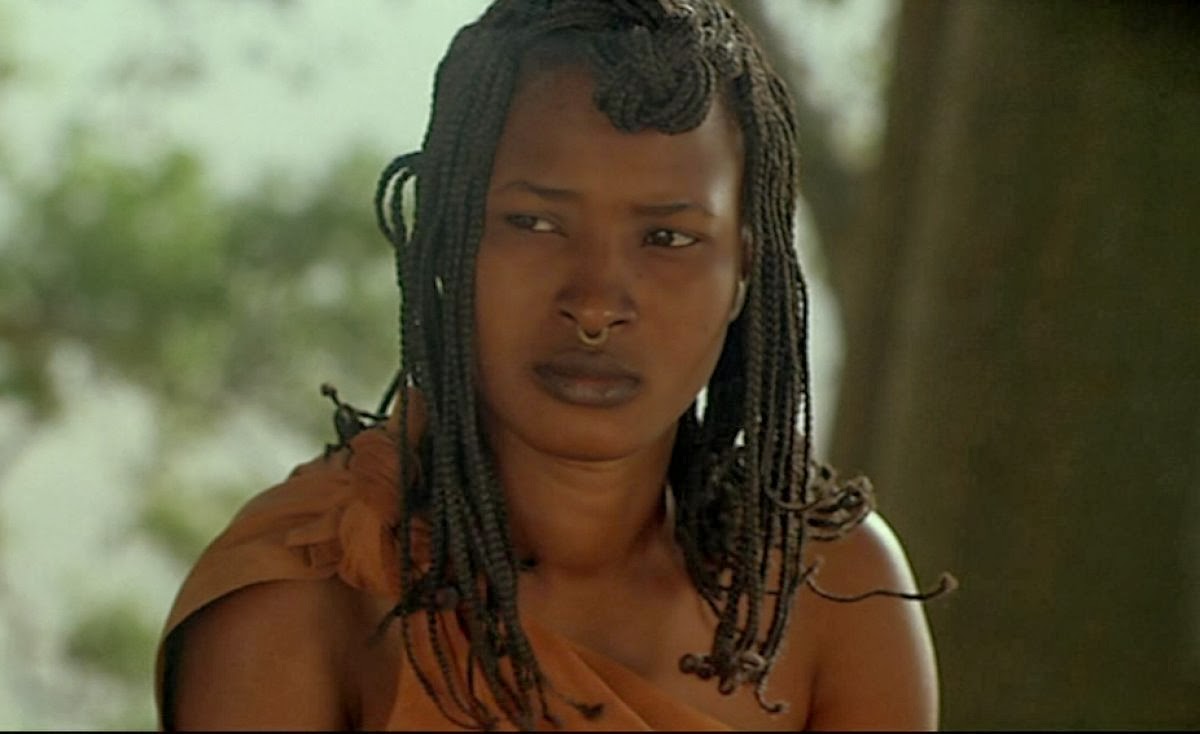
The only place to start is Sembène and his debut feature La Noire de... or Black Girl. I was told, and by now I can't remember if it was Claire or someone else who told me, that Sembène worked at a newsreel production house in Senegal and his station manager gave him the unused ends cut off of film reels to shoot his first few short films and La Noire De... It contains the hallmarks of the decades of African film that would follow. Shot for next to no money it flows beautifully, follows no established rules and it drips with an intense, sensuous fury that cinema had never experienced in so pure a form. Anger and despair characterized so much of living under colonialist rule (French in the case of Sembène's Senegal) and those emotions have been turned into creative fuel and produced some of the best films of all time. The importance of La Noire De... can't be understated. Breathless and Pather Panchali ushered in new eras of cinema for their countries that had groundswell effects on the rest of the world, but they were made in places of great cinematic history. Sub-Saharan Africa had never produced a filmmaker before Sembène, and yet he seemed to understand something about what motion pictures could articulate. Perhaps influenced by his first career as a novelist, he immediately knew how much to show, how much to imply, how to show the inner life of a protagonist robbed of a way to speak. The story is of an African woman who takes a job as a maid for a French family and slowly rebels against them and even today that's a potent metaphor. The film's point of view is still one worth exploring because the issue hasn't dulled. What's worse: most people have forgotten about it. Seeing it for the first time was like hearing The Clash's debut album; this was righteous anger that would never lose its edge or stop being a rallying call of an abused people who will not settle for being victimized. 


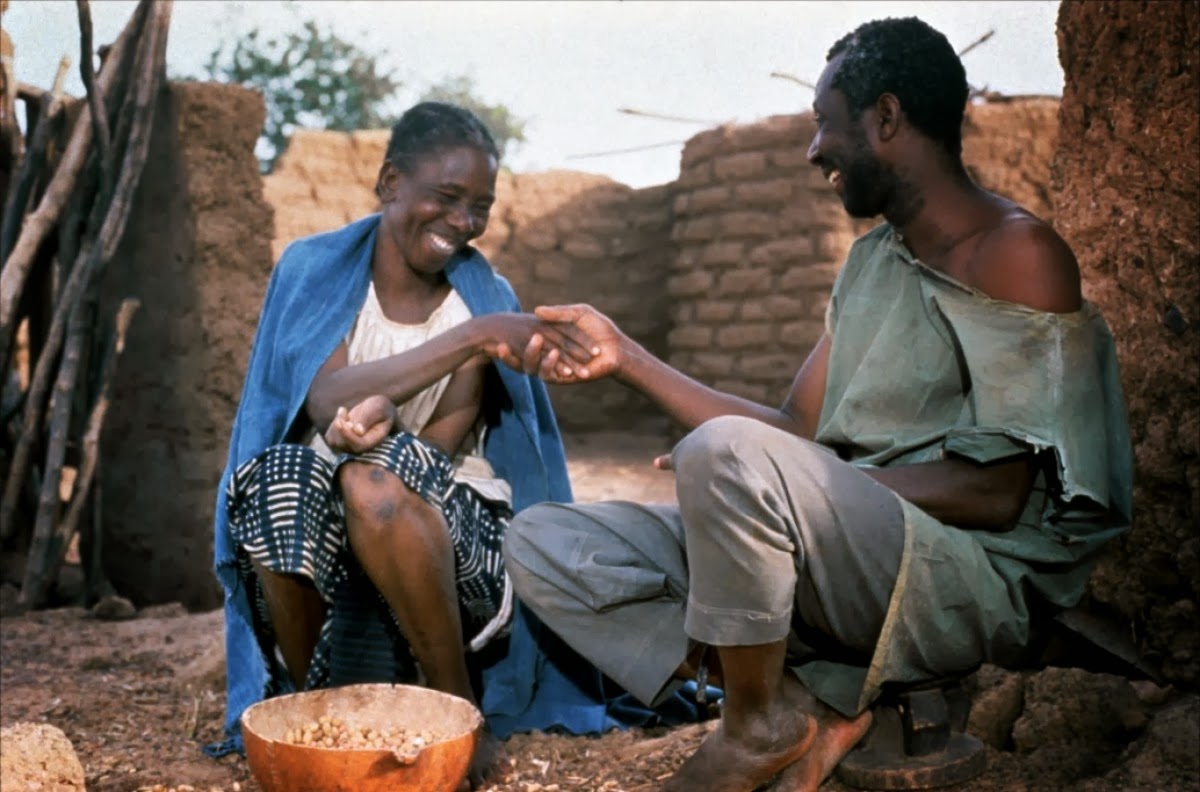
As La Noire de...'s dialogue was in French it could be awarded the Prix Jean Vigo that year for best first film. This and other accolades allowed Sembène to raise a little more money to make hid next film. He chose to adapt his own novel, Mandabi, which became the first film to have its dialogue entirely in Wolof the language spoken by native Senegalese. Despite being in color and on a grander scale, Mandabi's craft leaves a little to be desired. The boom mic is occasionally visible and Sembène's framing is merely functional, but the important thing is that the story moves beyond ambitious into audacious, this time focusing not only on the deplorable behavior of the French but on the greed that infects Africans living in the shadow of European powers. A man tries to cash a money order sent by his son, a street sweeper in Paris, but has no identification that holds up at a French-owned bank so he turns instead to local interests. All the while fortune refuses to smile on him. If Black Girl is anger directed outward Mandabi points it inwardly and proves that no struggle is ever as simple as black and white.

If Sembène was the spark that ignited independent African film, Djibril Diop Mambéty poured gasoline all over it. I've lately been obsessing over the differences between Godard and Truffaut and I think the most important is that for that first decade of their careers Godard spoke the language of cinema, Truffaut was more interested in human behavoir. At best Cinema was Truffaut's second language; his genre hopping never formed a coherent statement. As fun as his stabs at sci-fi, farce or Hitchcockian thriller are they don't feel unified. Godard's language intensified until there was nothing left but words and colors. Truffaut used the cinema to understand his life and his relationship to the world and history. Godard used his life to understand cinema. He was on the inside peeking out at reality. Which is to say that if Sembène was Senegal's Truffaut, then Mambéty was its Godard. The following quote could almost read like a rebuke to Sembène's more earthy approach to drama: "One has to choose between engaging in stylistic research or the mere recording of facts. I feel that a filmmaker must go beyond the recording of facts. Moreover, I believe that Africans, in particular, must reinvent cinema. It will be a difficult task because our viewing audience is used to a specific film language, but a choice has to be made: either one is very popular and one talks to people in a simple and plain manner, or else one searches for an African film language that would exclude chattering and focus more on how to make use of visuals and sounds."

Mambéty's first work was a documentary called Contras' City, which is a fabulous first statement but it isn't until he turned to fiction with Badou Boy that the Godard connection becomes clear. Over a song that mixes afro-beat with British-born psych music, a sound that can only be called cinematic, we see the crew getting ready to make the film we're watching. Djibril makes it clear that whatever the film is about, he's the rockstar auteur behind it. Right from these few seconds it's plain to see that Djibril would never settle for anything less than revolutionary syntax. He used editing as a weapon, deliberately exaggerating details to sell the wretched life of his characters. He also used colour in a way that escaped most of his peers. It's impossible to watch one of his films and not know who's behind the camera. He was Tarantino before the world was ready for him. Badou Boy is powerful even without considering that Djibril was the first person in an entire continent to attempt some of the techniques he employs. One shot begins entirely out of focus before racking in. His lead character jump on the back of a horse like Errol Flynn and races a bus while the sound of whooping and screaming plays on the soundtrack; a tiny send-up of Stagecoach. Africa's first cinematic joke. There are sight gags and choreography that owes something to door-slamming farce. The narrator talks a lot but hardly ever directly comments on the action. The film is all style and attitude. 

When he next directed a feature, the earth-shaking Touki Bouki, these ideas and experiments become perfectly articulate. Every gesture and action in Touki Bouki does not wait for your consideration, it skips right to your unconsciousness and never leaves. Starting with a mugging-by-bullhorn and ending in the heroes' fevered imaginations, the film is not only a dissection of the particular hopes of a generation, but also a director putting his foot down and saying there was nothing that Western and European cinema could do that Africans could not do better. One of the first films restored by the World Cinema Foundation, it deserves to be mentioned in the same breath as Bonnie & Clyde for both its mesmerizing command of form, but also its depiction of a beautiful outlaw couple. By now Djibril and Sembène were arthouse heavyweights, having become been to the Director's Fortnight several times and the film festivals in Venice, Moscow and Locarno, and the time was right for more voices to emerge like Nigerian Oumarou Ganda who was 'discovered' in one of Jean Rouch's documentaries, Michael Raeburn who was born in Egypt and studied in Rhodesia and Nana Mahomo from South Africa. The secret was out. 

History was made at the Cannes Film Festival in 1975 when the first African film was awarded the Palme D'Or. Made in Algeria by Mohammed Lakhdar-Hamina, Chronicle of the Years of Fire was a look at the Algerian War of Independence, one of the first films about the conflict made by a native. The first African film to ever compete in the festival was Winds of the Aures, also by Lakhdar-Hamina, in 1966. Chronicle opens stunningly: a man publicly swears off his homeland, his work, his family and god and swears to go to France and leave it all behind. The credits then appear over hazy footage of the man walking the harsh deserted landscape in the scorching heat like Omar Sharif making his way to Peter O'Toole in Lawrence of Arabia. Indeed the filmmaking most commonly resembles epic makers like David Lean or Victor Fleming (there's even an homage to the famous crane shot in Gone With The Wind just before the final act), with occasional flashes of the kind of gritty stability and confidence that William Friedkin and Sidney Lumet trafficked in. A scene of a wheat harvest could hardly be any prettier and puts one back in Friedkin's Iraq for the opening of The Exorcist. Pans and tracking shots are used to emphasize points both large and small; despite its enormous scale and cast of thousands this is tightly focused filmmaking. The sheer size of Chronicle is impressive, but more so is its ability to find moments both harrowing and touching amidst great landscapes teeming with people in similar circumstances to our heroes. This is one person in thousands undergoing hardship, but Lakhdar-Hamina finds essential humanity to reduce the scope to one powerless man making a life-changing decision. 

Chronicle of the Years of Fire is chiefly about the fate of a tribe of Algerians looking first for a water source and a way out from under France's thumb but more importantly a place they feel they belong. The search for a 'home' is probably the most used theme in African cinema. Identity was strongly developed but colonial powers and in-fighting made living peacefully or land ownership seem impossible. This is what Claire's film, Some Kinda Funny Porto Rican? was about. The Cape Verdian diaspora trying to find a place to live and be together in the US and not always having luck. The point was that home was wherever they were together, not that anyone ever realizes this in time. Chronicle of the Years of Fire is about the tragedy of being a second too late, of a man dying before his family can say goodbye, of believing that the French will finally treat Algerians like human beings, of giving up hope before crossing the next hill. Lakhdar-Hamina is tireless in his depiction of what belief can do to the spirit. Belief in god, belief in a place that can be home, belief that water can be found, belief that anyone has answers to a better life and can lead you to them. 

Chronicles has largely been forgotten as part of history, though its influence is certainly felt in modern films like La Sources Des Femmes by Radu Mihaileanu and Where Do We Go Now? by Nadine Labaki. As of this writing you can watch a badly cropped VHS-rip on youtube but I don't think it ever made its way to DVD. It's mostly referred to as an Arabic movie, rather than African, and many don't seem to recognize it as part of the national cinema. Cannes' inclusion of African films (to say nothing of its only awarding the Palme to North Africans) has been accused of tokenism, which at worst, threatens to undermine the artistry of the directors chosen for inclusion over the years. I personally won't dignify claims that Mahamat Saleh Haroun doesn't deserve to be in competition with outrage. 

If its success lead to the founding or discovery of many country's worth of filmmaking talent then its importance cannot be overstated. After all it wasn't until the 1980s that many countries found themsleves with the means to make movies of any kind. It's humbling to consider that the history of film in some countries is often the work of a single director, as is the case in Botswana and Liberia. To my knowledge not a single indigenous film has ever been made in Malawi. Within the last year the African Film Academy set up a program called Film in a Box, which traveled to four cities and taught anyone who showed up how to write, direct and edit films. The resultant work may well have been the first completed motion pictures in Malawian history. 

Some countries, like Sudan, have a history that has gone almost entirely unrecognized. The country's most famous and respected artist, Gadalla Gubara, filmed life in his country for years and went blind doing it without stopping. Yet his work is rarely ever spoken of or seen. He trained as a camera technician while serving in the British Army Signal Corp and helped film war-time propaganda for the English. He later made documentary film of life in Sudan which was sent around the country to educate his people. He was sent to the University of Southern California by the Ministry of Information and when he returned was placed in charge of the country's only film unit. His documentaries became national treasures and he directed both his and Sudan's first feature film, Tajouj, in 1979 (Good luck finding it). Imagine if your country was full of people who could still recall the first feature film ever made and shown in your hometown. Indeed before the 1980s there appear to have been no major films made in Zaire, Uganda, Tanzania, Sierra Leone, Rwanda, Mali, Nigeria or Ghana. 

It was in the 80s that the African film community begins to find its feet and starts producing great works with something like regularity. In 1982 Gaston Kaboré, a director from Burkina Faso, releases Wend Kuuni or God's Gift, about a mute orphan and the way he effects the lives of the people who take him in. Kaboré belonged to the wave of filmmakers who opened up his mise-en-scene and begin filming communities as characters rather than focusing on individuals, resembling the work of Jean Renoir or even early Terrence Malick. Wend Kuuni is a film that does not judge or, despite its title, deify its characters but instead seeks to put their hardships in context. I haven't seen quite enough African cinema to be certain, but I do know that for me Wend Kuuni is the earliest film that displays organically and uniquely African storytelling, which is to say, stories exclusively about Africans and not outside interests. Much of the filmmaking grammar from here to the 2000s is beholden to no one's influence and in some cases seems sui generis. Djibril's films spoke with verve and immediacy, but they did feel indebted to European, specifically French, cinema even if only in opposition to them. Wend Kuuni feels like a movie made by someone raised only on an African mode of storytelling. David Edelstein once described Renoir's direction as 'non-judgemental', and that to me is the most important characteristic of African cinema in the 80s and 90s. Whatever damage the outside world can do has been done and Kaboré's characters are trying to live and let live. Their dreams and conflicts are modest. What feels most refreshing dramatically is that characters only punish themselves; no outside government or force is responsible for the ill-starred destinies of the heroes. Wend Kuuni focuses on a village and a way of life that is self-contained and self-sufficient, which means that yes they cause their own problems but they are in thrall to no one. Not only does the film only converse with African narratives but it only shows the lives of independent African people. There isn't even a token agent of law enforcement - the action here is strictly rural and domestic transferring from family to family and community to community, stripped of the urban environments of Djibril and Sembène. 

Of course one could probably read the slightly oedipal father-son relationships that come to dominate African films (specifically, as we'll see, in Yeelen and Tilaï) as a statement about colonialist powers, and I think the texts support that, but it's just as powerful to watch the films as evidence of a society artistically freeing itself of its most painful memories. What stronger message is there then to not mention the global superpower who set the agenda for so long in your country? Now, clearly, this was not everyone's choice, but those who did were being unfathomably bold in telling stories the rest of the world might not be able to understand. But these were the stories and traditions that had endured, and they would prove not just captivating, but inherently cinematic. Unsurprisingly the photography in films around this period has a particular kind of charm, showing off the land as the almost majestically unsoiled feature that has supported people through the best and worst parts of their history. The relaxed pans across landscapes and hills and fields allow you to gain perspective on the lives of characters as much as any piece of dialogue. Those are the windows into the culture that the scripts stop granting you and frankly you don't need anything more. The stories are gripping enough without a primer on life in another country. 

This is nowhere more proudly showcased than Souleymane Cissé's Yeelen or Brightness. As I've mentioned, African cinema has some of the most audacious and attention grabbing opening moments in history and Yeelen takes the cake. In an expressionistic montage we see a man cause a chicken and a great monolothic stone to catch fire through some kind of spell, only to realize we're seeing it as told in a vision to the man's son. It's breath-taking and like the rest of the film shows an unprecedented command of detail and rhythm. You could carbon-date the effect to something like Andrei Tarkovsky's The Sacrifice from the year before but Cissé's film doesn't sink under the weight of its own portent as that does. It breathes and moves with the joy of discovering new forms and playing with them. Yeelen tells the story of a young man named Nianankoro whose father wants to hunt and kill him because he has left his village and taken the secrets of a form of sorcery with him. His father, Soma, sees it as betrayal and after getting approval from a high council, seeks his son out for a fight to the death. 


Yeelen is a film that succeeds on macro and micro levels. It's loaded with heavenly little details, like a scene of Nianankoro's mother bathing in a river, aware that the two men in her life are destined to kill each other. The water takes a strange white colour against the eerie blue of the night sky. Later when Soma visits the council of elders, they greet each other by singing and their speech has a beautiful timbre that makes their conversation sound like arresting multi-part contrapuntal harmonies. And then there are simply stunning shots of Nianankoro fleeing across the desert. Those little successes make it so I could have waited hours for father and son to meet. The film has but one bum note: a needless special effect shot of a levitating object that slightly overreaches and spoils the mood. Beyond that, Yeelen is the kind of movie I could watch every day and never tire of its gifts. 

Continuing both the theme of hostile patriarchy and moving at the same pleasing rhythm is Idrissa Ouedraogo's Tilaï or The Law, another film set in Burkina Faso. Tilaï follows a man called Saga who returns to his home town after a few years away and discovers that his father has taken his intended as a second wife. The woman he loved, Nogma, is now his stepmother. He will not re-enter his village and builds a hut just outside its limits as a form of protest. It isn't long until Nogma and Saga pick up their affair and major complications arise. As in Yeelen the drama feels like something out of myth or legend and matters far less than how Ouedraogo captures the way his characters express sadness in their faces or walk for miles alone. Saga, Nogma and others travel great distances to meet their fates and in these treks allow us to see the way the land shapes their lives (aided by a transcendent score by legendary jazz musician Abdullah Ibrahim). As they walk apart from the judgment they face in the pockets of civilization waiting at the edges of the open plains, we see who they truly are. 

Unfortunately, Ouedraogo turned into a much more conventional filmmaker. Compare the timeless quality of Tilaï to the sturdy but far more dated approach he employed in 1997's Kini and Adams, which played in competition in Cannes. The more interesting film is immediately evident. The worst thing you can say about Kini and Adams, a Zimbabwe-set dramedy, is that it's unremarkable. It's an ordinary piece of filmmaking that holds up against any major American film that year (it's often hilarious and it's even in English) but between displaying none of the strengths of his early work and featuring a bitter misogynist subtext it's not a great entry into the national cinema or even Ouedraogo's canon. It hardly feels like the work of its director, let alone someone intimately familiar with provincial life in Zimbabwe. 

The flipside of the narrative coin, those films that looked openly at the wounds opened by European oppression, is best represented by Flora Gomes of Guinea-Bissau. His debut, Mortu Nega or Those Whom Death Refused, missed being the first film made in Guinea-Bissau by one year, though it's certainly the best remembered. Though ostensibly about a handful of soldiers fighting the Guinea-Bissau war of Independence, a ten year struggle by the natives to force the Portuguese out of the country, it is also about the importance of cultural preservation. If it has a stylistic kinship to Yeelen and Tilaï, it also implicitly stands as an act of defense for the development of that style. Mortu Nega is about the future of Africa and that there can be none without the philosophies and stories that its people hold dear. I think it's safe to add filmmaking to the list of indigenous artistic expression that strengthens regional, national and continental identity. After all, what more accurate way to represent its people?

An example of a counterpoint can be found in the cinema of Haile Gerima. Born in Ethiopia, he moved to the United States, studied film at UCLA and became a member of the LA Rebellion film movement which also counted Charles Burnett and Julie Dash among its members. Though he returned to Africa to make movies the film he's best known for, Sankofa, is characterized by an LA-bred slickness; everything a little too perfect and musical for its own good. The suffering it depicts feels at a remove from the aesthetics, which at times recall an exceptionally well-directed music video (which is not neccesarily a bad thing - its points are never less than entirely clear). The story is important and the narrative - that of someone being sent back in time to endure the worst of slavery - is recycled often because it's an incredibly powerful idea. There remains, however, a distance between the language Gerima uses, feeling much more the work of the African American artists of the 90s than the African filmmakers of the 80s. There are fewer rough edges and an inessential tightness that calls too much attention to itself, not unlike like the predictable story beats in Kini and Adams

The development and reception of African cinema continues to evolve into the 2000s, but first it's worth breaking for a bizarre footnote. With the distribution of betacam and other pro-sumer video equipment, a group of filmmakers in Nigeria began making and distributing cheap, incredibly raw genre films at a rapid clip. With the advent of digital and the availability of cheap DVD production at the turn of the century the production speed increased. This industry, often referred to as Nollywood, is driven by totally insane little films directed by people raised on a steady diet of Hollywood romance, Rambo and The Road Warrior. There are flourishes you won't believe. For instance seek out the trailer for a film called Paint My Life, a sort of Tyler Perry-esque melodrama about the mentally unstable daughter of a politician wreaking havoc on every man she meets. A minute into advertising this truly odd film, filled with savage beatings, murder, seductions and much screaming from its female lead, the title then appears in the same font used in all seven Harry Potter movies! There is no predicting what these movies and the guys with the cameras will do next. They not only outpace hack units like The Asylum and Roger Corman's New Horizons Pictures (in fact the Nigerian film industry has the second highest productivity rate in the world, above the US and just under India) but also brim with anarchic creative spirit that both want for. For further proof I suggest looking up Baby Police. It might change your life. 

Just as the old guard began slowing down their productivity or passing away (Djibril in 1998, Sembène in 2007) a new school of filmmakers emerges all over Africa. These directors traffic in their own version of what AO Scott calls neo-neo realism: a patient staring down of lone men and women trapped by uncontrollable events, often with political underpinnings. Long takes that slowly unravel the exteriors of their harried protagonists were the preferred method of filming. If you turn this style up to 11 you get what some critics call Slow Cinema. Lav Diaz from the Philippines, Jean-Pierre & Luc Dardenne from Belgium, Lisandro Alonso from Argentina, Nuri Bilge Ceylan from Turkey, Tsai Ming-liang from Taiwan, Cristian Mungiu from Romania, Sergei Dvortsevoy from Kazakhstan, Kelly Reichardt from the US, Apichatpong 'Joe' Weerasethakul from Thailand and dozens, if not hundreds, of others rose to the forefront of world cinema in the mid 2000s. The movement proved such a ground swell that in the first decade of the 21st century, Mungiu, The Dardenne Brothers and Joe all took home the Palme d'Or at Cannes. Two-time winner Michael Haneke could be said to be on the borderline of this approach, but that's a controversial notion I won't fully commit to. The African directors who took part in this movement, Abdellatif Kechiche from Tunisia, Abderrahmane Sissako from Mauritania, and Mahamat Saleh Haroun from Chad, bring our story up to today.

Each director has distinct handwriting, but they undoubtedly were influenced by the global move toward objectivity; a reaction to the formulaic narratives and uniform craft that had seized control of cinema in the mid-to-late 90s (Sissako even nestles a fake western starring Danny Glover and Palestinian director Elia Suleiman in one of his films as a rebuke to dominant cinematic convention). The best moments in their films are about careful, sometimes painful observation. My favourite moments in Sissako involve watching a woman teach her daughter how to sing traditional songs, or seeing how life goes on while a monumental trial takes place in a small village in Bamako. In Kechiche, the most active with his camera, my favourite moment involves watching Hafsia Herzi belly-dancing while all around her, in and out of her sight, people have extreme physical and emotional reactions to a changing culture. In Haroun, it's a conflicted man watching his son being arrested by the military for enforced service and being unable to do anything about it. The hallmarks of classic African cinema are present (a knee-deep approach to culture and custom, splendid use of the landscape, fractured parent-child relationships, old world vs. oppressors, the depiction of community instead of merely the individual, urban vs. rural environment) but it's filtered through a new set of aesthetic principles that puts them in touch with a global community of filmmakers, all evolving and finding new paths simultaneously. Just as, say, Pablo Larraín evolved by reverting to VHS and tackling a true story, so too has Kechiche by making a historical epic and most recently a sexually charged coming-of-age story. That film, Blue is the Warmest Colour, became the second African film to win the Palme d'Or at the 2013 Cannes Film Festival, beating among other films, Gris-Gris, the latest by Haroun. If nothing else gives me hope for the continued success and exposure of African cinema, it's that victory. When these films premiere in the US and Europe in the next year, it might just propel people to seek out more films from a history that too little is known about. 

Or who knows, maybe it'll be the continued success of a young director who makes sci-fi epics named Neill Blomkamp. Born in South Africa and thus far the director of the massively successful District 9 and Elysium, Blomkamp couches his big budget actioners in deeply angry political subtext (shades of Mortu Nega and Chronicles of the Years of Fire) and, if you look carefully, a touch of Sub-Saharan grammar. From his earliest short films, including test reels for an aborted adaption of the video game Halo through to Elysium, you see a lackadaisical approach to carnage and mayhem that at best recalls the touchstones of Burkinabé cinema. Look first at the fact that his frame is constantly bustling with activity, evidence that a community will continue living no matter what the action of the film depicts, a theme visible as early as La Noire De.... His appropriating old genre grammar, and indeed even dabbling in found-footage and fourth-wall breaking puts me in mind of the young Djibril Diop Mambéty and those opening shots of Badou Boy. Then there are the mismatched heroes, the confident foil to the bumbling dreamer, a dynamic first found in Touki Bouki and seen again in the likes of Kini and Adams. Indeed as Sharlto Copley's hero in District 9 finds himself in worse and worse trouble I can't have been the only one imagining the poor sap in Mandabi losing hope fast. Or could I? Maybe you should all go watch some early African cinema and tell me if you think I've gone crazy. If nothing else, you'll see some great films. 
Update (1/4/25): Turns out I was wrong about Neill... 

The '68 Comeback Special: Grazie, Zia

As David Cairns and I have been highligting the films of the '68 Cannes Film Festival, I was wondering which of us would hit upon a true disaster first. Turns out, that would be me. I try, always, to find something likable in even the most detestable works of trash (I am a card-carrying member of the Joe D'Amato fan club, after all), and Grazie, Zia came close to defeating me. It starts with the cartoon intro. An insidious pop song with a shrieking girl chorus plays over too-loud drums while an impish, exaggerated cartoon avatar of wheelchair-bound hero Lou Castel races around the credits against a backdrop that suggests Hanna-Barbera approximating Laugh-In for even less money than they typically spent. Then, before the song has played for an entire verse, the other music comes in...the somehow even-more-saccharine Ennio Morricone piece that will pop up every six or seven minutes from then on to remind audiences to feel something, anything! The soundtrack tries for innocence or insouciance and comes off cloying and obnoxious, which might be fine except it never. Fucking. ENDS! 

Once we've gotten enough of that piece stuck in our heads, against all odds the pop song then returns for another few bars. The first image we're treated to when the misguided titles have stopped flashing? Lou Castel writhing in pain during electroshock treatment. The movie might have been intended as a joke, a pop-art cartoon satirizing the idle rich, but Castel has not been let in on this joke. He injures you with his screaming, and no amount of mock playfulness can hide the torment he's going through. The movie hasn't started and it's clear that with Salvatore Semperi, we are in the hands of a truly sadistic director, someone on par with Michaels Bay or Winner. 


The trailer below is important because it gives you a sense of everything that goes wrong. There's the focus on the breasts and vaginas of humiliated, sad women over faces or dialogue (no subtitles, but believe me you don't need them). Castel freaks out like a petulant child, not like someone plagued by massive internal conflict. You'll see the editing attempting to forge some coherent tone or shape. You'll notice not only the grating pop song from the credits, but towards the end that deathless Morricone tune that plagues the soundtrack like a rash it can't shake. The accidental glamour of the players. The pigheaded image-making and the overbearing, unattractive confidence. Watch this so you might be spared the whole ugly picture.

In its defense: a performance from Lisa Gastoni that's so good it doesn't seem possible she gave it. This from the pin-up girl from the Gamma One films? She drips with a unique melancholia, at once sad, neglected, conflicted, rich, empty and powerless. Her intended doesn't appreciate her fully and Castel (playing her nephew) does, but in a deeply upsetting way. Which makes her feel worse? Semperi tries to undercut her at every turn by disrobing her and making her purely an object of lust whenever it suits him, but she evidently sensed she might never get another shot at heavy-lifting like this and never does anything less than awe-inspiring work. I don't think she was ever as beautiful on screen and she certainly never commanded the frame in this way, her dark eyes effortlessly pulling you in. The script makes a hash of her character but she's better than the material. Of course she'd almost have to be as Grazie, Zia feels like a fratboy power fantasy (a rich boy seduces his appealing older, unfulfilled relation) rather than the scathing social commentary it wants to be. 

Also in the film's corner: Lou Castel. Any film with Castel is interesting enough to watch at least once. Don't question me on this. It's a fact of science! This film's biggest misstep? Putting Castel, a live wire who so ruthlessly grabs your sympathies in Fists In the Pocket, in a wheelchair. Not only is he stuck delivering warmed-over political-ish dialogue (for all his fuckery, his character doesn't actually seem to believe in anything), he can't even stand up and walk away, let alone explode with anger, run around or hide in shadow. Everything that makes Fists in the Pocket seem like a revelation, something both outside of and in the guts of the time that spawned it, are why Grazie, Zia feels totally inessential and useless. It wants to have thought of the conceit of Fists in the Pocket first, so rather than be subtle about its apocalyptic implications it saws them off like shotgun barrels and begins blasting up the place like William Holden in The Wild Bunch. Its overt politics are second-hand Godard but rather than playful and knowing they're childish and snide. Godard, for his part, had said everything he could by 1967 in a completely oblique fashion that plays as subtle if only because it's wrapped in thirty layers of text, subtext, supertext, metatext, megatext and context, then chewed up and spit out for our second digestion. When you reach 1965, you feel permanently a step behind him; not always a good feeling. How do you fully enjoy something that feels like it was deliberately not made for you? Grazie, Zia is even further behind that. Worse still is that all its best elements and style are begged, borrowed or stolen. 
Nothing is explained, up to and including everything Castel, Gastoni and her fiance Gabriele Ferzetti do, say or feel. Everything in Grazie, Zia simply happens because Semperi had seen these things happen before in better films and that was motivation enough. Lou Castel is here as a man who wants to murder his family because he did the same thing in Fists in the Pocket. This has the effect of making him seem like he survived that film and found a new family to terrorize, rather like Patrick Vive Ancorra only, needless to say, far less fun. To waste Lou Castel is criminal. To make him borderline slappable is unthinkable. Rarely are actors so impossibly fascinating. He twitches and sparks fly. Semperi relies on this to make his film compelling when he isn't lifting devices wholesale. Pop music appears because he'd heard it in Masculin Féminin, La Chinoise, L'Avventura and L'Eclisse. The framing and contrast are right out of Bellocchio's China Is Near. The relationship dynamic between Gastoni and Castel is straight out of Bertolucci's Before The Revolution. To add insult to injury, Semperi boosted Revolution's cinematographer Aldo Scavarda, (who, along with Ferzetti, is a hostage from L'Avventura). Even worse, if clearly a coincidence: Bertolucci is now actually confined to a wheelchair due to health problems, as if Semperi wasn't content with stealing from him and took his health while he was at it. That's how powerfully awful this film feels. The editing becomes crisp and angular just as Castel reads a Diabolik comic, suggesting the serialized work of Franju (rather than Bava - Semperi would have needed an actual sense of humour to crib from him), whose work we suddenly feel we're watching second-hand, as if Castel had found one of his films while channel surfing. The political subtext makes the film feel like like a forerunner to Animal House and Revenge of the Nerds about bringing the wealthy elite off their pedestal. Except that Semperi acts like one of the cardigan sporting villains from those movies, looking down on everyone with equal, unearned contempt. It's Snobs Vs. Snobs, and no one wins. As soon as I saw the game he was playing I began joylessly waiting for the incest I knew must surely be on the way, pining for the overblown and misguided La Luna. I knew anything that Bellocchio and Bertolucci flirted with, Grazie, Zia would mount like a drunken coed playing truth or dare. Every Cannes has a dud or two. If only this had been the lone misstep in the 1968 line-up. Unfortunately, greater crimes await us...