Showing posts with label Alain Resnais. Show all posts

The 68 Comeback Special, The 68 Comeback Special


Over at Shadowplay you'll find David Cairns on the rather good, always beguiling Je T'Aime Je T'aime, by Alain Resnais. Resnais' Modus Operandi always resembled a failed experiment in time travel (this is what made him so good), so it makes sense that he'd actually make a film about a time traveller. If it never reaches the highs of Marienbad, Providence, or Hiroshima Mon Amour I think it's because he imposed rules and a structure on himself, which hems him in just a hair too much. When the '68 Comeback Special draws to a close I might revisit this fascinating work just for fun. But go and enjoy David's take on the film which is typically fantastic! And participate in his erotic questionnaire while you're at it. 

White Epilipesy and the 21st Century Problem

Leos Carax was back in New York not only ago, in discussion with Richard Brody about his movies. If anyone can offer an atmosphere condusive to Carax's interview phobia it's Brody. Both men appear to be on the same wavelength, defined by a reverence for cinema unrivaled by most. Across town at Lincoln Center a few days prior Carax's evil twin Philippe Grandrieux was in town with a new experiment to lay on our unprepared brains. I've written before that I think that Grandrieux is the best filmmaker alive; his last four features standing as testament not only to his unique powers as a director, but the very boundaries of cinema and a cinematic experience. Since the start of his feature filmmaking career, his work has just gotten stranger and more beautiful. He's slowly evaporated his narratives, turning them more and more elemental and bare; just enough to get from one end of a sensory journey to the other.  His latest and second in the span of a year is his aesthetic purified of all narrative. The beguiling White Epilepsy has no plot to speak of. It's a straight-up experiment and thus doesn't fit so neatly in his ouevre. His previous work, the documentary Perhaps Beauty Has Strengthened Our Resolve - Masao Adachi was very clearly his work, even if it told someone else's story. No one else sees the world the way he does. And as he now always holds the camera himself he is presenting a view of the world that is as close to how he sees things/how his brain translates the relationship people have to their environment as possible. The world may not appear as washed out mini-dv with high grain and contrast, but I have no doubt that this is what his brain makes of it. His films seem projected from the very recesses of his sensory perception. If it fails, as it has to many, it's because there is no reprieve from his vision this time out. No story of character to comfort a viewer adrift in this hopeless, dark landscape of primal instincts. I can't say I enjoyed this as much as his other work (it stands just above his debut doc Retour à Sarajevo, another journey with no parameters), but I wager few other films will occupy my mind the way this does.


It's purely an immersion, after your eyes, ears and unconscious mind. It doesn't go for the tactile the way Tom Tykwer might, or touch, smell and taste like only Cate Shortland can seem to. It's about presenting visions that seem to want you to look away. The motion of the bodies on display, already deliberate before being slowed in post, is there to play games with your perception of what's really in front of you. Their shapes merge like optical illusions. Strange designs and patterns appear in their skin as if drawn on by computers. Their fists seem to seamlessly penetrate their skin as if merging into the same form. But is any of that imagined shapeshifting real? Can't be, right? Grandrieux doesn't use digital post. Or anyway, he hasn't in the past. There's something pure about his vision (an acceptable purity I associate with Tsai Ming-Liang) that precludes the thought or even the notion that he'd fuck around with green screens. He tricks you the hard way, by simply showing you images, faces and bodies in the most extreme conditions imaginable. He shows them in forms so abject and close-up, they're barely recognizable. And he's playing the same game here, so it doesn't seem right that he'd deliberately write something in the veins of his actors. Not when they've gone so far into character; they've committed to their very bones. Yet it also seems wrong that I saw his female performer's navel appear to invert before my very eyes, but the image below confirms that I didn't imagine it. But is it real simply because it's there? As a work of hypnosis, something akin to Nolan's shared dreaming or the audience gathering to sleep in the opening moments of Carax's Holy Motors, it works splendidly. Indeed my perception of the film has shifted so much since watching it that I feel as though it put a spell on me and the effects still linger. Manoel De Oliveira and Alain Resnais produce this same effect, especially in their latest works, Gebo and the Shadow and You Ain't Seen Nothin' Yet, which tellingly do manipulate their environs through digital effects. Their characters and spaces are frequently unflinching, forcing our brains to move them and see more in them. But I believe they encourage viewers to drift off, to sleep and let dreams enter the equation. My girlfriend and I both nodded off for a brief second during Gebo, which only intensified the experience, and allowed us to leave the confines of the set and into the unreal world outside that Oliveira created. One of my greatest cinematic memories is of seeing Resnais' tricksy epic Stavisky at the Harvard Film Archive, a place I have the fondest memories of (I saw the bulk of Grandrieux's films there). My friend Laura and I went on a frigid night in January and as Resnais began holding up more and more mirrors to the story and its characters, beautiful streams of information flying all around us, we both drifted off and began dreaming along with the movie. We both woke up a few minutes later. It was more like communion than a simple viewing. It's more than a film and more than a dream. I fell asleep during my first viewing of David Lynch's sublime, final film Inland Empire, and upon awakening couldn't determine what was real and what was in my head. I can't help thinking this would please the man. It felt like tapping into the film's dreams. Takashi Miike says his favourite films are often the ones that put you to sleep. I think he's got something there. What are films but dreams we're awake for? Awake in the dark, as Roger Ebert put it.

The devilish thing about film now in the hands of masters like Resnais and Oliveira is that they've had time to consider the change. They put great deals of energy into how to use digital to their advantage, rather than simply adopt it. In their latest films, they go out of their way to prove that environments can become anything through digital manipulation; their landscapes are imaginary, as deep in the brain as memories. In Gebo and the Shadow we see a young man imagined by his family, standing alone in an imagined tableaux. Nothing but the boy is real. Similarly once the characters in You Ain't Seen Nothin' Yet begin taking part in the drama they see onscreen, suddenly the world they actually inhabit becomes a green screen-aided studio set where a train can come by at any moment, killing an offscreen character. Anything becomes possible. When we dream, we can suddenly not imagine anything outside the realm of possibility, because they've taken away the safety of the concrete image. Grandrieux and Carax do the same but through rather less obvious means. In Holy Motors, Carax deliberately goes into a green screen studio to pull back the fabric of reality and admit that nothing could be real, but then sticks to the truth of an image he can actually provide. The trickery from then on is all in make-up and practical effects. Carax believes in the image's power, but knows it can be tainted, brings us right to the brink of the uncanny valley showing us its grotesque imitation and abandonment of the reality of the image and then retreats. Cinema and the purity of the image can no longer be trusted and so Carax's brand of cinema (frames so carefully chosen that they burn into your memory, as if your brain were celluloid and silver halide crystals) is now up against the challenges of the 21st century. Anything can be faked, so what's real? What was ever real? Grandrieux, Resnais and Oliveira are all masters at imprinting memories outside of the image in the mind of their viewers. They confront the 21st century problem by figuring out ways to say more than can be written. Is White Epilepsy really as simple as I recall the experience being? Or is it a devastating treatise on the conflicting instincts of the body vs the mind's search for order? It's probably both and if success is measured in what we make of the piece after it's done, it should be called one, even if I have no aching desire to rewatch and better understand the thing anytime soon, a first since Sarajevo.


 Weirdly, the film that I couldn't help thinking of a sort of analog, at least presentationally, was Peter Jackson's The Hobbit: An Unexpected Journey, the sort of thing Carax so eloquently dismisses in Holy Motors. The facts of their creation: The Hobbit was shot in 3D at an unprecedented 48 Frames per second, a most unusual and supposedly groundbreaking format. White Epilepsy is shot in the same kind of lowlight that 3D unintentionally produces and in the slender frame usually associated with videos shot on an iPhone. These are two different acceptances of modern technology. The Hobbit came after an unsuccessful attempt at a new genre and was viewed by most critics and fans of the director's past work (though not necessarily fans of the idea) as a major comedown from the remarkable achievement of the first films in the series. White Epilepsy is a return to the experimental form of its director's three greatest successes after a diversion into documentary, and is seen by many as something of a comedown. The difference is that The Hobbit's changes have zero to do with the skills of its director, and everything to do with how we view them. Peter Jackson shows no overt signs of being a better director because his juggling of elements than when he took on the original Lord of the Rings films, so The Hobbit will play as stagnation to those who expected progress. In fact, to some it was viewed as devolution. By contrast, White Epilepsy is purposefully a devolution from narrative to simply a single event. So it is engineered as a comedown, in essence, even if I'm sure Grandrieux didn't make Epilepsy to be compared unfavourably to his other films, he was also very clearly following his mind to a place where his entire toolkit as a director was not needed or entirely welcome. The question that most interests me most now: which of these artists was taking the greater risk?

Last Year at Marienbad / Carnival Non Drôle


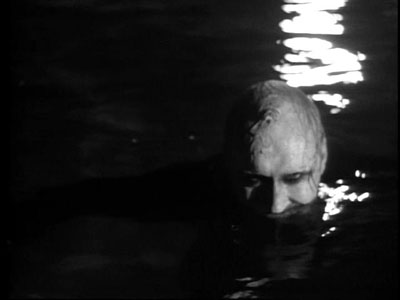
There is only one other movie that comes close to resembling Last Year at Marienbad. Last Year, directed by Alain Resnais in 1961 is about a man stuck reliving a memory differently as he tries to explain it to a girl (time and reliving mistakes, was Resnais great obsession). He's in love with this girl and tries to make her remember their time together. As he recalls it, he remembers the scene differently each time and soon the versions of the story begin overlapping. People drift from one evening to another, different clothes, same dialogue and events. All the while the man's pleading voiceover mixes with an almost perpetual organ score. The organ plays even when violins are played by musicians onscreen, making flesh the frustration at the heart of the story. It won the top prize at Cannes, and with good reason: there hadn't ever been anything like it. There is only one movie that has since come close to its haunting, dream-like, angst-ridden feel: Carnival of Souls.
As far as markets, personnel and reception are concerned the films are as close as an orange and a buffalo, but, in the reels lie similarities strong enough to make someone mistake them for brothers (albeit one elegant, the other deformed and awkward). They both feature characters stuck in a world they cannot control, alienated by the forces closing in on them, trying to probe their mind for some meaning to their suffering. In Last Year the stranger has his thoughts twisted and doubted by the woman he loves. He tries desperately to make her see that she too, once, distantly loved him as passionately as he did. The memories are clouded by thoughts of her rejecting him in the past, present and future. Carnival of Souls follows a woman for whom every aspect of her life is uncertain: she survives a car accident in which, it seems, all of her friends have been killed. She moves to a strange place and is menaced by a spectral face everytime she is alone. The people in her everyday life are intimidating and make her feel uncomfortable to the point where she doesn't feel a part of the living world. Both films have people wandering in and out of time and space. Both have a haunting face that disrupts their mental stability (Herk Harvey, our strange shadowy auteur, in Carnival; Sacha Pitoëff in Marienbad) and leads them into the darkest realms of their soul. Both films would have had to have been labours of love for their directors: Herk Harvey made only one feature length film in his lifetime and Carnival of Souls is a very pronounced vision; I say the same of Resnais simply because Last Year at Marienbad is such a strange goddamned film. Who would spend the six weeks shooting the same scene ten or eleven times over, only to lose most of the footage on the cutting room floor and have a gothic whirlwind of anti-baroque moodiness to show for it? I hope for his sake that he knew what he was doing.

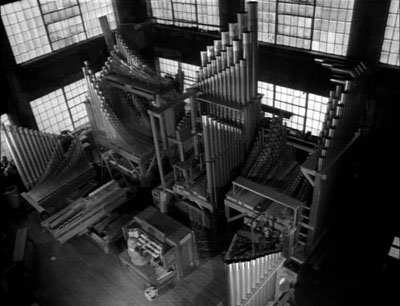
The final thing that binds these films like split embryos in a womb is the soundtrack, oh yes, the soundtrack. The only music we get from either of these films is non-stop organ music. Wailing, noodling, aimless, screaming organ music from frame 1 to frame ∞. This can't be an accident. Harvey went so far as to make his heroine a church organ player; when's the last time you've seen a movie where someone goes out of their way to take a job as an organ player at a church no one is ever seen entering? Both of these men knew something and organ music was part of the plot. Personally, I like a violin or a tuba every now and again. Not these two. It's pipes or bust. Now of course Resnais had much else to represent his style and vision as a director (I highly suggest Hiroshima Mon Amour, it is the Frenchest movie of all time. And of course, a blinding masterpiece of eroticism and loss), but Harvey only had Carnival of Souls. This means that both men thought highly enough of the idea of gloomy tales of alienation to pour a hell of a lot of effort into making them. For all my jaw-clenching, these are original movies and were made by men with vision, which is more than most films can claim. Resnais was obviously rewarded more than Harvey (ed. Now both films share a Criterion DVD sleeve. Though Harvey beat Resnais to the punch by about four years).

Personally, I can't decide which one I liked better on first visit. Last Year pulled ahead lately, but you have to admire the purity of obscure vision from both films. As far as motivating ideas and atmosphere go, Harvey and Resnais are just about even in my book. Composition: Resnais wins by a mile with his nods to the geometric avant-garde films of the 20s in the garden and every sweeping run over the exquisitely crafted, but soul-crushing hotel corridors. The images themselves say as much about the facile arrogance of the rich and so it is clear that Resnais had the more hyper-active brain. The shapes and contrasts, the beautiful shot of the hotel alone at night. He had ideas about relationships other artists have never touched and his movies are a testament to the wonderful mind he's still putting to use today. Harvey had some wonderful compositions and I can't help but wonder as to whether he was a misunderstood genius or a creepy amateur with a whole lot of luck. That Harvey achieves a number of truly awe-inspiring shots is to his credit, but his background gives me pause in my appraisal of him. I've seen his other work, as a maker of educational/safety shorts, and clever though they are, they aren't exactly early Kieslowski either. One can't deny that these are unique; those great expressionistic shots of the organ; the silhouettes outside the theme park; Candace Hilligoss's hair deserves special commendation for being so photographable; the dance of the ghosts; the walk through the empty town; the infamous face. He really makes a showing of himself. He, like Russ Meyer, is one of the few men who have provided people with something else to look at other than the thing they've paid to stand in front of the camera. Intention is another matter, but such is the burden of the cinephile. Our reward is to be able to bask in the wonderful enigma of a case such as this and have both texts at our fingertips.

Both films undeniably served as an influence for The Shining. And for that we can all be thankful.

Teorema


Pasolini was what you might call a film theorist. Or anyway, that's what he called himself. No, more important film theorists came before and after him. Lars Von Trier, Peter Greenaway, Alain Resnais, Jean-Luc Godard, Ingmar Bergman, Paul Schrader to a certain, oft facile extent and certainly Tarkovski. Maybe Masahiro Shinoda. None of them is a perfect example, but if you've seen enough of their work you get my meaning. It deserves some more thought.

Film theorists, as Pasolini would like us to believe, are not people who concern themselves with plot specifics or reasonable character archs, but directors who manipulate both for the sake of proposing something greater. Teorema, the first movie where this was put into practice for the first time in 1968. It stars Terrence Stamp as a gorgeous divine force who seduces an entire family, even the maid, and then leaves. Their reactions are all different but it is only the maid, the sole member of the working class, who actually benefits from their encounter. Pasolini never said whether or not Stamp was supposed to be god or satan but it hardly matters. He is of some other realm and wields a great and terrible power. His desire to be a theoretical filmmaker was really part of a greater identity crisis that stemmed from a deep hatred of himself and the world that created him. He felt it desperately unfair that he was destined to be a wealthy artist while millions were poor and died. That's why his films were initially neo-realist in nature, he wanted to show the world what poverty and religion were doing to the people of slumland Italy. Prostitutes and hustlers were his people and he pitted them against priests, the law and the idle rich. Religious idolatry was another specialty of his. He wasn't satisfied telling the truth, so he left that behind and began his quest for spiritual satisfaction. He failed by his own admission. He did however get the wheels in the head turning like with his notions of theory. And so something else emerges - film as an idea rather than entertainment. Which is fittingly an Italian notion as they also pioneered the practice of making entertainments that weren't entertaining. Anyone who says they enjoy Late Night Trains, is, I'm afraid, lying. Teorema doesn't seem designed by someone out to assault you with aesthetics, yet its beauty comes through anyway, rather like a Bunuel gutted for speed. He uses shorthand like Terence Stamp and volcanic landscapes. You could mistake it for entertainment or surrealism, but it's something more and less. It's been covered many times since, because it is in essence, the perfect arthouse idea. The consequences of the visitor on each member of the family is where your new artists (Joe Swanberg, Takashi Miike) get to add their new coat of paint. In rejecting conventional narrative, and even his usual mise-en-scene, he created a whole new way to frame ideas. The world caught on eventually, but by then Pasolini was dead, killed by the very people he had set out to glorify, a rebuke to his own theory, having tried to walk among another class and failing to change them, only those who were his peers - other artists. Roberto Saviano quotes him in his book, the impossibly gripping Gomorrah, and it's clear that though many of us will forever be touched by his idealism, masked as it may have been behind mountains of anger, they may never save the people he wished, or touch the people who need it most.

Fantasy of All sorts

Ok, brothers and sisters, it's time to play six degrees. In 1917 a young poet and painter called Jean Cocteau was asked to compose a ballet. With Erik Satie's music and Pablo Picasso's painting he came up with Parade, something people hated tremendously. The only person who did like it was their friend Guillaume Apollinaire, who had to protect the creators of the work from angry patrons with his fierce looks and scars. No one could think what to call the thing, so Guillaume coined the term Surrealism to describe the style. Cocteau never liked the term and denied being a part of it.

Around the time he became something of a revered cinematic figure, Chris Marker, one time assistant to the great Alain Resnais, the creator of wholly unique movie La Jetee, composed, as we all know, entirely out of still photographs, save for one beautiful piece of film, began to realize that he didn't like fame, as it were. He's a man who loves cats, and they can be found in many of his films. He makes an important decision; whenever anyone asks him for a publicity photograph, he instead sends a picture of his cat, Guillaume-de-egypt.

Terry Gilliam's kind of a name in 1995 when his latest film Twelve Monkeys gets nominated for two oscars. Not that he does now, or ever will, care a bit about what America thinks of his art. Monkeys is based on a short film called La Jetee by Chris Marker and stars Brad Pitt and Bruce Willis. Bruce Willis is an outspoken republican, Terry Gilliam renounced his American citizenship because he hates President Bush. A young british woman called Jo Murray sees it somewhere in Edinburgh, Scotland. Probably without her daughter, maybe at the Movie Bank on Dalry Road or the Filmhouse on Lothian.

A woman recalls having seen films of a fantastic nature and timeless quality, she wishes to add that magic to her own. Terry Gilliam, years later complains that Chris Columbus' film versions of the Harry Potter novels are lifeless and uninspired. He is right. They resemble not so much as any family film hampered in by a complicated plot he doesn't explain well and heinous no-acting. JK Rowling née Joanne Murray, wants Terry Gilliam to direct Harry Potter & The Philosopher's Stone, but after his many failures and many, many non-child friendly movies (Fear & Loathing In Las Vegas, Brazil, Twelve Monkeys) there's no way studio executives will take a chance on this man and his warped mind and dark visions.

Alfonso Cuaron makes beautiful films, but for every Little Princess there's an Y Tu Mama Tambien. How can they look at his one child friendly movie and decide to overlook the dynamic sexuality of his other films. Quartet for the End Of Time is so very heavy it might crush someone who's paying attention at the right moment. JK Rowling sees his version of her novel The Prisoner of Azkaban and says she 'loved it immediately'. Alfonso Cuaron isn't Terry Gilliam, he likes the fantastical, sure, but his success comes when he grounds it in the horrific real world. Maybe he's more special in his own way.

Cuaron's had a brush with success. Y Tu Mama Tambien was nominated for all kind of awards, even won a few. Nominated for BAFTA Film award, Best Film in any any language. Used to be called Best Film from Any Source, back in 1960 when Jean Cocteau got nominated for his film The Testament Of Orpheus. He made it with his friend Pablo Picasso.