

It's alright! It's alright! It's all been approved! I'm an American!
Showing posts with label art. Show all posts
Showing posts with label art. Show all posts


Beksinski
Zdzislaw Beksinski is a polish artist. He has, for many years created art that is haunting and timeless.

Beksinski's themes and images of whirring, boney apendages and of solitary figures in landscapes enormous, ancient and foreboding, have long been the stuff of nightmares as they appear in the works of other artists such as H.P. Lovecraft, Robert Weine, Stephen King, Aleksandr Ptushko, Dante Alighieri, Stanley Kubrick, HR Giger, and the makers of countless video games. His work is a testament to the transcendent quality of certain shapes and figures and illustrates that some things will never lose their ability to arrest. His website I found when looking at Guillermo Del Toro's favorite things on the director's fan page. Visiting www.beksinski.pl was one of the more rewarding experiences I've yet had on the internet.

Filled with endless chasms of dawn's colors and nameless forms moving through a limitless-yet-claustrophobic environment, Beksinski's paintings are just the tip of the iceberg. The website itself moves and breathes like plant life and the haunting music, done by none other than brilliant Polish composer Zbigniew Preisner (The Double Life of Veronique, Blue) carries you on this journey of skeletons and canines like a guiding wind. Beksinski's photographs, digital art, and black & white drawings are all beautiful and terrible and will all be just as alarming in 100 years.

Run, don't walk. See the colours. See the life.

Beksinski's themes and images of whirring, boney apendages and of solitary figures in landscapes enormous, ancient and foreboding, have long been the stuff of nightmares as they appear in the works of other artists such as H.P. Lovecraft, Robert Weine, Stephen King, Aleksandr Ptushko, Dante Alighieri, Stanley Kubrick, HR Giger, and the makers of countless video games. His work is a testament to the transcendent quality of certain shapes and figures and illustrates that some things will never lose their ability to arrest. His website I found when looking at Guillermo Del Toro's favorite things on the director's fan page. Visiting www.beksinski.pl was one of the more rewarding experiences I've yet had on the internet.

Filled with endless chasms of dawn's colors and nameless forms moving through a limitless-yet-claustrophobic environment, Beksinski's paintings are just the tip of the iceberg. The website itself moves and breathes like plant life and the haunting music, done by none other than brilliant Polish composer Zbigniew Preisner (The Double Life of Veronique, Blue) carries you on this journey of skeletons and canines like a guiding wind. Beksinski's photographs, digital art, and black & white drawings are all beautiful and terrible and will all be just as alarming in 100 years.

Run, don't walk. See the colours. See the life.
New Music
Ok, something brief for fans of music you wouldn't find just by looking or listening.
Nat Baldwin - Nat Baldwin is an upright bass player who also happens to write incredibly beautiful not-quite-pop songs. He's basically a one-man Kronos Quartet playing Philip Glass, but with a voice like Halfway between Jeff Buckley and Joey Burns of Calexico. He also injects his songs with momentary John Cage style avant garde freakouts and blips. His arrangements and instrument choices are left-field in the best possible way. Surprise after Surprise confronts the listener. He is a genius, friends. No two ways.
Tulsa - Pastoral, soulful foursome from Cambridge who have that great country sound, even if their music is made in a city. Like some of my other favorite new-wave country influenced bands like Honeychurch and Fleet Foxes they have that sweet, amber-tinted soundscape down and can pull off a timeless musical happening whether in a full band setting or a Carter Tanton solo sitting. Real ageless type stuff. Their on Park the Van and their getting huge, so listen now so you can tell everyone you did it before it was cool.
Thomas Francis Takes His Chances - This wonderfully weird New Jersey band just opened for Sunset Rubdown at the First Unitarian Church in Philadelphia and they assure me that their going to start taking themselves seriously. I hope they do because they are an exciting musical feast. Jarring dystopian lyrics and a lot of really interesting production design make them a unique offering indeed. A little early Modest Mouse, a little Devendra Banhart, a little Captain Beefheart, a lot of fun
Nat Baldwin - Nat Baldwin is an upright bass player who also happens to write incredibly beautiful not-quite-pop songs. He's basically a one-man Kronos Quartet playing Philip Glass, but with a voice like Halfway between Jeff Buckley and Joey Burns of Calexico. He also injects his songs with momentary John Cage style avant garde freakouts and blips. His arrangements and instrument choices are left-field in the best possible way. Surprise after Surprise confronts the listener. He is a genius, friends. No two ways.
Tulsa - Pastoral, soulful foursome from Cambridge who have that great country sound, even if their music is made in a city. Like some of my other favorite new-wave country influenced bands like Honeychurch and Fleet Foxes they have that sweet, amber-tinted soundscape down and can pull off a timeless musical happening whether in a full band setting or a Carter Tanton solo sitting. Real ageless type stuff. Their on Park the Van and their getting huge, so listen now so you can tell everyone you did it before it was cool.
Thomas Francis Takes His Chances - This wonderfully weird New Jersey band just opened for Sunset Rubdown at the First Unitarian Church in Philadelphia and they assure me that their going to start taking themselves seriously. I hope they do because they are an exciting musical feast. Jarring dystopian lyrics and a lot of really interesting production design make them a unique offering indeed. A little early Modest Mouse, a little Devendra Banhart, a little Captain Beefheart, a lot of fun
Genius
There is one piece of music and film that shines above all others of the type. It transcends time, trends, and taste. Fans of film and music will know exactly what I'm talking about and will be unsurprised to hear me say that it is one of the greatest achievements by any artist.
Stop Making Sense
by Jonathan Demme & Talking Heads

Now this defies easy classification and so cannot fall under many of my series headings. It is a documentary/performance and so cannot fit in with my 100 favorite fiction films. It is a live performance and so cannot be grouped with studio albums. It is not unknown and so I can't claim to be doing anyone a service by harping on it's genius here on this lonely website. It isn't under-rated, per se, but it's genius on a level that maybe seven people in a given generation will achieve. I'll frame this little opinion piece with some perspective. When some artistic things catch on, music, film, what have you, a lot of time the fans of that movement will have a dilemma. When the White Stripes starting getting huge and again when their Icky Thump record sold like weed at Hampshire, fans were perplexed. Many of my friends, Siren Records owner Blair Elliott, and my talented friend (she was in 10th grade when we spoke on the subject) Caitlin Mcginnis were equally stumped, though they were both fans of a kind, who don't give their favor to bands easily. Their point is well-received; this was art that wasn't supposed to catch on. It wasn't music for the masses, it wasn't created in a lab for people to enjoy, they didn't labor over the melodies or instrumentations to make sure they had a commercially viable sound. No, they did it, and will continue to do it because it's what they believe in. So, do fans trust the new affection for the weirdness, or do they rebel against it, citing selling out as the cause. The same I believe can be said of Talking Heads. Talking Heads are...well, I'll say this, I don't know who anyone whose opinion I respect who doesn't like them. They are not as abrasive or brash as the White Stripes, but that they caught on was a triumph for artists everywhere. The product of three RISD students and a guitarist/keyboardiest whose only demand was that he be allowed to finish his year at Harvard, they cannot be said to be commercial (At the very least, they're commercial appeal is completely incidental). They went from making mild psych-pop to blissfully weird idiosyncratic funk-rock in the span of three years and in the process recorded three of the greatest albums of all time. All the while of course, their artistic egos flared like gas ranges. Artists being what they are, these were strange people with big, big dreams. And as is only natural, with those dreams, comes conflict. Their conflicts are rumoured to have persisted up until the moment of their ultimate concerts' start. The concerts in question? Three nights at a theatre in Los Angeles that would be crafted into the ultimate concert experience.
Thanks in part to Jonathan Demme's minimalist style and the elaborate stage show meticulously mapped out by head Head David Byrne and his bandmates Tina Weymouth, Chris Frantz and Jerry Harrison, Stop Making Sense makes for just as entertaining a film as it does a kick-ass live record. I hesitate to praise Stop Making Sense so unabashedly because I have some pretty strong things to say in its favor. Live records are often roped in with studio albums in estimations of popular music. James Brown's groundbreaking Apollo concert or Aretha Franklin's many live performances are usually given rank amongst Let It Be or London Calling (not that there's anyway to distinguish a superior record, mind you), and so it is clear that many people aren't interested in making the distinction. And there are cases like The MC5's Kick Out The Jams, which was both their debut and a live record. Here we have what could have been taken as a live record, a film, and/or a soundtrack to a motion picture, which is how the record is listed in the credits. On the IMDB, Frantz, Weymouth, Byrne, Harrison and their five session players are listed next to their instruments. Alex Weir is his guitar; Weymouth is her bass, Bernie Worell is his keyboard. They aren't playing the parts of musicians, they are playing the parts of their instruments, cogs in the machine of the experience of the band. They are aware of their roles, and fulfill them as good as any troupe of actors has ever. But let us take this strictly as a live record for a moment. If we take the opinion that live shows and/or concert recordings are a much more accurate showing of a bands capabilities, and Stop Making Sense is almost certainly the greatest rock concert ever released, what we have by the transitive power is the greatest performance by any band ever recorded. Though I'm speaking entirely in theoretical terms, I stand by my claim fiercely and gladly stack Stop Making Sense next to Hendrix at Monterey, Live At Leeds, Wilco's Kicking Television, Kick Out The Jams, The Last Waltz, or the televised James Brown performance that prevented riots from breaking out all across America. The real difference between those performances and the Talking Heads' farewell to obscurity was that the Heads were artists and cared as much about aesthetics as they did attitude. They most certainly had the sound to back up their stage presence, but they also had a live show the likes of which had never been seen. I guess it's fitting that former Funkadelic keyboardist Bernie Worrell joined them on stage because the only band who'd ever come close to this sort of hypnotic stage presence was George Clinton's Parliament and their mothership landings.
Where else in rock history can a band's sound be seen to expand as well as heard? We start with David Byrne playing his Martin acoustic guitar next to a ghetto blaster with a drum program on tape. Towards the end of the song a riser is wheeled out by men in black uniforms. This sense of progress, a machine being assembled for enhanced performance, is crucial to the success of the piece. From there Tina Weymouth, the greatest white bass player, joins him with her beautiful blue instrument and her molasses-thick tone, and so do the unseen voices of Lynn Mabry and Ednah Holt. When they've completed "Heaven", Chris Frantz and his military precision start "Thank You For Sending Me An Angel". The machine grows. Jerry Harrison and his black Stratocaster match Byrne's sunburst, the first electric guitars of the evening. Then the band grows to its full size to realize its potential. Worrell and his enormous hands, Alex Weir and his proto-mustang guitar and high-energy bouncing about, Steve Scales and every hand drum imaginable, and Ednah and Lynn who perform the greatest two-person backing performance I've ever seen. Doing the work of the Supremes or the Vandellas, these two girls sound like a choir and have the stage presence of Little Richard, James Brown or Prince. Byrne is something to behold, as well. Alternately marching in time to his own music, writhing on the floor, running laps around the stage, and rocking elastic guitar solos, it's a small miracle he never passed out from exhaustion (I suppose we can thank cocaine). Concerts like this aren't merely art installations, they're marathons and contact sports. Musicians will experience the adrenaline of scoring a touch-down and winning the super-bowl, athletes may never know the sensation of their visions feeding the hungry minds of their fans. Have you ever made ten thousand people dance? People who may never dance again? No other film brings you inside that feeling, of complete artistic success, like Stop Making Sense. The footage of the David Byrne song "What A Day That Was" is particularly compelling. We see Bryne's bulging eyes, Weymouth's nervous glances, Alex Weir chugging away at his guitar, Lynn Mabry and Ednah Holt's bright faces all glaring from above the intense low-lighting. Their shadows dance against the vast walls like tribal gods in wide shots. The band, though seemingly miles apart judging from Demme's close-ups, are so in tune with one another. One moment always gets me, of the consescutive guitar solos on "Crosseyed and Painless" the last song on the record. After watching Weir play rhythm for most of the evening, to see him lose control and deliver a screaming lead that primes Byrne's burning and whirling finishing blows has force enough to wake the dead. Some songs, like "What A Day" only appear on Stop Making Sense in these particular forms. "Psycho Killer" never sounded so clear, "Crosseyed" so high-octane. Some songs, like "Girlfriend is Better" and "Life During Wartime" simply come to life in ways they don't on their respective records. My favorite example of this is the non-single "Making Flippy Floppy" which sounds like instructions from the almighty here; it's absolutely flawless. I've never been so excited by a keyboard.
Stop Making sense is something of an anomaly, because though it is much easier to listen to MP3s today, I've found myself just as compelled to watch the film as I have to listen to the record. To see the movie is to see the world's most progressive rock band in action. It is to witness the melding of art and rock in heaven. It is to understand what all bands have since been striving to achieve, consciously or not. Talking Heads are as essential to today's musical climate as Giorgio Moroder, Michael Jackson, Phil Spector, Paul Simon, David Bowie, John Lennon, or Keith Richards. They don't get the credit of many of these figures, but, they are crucial to the development of an artists' reception in the 21st century. What other event would allow squares to get behind a man on cocaine dancing in an enormous suit to post-punk disco written by three other dorky white people. (The difference between say The Sex Pistols and Talking Heads: unprecedented talent of all of its members) Stop Making Sense is a testament to the world of the artist combining with the lives of all other people and shall continue to inspire as long as humans can perceive it.
Stop Making Sense
by Jonathan Demme & Talking Heads

Now this defies easy classification and so cannot fall under many of my series headings. It is a documentary/performance and so cannot fit in with my 100 favorite fiction films. It is a live performance and so cannot be grouped with studio albums. It is not unknown and so I can't claim to be doing anyone a service by harping on it's genius here on this lonely website. It isn't under-rated, per se, but it's genius on a level that maybe seven people in a given generation will achieve. I'll frame this little opinion piece with some perspective. When some artistic things catch on, music, film, what have you, a lot of time the fans of that movement will have a dilemma. When the White Stripes starting getting huge and again when their Icky Thump record sold like weed at Hampshire, fans were perplexed. Many of my friends, Siren Records owner Blair Elliott, and my talented friend (she was in 10th grade when we spoke on the subject) Caitlin Mcginnis were equally stumped, though they were both fans of a kind, who don't give their favor to bands easily. Their point is well-received; this was art that wasn't supposed to catch on. It wasn't music for the masses, it wasn't created in a lab for people to enjoy, they didn't labor over the melodies or instrumentations to make sure they had a commercially viable sound. No, they did it, and will continue to do it because it's what they believe in. So, do fans trust the new affection for the weirdness, or do they rebel against it, citing selling out as the cause. The same I believe can be said of Talking Heads. Talking Heads are...well, I'll say this, I don't know who anyone whose opinion I respect who doesn't like them. They are not as abrasive or brash as the White Stripes, but that they caught on was a triumph for artists everywhere. The product of three RISD students and a guitarist/keyboardiest whose only demand was that he be allowed to finish his year at Harvard, they cannot be said to be commercial (At the very least, they're commercial appeal is completely incidental). They went from making mild psych-pop to blissfully weird idiosyncratic funk-rock in the span of three years and in the process recorded three of the greatest albums of all time. All the while of course, their artistic egos flared like gas ranges. Artists being what they are, these were strange people with big, big dreams. And as is only natural, with those dreams, comes conflict. Their conflicts are rumoured to have persisted up until the moment of their ultimate concerts' start. The concerts in question? Three nights at a theatre in Los Angeles that would be crafted into the ultimate concert experience.
Thanks in part to Jonathan Demme's minimalist style and the elaborate stage show meticulously mapped out by head Head David Byrne and his bandmates Tina Weymouth, Chris Frantz and Jerry Harrison, Stop Making Sense makes for just as entertaining a film as it does a kick-ass live record. I hesitate to praise Stop Making Sense so unabashedly because I have some pretty strong things to say in its favor. Live records are often roped in with studio albums in estimations of popular music. James Brown's groundbreaking Apollo concert or Aretha Franklin's many live performances are usually given rank amongst Let It Be or London Calling (not that there's anyway to distinguish a superior record, mind you), and so it is clear that many people aren't interested in making the distinction. And there are cases like The MC5's Kick Out The Jams, which was both their debut and a live record. Here we have what could have been taken as a live record, a film, and/or a soundtrack to a motion picture, which is how the record is listed in the credits. On the IMDB, Frantz, Weymouth, Byrne, Harrison and their five session players are listed next to their instruments. Alex Weir is his guitar; Weymouth is her bass, Bernie Worell is his keyboard. They aren't playing the parts of musicians, they are playing the parts of their instruments, cogs in the machine of the experience of the band. They are aware of their roles, and fulfill them as good as any troupe of actors has ever. But let us take this strictly as a live record for a moment. If we take the opinion that live shows and/or concert recordings are a much more accurate showing of a bands capabilities, and Stop Making Sense is almost certainly the greatest rock concert ever released, what we have by the transitive power is the greatest performance by any band ever recorded. Though I'm speaking entirely in theoretical terms, I stand by my claim fiercely and gladly stack Stop Making Sense next to Hendrix at Monterey, Live At Leeds, Wilco's Kicking Television, Kick Out The Jams, The Last Waltz, or the televised James Brown performance that prevented riots from breaking out all across America. The real difference between those performances and the Talking Heads' farewell to obscurity was that the Heads were artists and cared as much about aesthetics as they did attitude. They most certainly had the sound to back up their stage presence, but they also had a live show the likes of which had never been seen. I guess it's fitting that former Funkadelic keyboardist Bernie Worrell joined them on stage because the only band who'd ever come close to this sort of hypnotic stage presence was George Clinton's Parliament and their mothership landings.
Where else in rock history can a band's sound be seen to expand as well as heard? We start with David Byrne playing his Martin acoustic guitar next to a ghetto blaster with a drum program on tape. Towards the end of the song a riser is wheeled out by men in black uniforms. This sense of progress, a machine being assembled for enhanced performance, is crucial to the success of the piece. From there Tina Weymouth, the greatest white bass player, joins him with her beautiful blue instrument and her molasses-thick tone, and so do the unseen voices of Lynn Mabry and Ednah Holt. When they've completed "Heaven", Chris Frantz and his military precision start "Thank You For Sending Me An Angel". The machine grows. Jerry Harrison and his black Stratocaster match Byrne's sunburst, the first electric guitars of the evening. Then the band grows to its full size to realize its potential. Worrell and his enormous hands, Alex Weir and his proto-mustang guitar and high-energy bouncing about, Steve Scales and every hand drum imaginable, and Ednah and Lynn who perform the greatest two-person backing performance I've ever seen. Doing the work of the Supremes or the Vandellas, these two girls sound like a choir and have the stage presence of Little Richard, James Brown or Prince. Byrne is something to behold, as well. Alternately marching in time to his own music, writhing on the floor, running laps around the stage, and rocking elastic guitar solos, it's a small miracle he never passed out from exhaustion (I suppose we can thank cocaine). Concerts like this aren't merely art installations, they're marathons and contact sports. Musicians will experience the adrenaline of scoring a touch-down and winning the super-bowl, athletes may never know the sensation of their visions feeding the hungry minds of their fans. Have you ever made ten thousand people dance? People who may never dance again? No other film brings you inside that feeling, of complete artistic success, like Stop Making Sense. The footage of the David Byrne song "What A Day That Was" is particularly compelling. We see Bryne's bulging eyes, Weymouth's nervous glances, Alex Weir chugging away at his guitar, Lynn Mabry and Ednah Holt's bright faces all glaring from above the intense low-lighting. Their shadows dance against the vast walls like tribal gods in wide shots. The band, though seemingly miles apart judging from Demme's close-ups, are so in tune with one another. One moment always gets me, of the consescutive guitar solos on "Crosseyed and Painless" the last song on the record. After watching Weir play rhythm for most of the evening, to see him lose control and deliver a screaming lead that primes Byrne's burning and whirling finishing blows has force enough to wake the dead. Some songs, like "What A Day" only appear on Stop Making Sense in these particular forms. "Psycho Killer" never sounded so clear, "Crosseyed" so high-octane. Some songs, like "Girlfriend is Better" and "Life During Wartime" simply come to life in ways they don't on their respective records. My favorite example of this is the non-single "Making Flippy Floppy" which sounds like instructions from the almighty here; it's absolutely flawless. I've never been so excited by a keyboard.
Stop Making sense is something of an anomaly, because though it is much easier to listen to MP3s today, I've found myself just as compelled to watch the film as I have to listen to the record. To see the movie is to see the world's most progressive rock band in action. It is to witness the melding of art and rock in heaven. It is to understand what all bands have since been striving to achieve, consciously or not. Talking Heads are as essential to today's musical climate as Giorgio Moroder, Michael Jackson, Phil Spector, Paul Simon, David Bowie, John Lennon, or Keith Richards. They don't get the credit of many of these figures, but, they are crucial to the development of an artists' reception in the 21st century. What other event would allow squares to get behind a man on cocaine dancing in an enormous suit to post-punk disco written by three other dorky white people. (The difference between say The Sex Pistols and Talking Heads: unprecedented talent of all of its members) Stop Making Sense is a testament to the world of the artist combining with the lives of all other people and shall continue to inspire as long as humans can perceive it.
Berlin
What makes a man do the things he does? Why do we choose one second over another? Every day men will make hundreds of tiny decisions and thus life. We decide to stop to drink from a fountain. We choose to think briefly about religion. We choose which character will live or die. There must be a reason for all of them, otherwise why would we make them. We make these decisions every minute. These thoughts come to me when I listen to music and hear all the ways the music could have gone. When I hear Joy Division's Unknown Pleasures. When paintings show women one way and not another. These thoughts come to me after I watch movies of a type. Mostly foreign movies, mostly German movies. Mostly Rainer Werner Fassbinder movies.
Berlin Alexanderplatz
by Rainer Werner Fassbinder
For a good half-dozen of his staggering output, I treated Fass like one of my cinematic nemeses; I felt ok writing off him as too strange for his own skin. He made strange movies and he made straight-forward movies, but they were all about the same stylistically. Slow, languorous, sexual, iconoclastic, claustrophobic, pensive... It seemed that until about 1978 his movies were almost always too stifling for me to sit through. He seemed to care more about the thoughts and images he was suggesting than getting a natural performance out of any of his actors (I hadn't discovered Bresson yet, reader. Pity me.) He frequently cast himself or one of a few of his stock players as people with no control over their circumstances. Men taken advantage of by those with power, women who felt old and dry because of their oppressive social surroundings. His movies were all very similar in a few ways. Their pace: running is a rarity in his films and no one speaks quickly when they can take their time. Their style; the outrageous fashion statements and bizarre characterizations. People cry, kiss, give monologues to no one, demand insane things from those below them. To me he was like the Klaus Nomi of film; the few who know him love him and defend him, but they also tend to read too much into his insanity. Not that there aren't things to be found in the canon they leave behind. I could complain about the hours that felt like days spent watching his movies hoping desperately for something to leap out of the malaise and prove Fassbinder's worth as a filmmaker, but a more interesting course of action is to ask why. Why do people love him? Not so interesting, too broad. Why did he do what he did? Why are there barely more than 60 lines of dialogue in The American Soldier? Why move from the completely unique style of the Bitter Tears of Petra Von Kant to the neorealist social drama of Fox and his Friends? It doesn't make any sense how one man could be as motivated as he was (43 feature films in 26 years, I'm not sure anyone but Joe D'Amato or Takashi Miike has matched his productivity while still leaving so distinct a stamp) could have made such lackluster examinations of the world he lived in.
He was a troubled man. He was a homosexual with two ex-wives who used production times to sleep with his leading men. His movies did scratch the surface of his problems (I feel like Fox & his Friends was as close as we come to Fassbinder the man). He tackled just about every dramatic genre there was and did his part to question (if not piss on) their assumptions. He often challenged the racist attitudes of early american films (while still perversely paying tribute to them) as in his disturbing western Whity, and his Douglas Sirk inspired melodrama Fear Eats the Soul. Learning of his admiration and later support for Sirk did a lot to warm me up to him. Fass punishes the womanizing heroes of his noir cycles (and his audiences by making them as slow and bleak as possible) and makes sure to give them sexually charged motives from both sides of the id. He spent so much time making tiny films with total control that when money started flowing in and expectations mounted there was bound to be change. Sweeping, beautiful changes.
Fassbinder loved the book Berlin Alexanderplatz for a long time before he made his film. He chose the name of its hero Franz Biberkopf, as the name of the man he plays in Fox & His Friends, the only time he built a film around himself. He used Berlin as a vehicle to display every complicated emotional hang-up he had ever experienced. He also cast just about everyone of his favorite actors. If El Hedi Ben Salem hadn't been in a french prison, I'm sure he'd have been in there too. It was a labor of love unlike any other. It took a year to complete and the finished film is nearly 16 hours long. It is among the longest movies ever made (yet somehow it feels shorter than The Bitter Tears of Petra Von Kant). It follows the life of massive, abrupt but sweet-hearted Franz Biberkopf after he is released from prison (his four year stint, we learn, was the product of his beating his girlfriend to death). He experiences unemployment, many girlfriends, deceitful acquaintances, rejection, highs, lows, insanity, love, and hatred. I was struck watching it realizing that this man had so much to offer the world but waited until this time in his life to finally let it all out. I imagined Maximilian Schell's harried lawyer Hans Rolfe in Judgment at Nuremberg "I want to leave the German people...with a shred of dignity." There has never been a more complete depiction of Weimar-era Germany. But that's not why I love this movie. Anyone could make a film about the horrors of living in Germany (Ingmar Bergman did it with David Carradine in The Serpent's Egg, and if that bizarre-o-world collaboration could yield results, then anything can), but not everyone can pour their heart into reels of film like Fassbinder did in 1980.

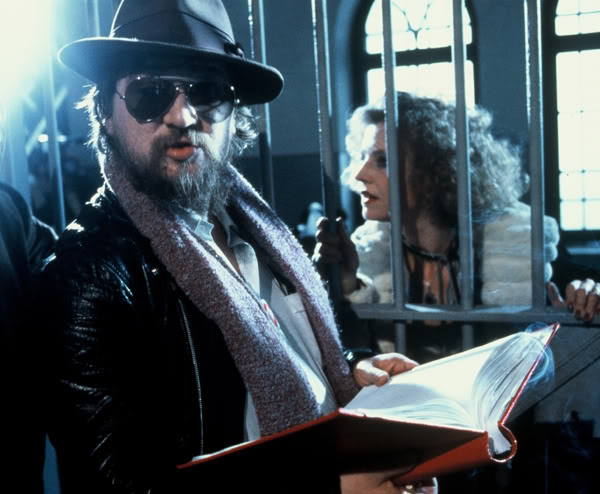
Any seasoned art fan can tell you about the many reappraisals they've experienced. In general, they're personal, chance encounters with one piece of an artists oeuvre. A boyfriend recommends a record, you spy a photograph that clashes with the pieces around it. Some people will tell you it happened when they saw Jeff Tweedy's breakdown in I Am Trying to Break Your Heart, or one of the thousands of Rolling Stones documentaries out there. I can tell you what made me want to give Rainer another chance was seeing the picture of him making Berlin Alexanderplatz. I'd seen it before on the Criterion Collection webpage above the New German Cinema page, but I had no idea it was him. I'd seen him in Fox, Whity, and Fear Eats the Soul and a few other of his movies and he looked...well, he kind of looked like me. He had a pale, round face, he was kinda short and a little out of shape and he seemed meek and unimposing. I felt bad for him in most of the roles he'd given himself. But then I saw that picture again with his name in the margins. What had happened? I knew he'd died prematurely (a drug overdose in 1982), but that didn't really explain how he'd gone from the awkward chubby guy in 1975 to the gruff, arthouse biker staring provocatively at the camera in 1980. At the end of his life, Fassbinder was a mess of a man. His lover would hang himself in prison the same year.
Berlin Alexanderplatz is a beautiful film, one of the thousand or so best. The cinematography is incredible (proto-West Wing sunbathing aplenty), the characters are fascinating, the music is perfect, the production design is remarkable, the acting is phenomenal, there isn't much wrong with the movie. It flows unlike any other Fassbinder film (which in a movie that already takes a day to watch is pretty fucking important). If I had to cite one thing that I was displeased with at the time, it was the epilogue. The movie is told in thirteen one hour chapters and a two hour epilogue. The epilogue is Fassbinder's id run wild as it never had before. Here we see the beautiful, logical, colorful narrative we've been following so closely for the last day and a half dissolve into piles of naked bodies, brothels, satanic boxing matches, biblical judgment, quarreling angels, and all kinds of other madness. Not that it isn't effective, but, I feel like there was some way to explain the madness of Franz Biberkopf better than playing Elvis and Kraftwerk in the 1920s. It's like he had spent so long making this serene movie and needed at the last to take a knife to it. To slash his canvas, as the saying goes. Was this inevitable, that someone as self-destructive as Fassbinder would unhinge the story. He couldn't get through one film without harping on bisexuality and zombie-like sexuality. Before this point, Berlin was one of the most thoughtful films I'd ever seen. It still is, but I wish he hadn't slipped up like that and felt the need to show Gottfried John kissing his cellmate or Gunter Lamprecht in boxing shorts (he looks like Tor Johnson). He needed to squeeze his caberet in the back door. But the more I've thought on it, the more I see: it wasn't his until the epilogue. The man may have vanished behind a beard, sunglasses and a leather jacket, but he was still the chubby kid from those early features, and that kid saw the world just so. I can't begrudge him these final moments to himself - they are his soul bared.

Whoever that guy is at the beginning of I Am Trying To Break Your Heart who says that ambition doesn't equal record sales couldn't have been more right. Berlin was a cult favorite when it came out, and has since disappeared. I don't think it ever got a vhs release because of its excessive length, and it appeared on American television exactly twice, in the 80s. It has to this day never been publicly shown from start to finish without interruption. I'm not sure what Rainer would have to say about this. He had to know he wasn't making Gone With The Wind (though I don't think I need to tell you which I'd prefer to watch), but still, the fact that there is a Rainer Werner Fassbinder Society and not one of them has paid to show the man's best film in its entirety in a movie theatre is a little disheartening. I can sit through anything (Female Vampire without once hitting fast forward. All of Carl Theodor Dreyer's films. Any DW Griffith film you put in front of me. All of Ed Wood's films. Gamera vs. anyone. 1900, anyone? Raymond Bernard's Les Miserables. Length or quality mean little to me. Watching movies is just what I do), but, I feel like there's gotta be someone out there who liked it as much as I did. This picture below is of him in Fox. He's the one with his eyes open. The photo below this one is of him making Berlin.

The reason I get so upset about this is because after I saw the tole that making films to the sounds of crickets had on Fassbinder, I questioned my future. If the reality of making movies or just trying to live as an artist could drive a man to this kind of devastation, what chance do I have? He might have been self-destructive, but no one had ever managed to put a leash on this guy and his work. Say what you will, his films are entirely his own. I respect him immensely even if I can take or leave a lot of his work and obviously recognize his contribution to the world I live in, but more than anything I feel some kind of connection to the guy. He was emotionally confused, clearly very awkward, stylistically alienating, and something of a pariah. Berlin Alexanderplatz is the work of a brilliant mind and his visual transformation is what confirmed this. People feel this way, I think, when they hear about Ian Curtis' suicide. What made this man so haunted? What made his world so dark that his music sounds like darkness and that made him end his life? Why did he do what he did? Why do we keep going back? Their lives frighten and excite us and their art does twice that. I'll be giving Fass and his films another chance from now on.
Berlin Alexanderplatz
by Rainer Werner Fassbinder
For a good half-dozen of his staggering output, I treated Fass like one of my cinematic nemeses; I felt ok writing off him as too strange for his own skin. He made strange movies and he made straight-forward movies, but they were all about the same stylistically. Slow, languorous, sexual, iconoclastic, claustrophobic, pensive... It seemed that until about 1978 his movies were almost always too stifling for me to sit through. He seemed to care more about the thoughts and images he was suggesting than getting a natural performance out of any of his actors (I hadn't discovered Bresson yet, reader. Pity me.) He frequently cast himself or one of a few of his stock players as people with no control over their circumstances. Men taken advantage of by those with power, women who felt old and dry because of their oppressive social surroundings. His movies were all very similar in a few ways. Their pace: running is a rarity in his films and no one speaks quickly when they can take their time. Their style; the outrageous fashion statements and bizarre characterizations. People cry, kiss, give monologues to no one, demand insane things from those below them. To me he was like the Klaus Nomi of film; the few who know him love him and defend him, but they also tend to read too much into his insanity. Not that there aren't things to be found in the canon they leave behind. I could complain about the hours that felt like days spent watching his movies hoping desperately for something to leap out of the malaise and prove Fassbinder's worth as a filmmaker, but a more interesting course of action is to ask why. Why do people love him? Not so interesting, too broad. Why did he do what he did? Why are there barely more than 60 lines of dialogue in The American Soldier? Why move from the completely unique style of the Bitter Tears of Petra Von Kant to the neorealist social drama of Fox and his Friends? It doesn't make any sense how one man could be as motivated as he was (43 feature films in 26 years, I'm not sure anyone but Joe D'Amato or Takashi Miike has matched his productivity while still leaving so distinct a stamp) could have made such lackluster examinations of the world he lived in.
He was a troubled man. He was a homosexual with two ex-wives who used production times to sleep with his leading men. His movies did scratch the surface of his problems (I feel like Fox & his Friends was as close as we come to Fassbinder the man). He tackled just about every dramatic genre there was and did his part to question (if not piss on) their assumptions. He often challenged the racist attitudes of early american films (while still perversely paying tribute to them) as in his disturbing western Whity, and his Douglas Sirk inspired melodrama Fear Eats the Soul. Learning of his admiration and later support for Sirk did a lot to warm me up to him. Fass punishes the womanizing heroes of his noir cycles (and his audiences by making them as slow and bleak as possible) and makes sure to give them sexually charged motives from both sides of the id. He spent so much time making tiny films with total control that when money started flowing in and expectations mounted there was bound to be change. Sweeping, beautiful changes.
Fassbinder loved the book Berlin Alexanderplatz for a long time before he made his film. He chose the name of its hero Franz Biberkopf, as the name of the man he plays in Fox & His Friends, the only time he built a film around himself. He used Berlin as a vehicle to display every complicated emotional hang-up he had ever experienced. He also cast just about everyone of his favorite actors. If El Hedi Ben Salem hadn't been in a french prison, I'm sure he'd have been in there too. It was a labor of love unlike any other. It took a year to complete and the finished film is nearly 16 hours long. It is among the longest movies ever made (yet somehow it feels shorter than The Bitter Tears of Petra Von Kant). It follows the life of massive, abrupt but sweet-hearted Franz Biberkopf after he is released from prison (his four year stint, we learn, was the product of his beating his girlfriend to death). He experiences unemployment, many girlfriends, deceitful acquaintances, rejection, highs, lows, insanity, love, and hatred. I was struck watching it realizing that this man had so much to offer the world but waited until this time in his life to finally let it all out. I imagined Maximilian Schell's harried lawyer Hans Rolfe in Judgment at Nuremberg "I want to leave the German people...with a shred of dignity." There has never been a more complete depiction of Weimar-era Germany. But that's not why I love this movie. Anyone could make a film about the horrors of living in Germany (Ingmar Bergman did it with David Carradine in The Serpent's Egg, and if that bizarre-o-world collaboration could yield results, then anything can), but not everyone can pour their heart into reels of film like Fassbinder did in 1980.

Any seasoned art fan can tell you about the many reappraisals they've experienced. In general, they're personal, chance encounters with one piece of an artists oeuvre. A boyfriend recommends a record, you spy a photograph that clashes with the pieces around it. Some people will tell you it happened when they saw Jeff Tweedy's breakdown in I Am Trying to Break Your Heart, or one of the thousands of Rolling Stones documentaries out there. I can tell you what made me want to give Rainer another chance was seeing the picture of him making Berlin Alexanderplatz. I'd seen it before on the Criterion Collection webpage above the New German Cinema page, but I had no idea it was him. I'd seen him in Fox, Whity, and Fear Eats the Soul and a few other of his movies and he looked...well, he kind of looked like me. He had a pale, round face, he was kinda short and a little out of shape and he seemed meek and unimposing. I felt bad for him in most of the roles he'd given himself. But then I saw that picture again with his name in the margins. What had happened? I knew he'd died prematurely (a drug overdose in 1982), but that didn't really explain how he'd gone from the awkward chubby guy in 1975 to the gruff, arthouse biker staring provocatively at the camera in 1980. At the end of his life, Fassbinder was a mess of a man. His lover would hang himself in prison the same year.
Berlin Alexanderplatz is a beautiful film, one of the thousand or so best. The cinematography is incredible (proto-West Wing sunbathing aplenty), the characters are fascinating, the music is perfect, the production design is remarkable, the acting is phenomenal, there isn't much wrong with the movie. It flows unlike any other Fassbinder film (which in a movie that already takes a day to watch is pretty fucking important). If I had to cite one thing that I was displeased with at the time, it was the epilogue. The movie is told in thirteen one hour chapters and a two hour epilogue. The epilogue is Fassbinder's id run wild as it never had before. Here we see the beautiful, logical, colorful narrative we've been following so closely for the last day and a half dissolve into piles of naked bodies, brothels, satanic boxing matches, biblical judgment, quarreling angels, and all kinds of other madness. Not that it isn't effective, but, I feel like there was some way to explain the madness of Franz Biberkopf better than playing Elvis and Kraftwerk in the 1920s. It's like he had spent so long making this serene movie and needed at the last to take a knife to it. To slash his canvas, as the saying goes. Was this inevitable, that someone as self-destructive as Fassbinder would unhinge the story. He couldn't get through one film without harping on bisexuality and zombie-like sexuality. Before this point, Berlin was one of the most thoughtful films I'd ever seen. It still is, but I wish he hadn't slipped up like that and felt the need to show Gottfried John kissing his cellmate or Gunter Lamprecht in boxing shorts (he looks like Tor Johnson). He needed to squeeze his caberet in the back door. But the more I've thought on it, the more I see: it wasn't his until the epilogue. The man may have vanished behind a beard, sunglasses and a leather jacket, but he was still the chubby kid from those early features, and that kid saw the world just so. I can't begrudge him these final moments to himself - they are his soul bared.

Whoever that guy is at the beginning of I Am Trying To Break Your Heart who says that ambition doesn't equal record sales couldn't have been more right. Berlin was a cult favorite when it came out, and has since disappeared. I don't think it ever got a vhs release because of its excessive length, and it appeared on American television exactly twice, in the 80s. It has to this day never been publicly shown from start to finish without interruption. I'm not sure what Rainer would have to say about this. He had to know he wasn't making Gone With The Wind (though I don't think I need to tell you which I'd prefer to watch), but still, the fact that there is a Rainer Werner Fassbinder Society and not one of them has paid to show the man's best film in its entirety in a movie theatre is a little disheartening. I can sit through anything (Female Vampire without once hitting fast forward. All of Carl Theodor Dreyer's films. Any DW Griffith film you put in front of me. All of Ed Wood's films. Gamera vs. anyone. 1900, anyone? Raymond Bernard's Les Miserables. Length or quality mean little to me. Watching movies is just what I do), but, I feel like there's gotta be someone out there who liked it as much as I did. This picture below is of him in Fox. He's the one with his eyes open. The photo below this one is of him making Berlin.

The reason I get so upset about this is because after I saw the tole that making films to the sounds of crickets had on Fassbinder, I questioned my future. If the reality of making movies or just trying to live as an artist could drive a man to this kind of devastation, what chance do I have? He might have been self-destructive, but no one had ever managed to put a leash on this guy and his work. Say what you will, his films are entirely his own. I respect him immensely even if I can take or leave a lot of his work and obviously recognize his contribution to the world I live in, but more than anything I feel some kind of connection to the guy. He was emotionally confused, clearly very awkward, stylistically alienating, and something of a pariah. Berlin Alexanderplatz is the work of a brilliant mind and his visual transformation is what confirmed this. People feel this way, I think, when they hear about Ian Curtis' suicide. What made this man so haunted? What made his world so dark that his music sounds like darkness and that made him end his life? Why did he do what he did? Why do we keep going back? Their lives frighten and excite us and their art does twice that. I'll be giving Fass and his films another chance from now on.

Earth Day
Four days ago was earth day. I don't think anyone mentioned it to me once that day. Dunkin Donuts gives out cold drinks in both plastic and styrofoam cups at the same time. We really deserve to be erased, don't we? This is a graphic Cooper Mckim made for a t-shirt design contest. I'm sorry he didn't win (not that I don't like Maggie Farrell's design, in fact I wear it as I write this); the best I can do is show it to everyone who'll look at it. Kind of like environmental problems; can't force anyone to acknowledge them, we can just do our best. Happy Earth Day, Cooper.


Composition/Arrangement
I think what makes new bands stand out above all their peers is the approach they take to arranging their music once it's been written. Some bands are content to play the songs the same way again and again (now, mind you this does occasionally work), but in my experiences music becomes so much vital and exciting when the bands take the time to change the way they play them. Broken Social Scene changes the tempo of many of their songs and almost every guitar part changes at every show (not exactly the most original concept, but it saves their concerts from becoming reruns). There is one band in particular that has taken a really proactive approach to re-imagining their tunes: Grizzly Bear. It's hardly unexpected that a crew of chic artist types from Brooklyn would be so interested in turning each song into something new for every performance, but these guys do it better than nearly anyone I've seen. Seeing them live was a revelation because not only did it show me that every member of the band sings, they've all got a whole bevy of effects running simultaneously to turn the songs into a whole new fleet. They highlighted their spirit of change in the Friend EP, wherein they redid a few of their own songs, had other bands interpret their work and even did a Crystals cover (it's a faithful rendition but it's pretty amazing nevertheless). They have a style and a sound and so to hear them turn regular sounds into the heavy, crunchy Grizzly Bear sounds.
What's more every member of the band has their own personality that enters into the music. Obviously bassist/clarinet player Chris Taylor and drummer/keyboardist Christopher Bear add very unique elements to the music (Taylor's awesome backing vocals for one, Bear's light-delay heavy drums for another) but where the real difference comes in is the dynamic between lead vocalists Ed Droste and Dan Rossen. Ed has a much deeper voice and you could swim in it when it takes off. His tracks tend to be darker and sweeter. Rossen has a lighter, earthier sound and tends to accompany it with slighter instrumentation. Their voices appear equally on Yellow House, the bands first real record as a band (though technically) and the difference is at first so slight as to appear as if there might just be one voice, but, upon closer inspection the differences are made apparent. It's really cool to listen to Rossen sing his Deep Blue Sea and then hear Droste sing He Hit Me to see exactly where their styles part ways. Rossen is also a remarkable guitar player which just makes their improvisation and fascinating compositions easier to envy and impossible to turn off. What's more they seem to be completely unpretentious.
What's more every member of the band has their own personality that enters into the music. Obviously bassist/clarinet player Chris Taylor and drummer/keyboardist Christopher Bear add very unique elements to the music (Taylor's awesome backing vocals for one, Bear's light-delay heavy drums for another) but where the real difference comes in is the dynamic between lead vocalists Ed Droste and Dan Rossen. Ed has a much deeper voice and you could swim in it when it takes off. His tracks tend to be darker and sweeter. Rossen has a lighter, earthier sound and tends to accompany it with slighter instrumentation. Their voices appear equally on Yellow House, the bands first real record as a band (though technically) and the difference is at first so slight as to appear as if there might just be one voice, but, upon closer inspection the differences are made apparent. It's really cool to listen to Rossen sing his Deep Blue Sea and then hear Droste sing He Hit Me to see exactly where their styles part ways. Rossen is also a remarkable guitar player which just makes their improvisation and fascinating compositions easier to envy and impossible to turn off. What's more they seem to be completely unpretentious.
Last Year at Marienbad / Carnival Non Drôle

There is only one other movie that comes close to resembling Last Year at Marienbad. Last Year, directed by Alain Resnais in 1961 is about a man stuck reliving a memory differently as he tries to explain it to a girl (time and reliving mistakes, was Resnais great obsession). He's in love with this girl and tries to make her remember their time together. As he recalls it, he remembers the scene differently each time and soon the versions of the story begin overlapping. People drift from one evening to another, different clothes, same dialogue and events. All the while the man's pleading voiceover mixes with an almost perpetual organ score. The organ plays even when violins are played by musicians onscreen, making flesh the frustration at the heart of the story. It won the top prize at Cannes, and with good reason: there hadn't ever been anything like it. There is only one movie that has since come close to its haunting, dream-like, angst-ridden feel: Carnival of Souls.
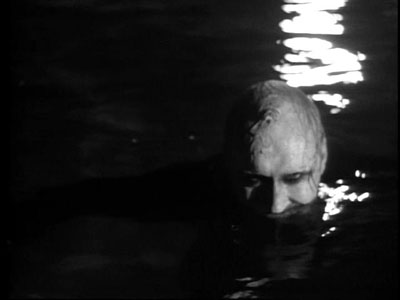 As far as markets, personnel and reception are concerned the films are as close as an orange and a buffalo, but, in the reels lie similarities strong enough to make someone mistake them for brothers (albeit one elegant, the other deformed and awkward). They both feature characters stuck in a world they cannot control, alienated by the forces closing in on them, trying to probe their mind for some meaning to their suffering. In Last Year the stranger has his thoughts twisted and doubted by the woman he loves. He tries desperately to make her see that she too, once, distantly loved him as passionately as he did. The memories are clouded by thoughts of her rejecting him in the past, present and future. Carnival of Souls follows a woman for whom every aspect of her life is uncertain: she survives a car accident in which, it seems, all of her friends have been killed. She moves to a strange place and is menaced by a spectral face everytime she is alone. The people in her everyday life are intimidating and make her feel uncomfortable to the point where she doesn't feel a part of the living world. Both films have people wandering in and out of time and space. Both have a haunting face that disrupts their mental stability (Herk Harvey, our strange shadowy auteur, in Carnival; Sacha Pitoëff in Marienbad) and leads them into the darkest realms of their soul. Both films would have had to have been labours of love for their directors: Herk Harvey made only one feature length film in his lifetime and Carnival of Souls is a very pronounced vision; I say the same of Resnais simply because Last Year at Marienbad is such a strange goddamned film. Who would spend the six weeks shooting the same scene ten or eleven times over, only to lose most of the footage on the cutting room floor and have a gothic whirlwind of anti-baroque moodiness to show for it? I hope for his sake that he knew what he was doing.
The final thing that binds these films like split embryos in a womb is the soundtrack, oh yes, the soundtrack. The only music we get from either of these films is non-stop organ music. Wailing, noodling, aimless, screaming organ music from frame 1 to frame ∞. This can't be an accident. Harvey went so far as to make his heroine a church organ player; when's the last time you've seen a movie where someone goes out of their way to take a job as an organ player at a church no one is ever seen entering? Both of these men knew something and organ music was part of the plot. Personally, I like a violin or a tuba every now and again. Not these two. It's pipes or bust. Now of course Resnais had much else to represent his style and vision as a director (I highly suggest Hiroshima Mon Amour, it is the Frenchest movie of all time. And of course, a blinding masterpiece of eroticism and loss), but Harvey only had Carnival of Souls. This means that both men thought highly enough of the idea of gloomy tales of alienation to pour a hell of a lot of effort into making them. For all my jaw-clenching, these are original movies and were made by men with vision, which is more than most films can claim. Resnais was obviously rewarded more than Harvey (ed. Now both films share a Criterion DVD sleeve. Though Harvey beat Resnais to the punch by about four years).
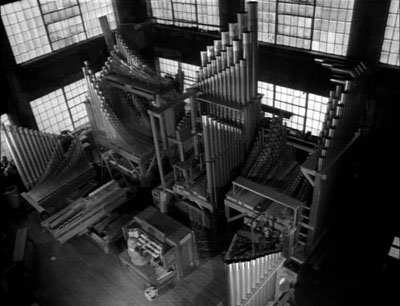 Personally, I can't decide which one I liked better on first visit. Last Year pulled ahead lately, but you have to admire the purity of obscure vision from both films. As far as motivating ideas and atmosphere go, Harvey and Resnais are just about even in my book. Composition: Resnais wins by a mile with his nods to the geometric avant-garde films of the 20s in the garden and every sweeping run over the exquisitely crafted, but soul-crushing hotel corridors. The images themselves say as much about the facile arrogance of the rich and so it is clear that Resnais had the more hyper-active brain. The shapes and contrasts, the beautiful shot of the hotel alone at night. He had ideas about relationships other artists have never touched and his movies are a testament to the wonderful mind he's still putting to use today. Harvey had some wonderful compositions and I can't help but wonder as to whether he was a misunderstood genius or a creepy amateur with a whole lot of luck. That Harvey achieves a number of truly awe-inspiring shots is to his credit, but his background gives me pause in my appraisal of him. I've seen his other work, as a maker of educational/safety shorts, and clever though they are, they aren't exactly early Kieslowski either. One can't deny that these are unique; those great expressionistic shots of the organ; the silhouettes outside the theme park; Candace Hilligoss's hair deserves special commendation for being so photographable; the dance of the ghosts; the walk through the empty town; the infamous face. He really makes a showing of himself. He, like Russ Meyer, is one of the few men who have provided people with something else to look at other than the thing they've paid to stand in front of the camera. Intention is another matter, but such is the burden of the cinephile. Our reward is to be able to bask in the wonderful enigma of a case such as this and have both texts at our fingertips.
Both films undeniably served as an influence for The Shining. And for that we can all be thankful.
Mother Symbols and Buddhist Music Scales
For the first time in months, I draw because I am inspired, by the first line of a Bright Eyes, song, "Amy has a baby in her stomach..." I have spent so much time concentrating on Aphrodite: our nurturing mother; but our central character is genesis.

At the bottom of this you may see some upside-down pentatonic scales. The are, from left to right (when rightside, up, that is): pentatonic major, minor, and the "Yo" scale.

At the bottom of this you may see some upside-down pentatonic scales. The are, from left to right (when rightside, up, that is): pentatonic major, minor, and the "Yo" scale.
Subscribe to:
Posts (Atom)