The Best Cinematographic Achievements in Film, dated 9/5/08

A while back I began noticing that I stopped viewing the natural world around me as I once did. I started looking at things, really looking at things - trees, ditches, fields, snow-covered flora - and began imagining them in different ways. Slowly my appreciation became deeper, in a twister sort of way it's no longer a simple matter of "this is nice looking", it's now "this is beautiful, it would look gorgeous on film. How might I film this?" An occupational hazard, I suppose. I'm not really a cinematographer - technically speaking of the three short films I've taken part in in the last year, I only photographed two of them, and only one of them I can say I really had a sense of what I was filming - it's more the sense I've been given since giving myself an education in cinematography slightly more in depth than the one I've been given twice in two different schools. I like my own self-imposed knowledge better because it meant watching all the movies that get roped in together as the best. I'm not saying that these estimations are incorrect, I just happen to think looking beyond the same five films in every summation is always a good idea. For example, in looking at the humbling work of master photographer Nestor Almendros, the film he gets most credit for is undoubtedly Days of Heaven. While I agree that the work is unrivaled in it's technique, I think more can be gained watching his first feature film La Collectioneusse, a film done without a single electrician or industrial light. I think the greatest feature of cinematography is that a film needn't be good to have rich photography. For example I greatly admire Roger Deakins work (on every one of his films, but especially) on The Village and The Assassination of Jesse James by the Coward Robert Ford, two films greatly wanting in other areas. I will say that I have favorites, those who have honed their craft into the purest of art forms, but the other redeeming feature of the field is that a novice can do just as beautiful work as a seasoned professional. Look at Mihai Malaimare Jr., who cut his teeth on three short films in his native Romania before taking on the dubious Youth Without Youth, a film that couldn't look more beautiful if the cast were all greek nudes. I think it's probably all the more impressive when Cinematographers can make as splendid use of shadow in Black and White film as shades and hues in color film. The Third Man (nay, the whole Noir genre) would be nothing without the work of it's light and shadow men. Imagine Detour, M, The Lady From Shanghai, or Kiss Me Deadly without their notorious shadowplay. Cinematography is often responsible for a film's most striking aspects. Picture a less competent man than Frederick Elmes behind the lens of David Lynch's flooring Blue Velvet, or someone with less experience in the expressionist movement than wunderkind Fritz Arno Wagner filming the famous stair sequence in Nosferatu, or most terrifying, imagine if David Lean had hired anyone other than cinematographer Freddie Young when filming Lawrence of Arabia, someone who wouldn't have had the resources to get ahold of a 482mm lens to film Omar Sharif's awe-inspiring entrance. I shudder to think. Below are my fifty favorite instances of cinematography in feature length films and their accompanying cinematographers, or really what I think are the most technically accomplished/beautifully filmed movies of all time. I've given descriptions of the top ten, as reading descriptions of fifty films might get as repetitive as writing them. How many synonyms are there for gorgeous, anyway?

1. The Assassination of Jesse James by the Coward Robert Ford – Roger Deakins

This film has something of a mixed reputation. I personally think it a bit heavy-handed and melodramatic at times and I think it could have done without the prosaic voice over narration, but one thing is absolutely without question: the movie is stunning to watch. Right from the start when we see the James Gang knocking over a train, while Brad Pitt strides past the steam of the locomotive, while the light from the passenger cars douses the bandits in gold, while the dark wood of the cars clashes with the shining metal of firearms, while the silhouettes of every member of the gang closes in on the brightly lit train cars. It's amazing and Roger Deakins made sure to fill every frame of the film with otherworldly beauty. While director Andrew Dominik's tribute to the westerns of Anthony Mann and Samuel Fuller lingers in the past, Deakins makes a showing for the age of technology. The leads in their eccentric costumes standing like pillars of marble in the blazing scenery Deakins photographs. The blue-hued snowy landscapes, the dusky fields and farms of James' hometown, the exquisite dinner scenes we're drawn into. The film's screenplay may lack subtlety, but Deakin's photography needs none.

2. The Double Life Of Veronique – Slawomir Idziak
Anyone who's seen Amelie is in the dark if they haven't seen The Double Life Of Veronique. Bruno Delbonnel employs much the same tricks and color schemes as Slawomir Idziak did in 1991, but without the porcelain skin tones or constancy of the light quality. Idziak delivers what is probably the most colorful non-technicolor film before the advent of digital editing. The colors of this film, deep, alluring greens and almost erotic reds run throughout unexplained, but never unwanted. Idziak manages to bring to life Director Krzysztof Kieslowski's intimate compositions and manage to make slightly extraordinary things look unabashedly enchanting. He certainly succeeds in making Irene Jacob look like the most beautiful woman on earth twice in one film. Between Kieslowski's fairy tale screenplay and Idziak's super-saturated colors, this film is something of a minor miracle; the most romantic movie ever made.

3. La Collectioneusse – Nestor Almendros
Almendros will forever be immortalized as one of cinema's greatest eyes, but he'll rarely get the credit he deserves for his best work. His work with Barbet Schroeder and Eric Rohmer far outshines his work in America in almost every case. With the aforementioned exception of Days of Heaven, his best work was done in France. This film, his first, is the deceptively simple tale of one man's struggle to conquer his feelings for a promiscuous girl as she learns to settle down. I'm not the least bit ashamed to admit that I was a little too preoccupied with Almendros' camera work to pay close attention to the story (the ending's happy, if memory serves). At times Almendros had ony two pieces of equipment while working on La Collectioneusse, a 35mm camera and a particularly bright bedside light (the bulb was intentionally replaced with something industrial grade). The rest of the time he had natural light and reflective surfaces. Any given still from this movie could easily be mistaken for some lofty Renoir-esque painting. He'd may have gotten cleverer, but his work never got more flawless than it did on his first feature.

4. Children of Men – Emmanuel Lubezki
Ok, so it's no secret in the film world that this movie is brilliant. As my friend Lizzy said after her first viewing "I wasn't expecting much, but...". The movie really didn't scream "genius" when it made it's pitiful rounds of American multiplexes and so expectations were all but erased by the time it hit DVD, but it was cinephiles who had the last laugh. This movie is, and I don't mean to hyperbolize, the most technically exceptional movie ever made, where live film is concerned. Emmanuel Lubezki, hands down my favorite cinematographer, manages to revolutionize the real-time tracking shot while still doing wonders with he and director Alfonso Cuarón's trademark green hues. His active lens makes sick situations frighteningly real and all the more nauseating; his camera seems to trigger the release of endorphins, like a rollercoaster, because when the ending titles began flashing, I couldn't help but feel both mildly ill and like I needed to see it again; it was all I could talk about for days. Lubezki's greens are a favorite of mine (you'll notice his name five times more on the list) and they're subdued just enough here not to take center stage like they do in Cuarón's earlier work, but they still manage to catch the eye despite the chaos that consumes the frame. Lubezki and his crew should have been given nobel prizes for their work on this film; not just because they manage to stay on a battle for 6:18 without ever making it obvious that cuts are being snuck in, but for making the most horrific things in the world look so vivid and unforgettable. If viewers never forget what they see, they may just act accordingly later in life.

5. Autumn Sonata – Sven Nykvist
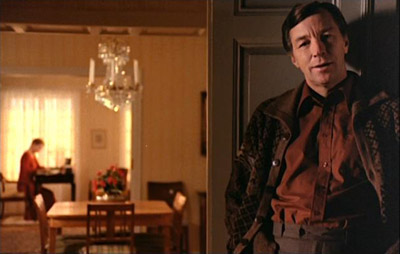
I'd seen a few of Nykvist's collaborations with Ingmar Bergman before I saw Autumn Sonata, but I had no idea just how well the two men understood each other. I don't know that there's a team that had such insight into the world of the other anywhere else in the annals of film history. I suppose Greg Tolland and Orson Welles came close, as do Cuarón and Lubezki, but the difference between any other teaming and this one, Bergman's entire life came out of Nykvist's camera. So when Bergman makes a film with an Autumnal motif, Nykvist came through beautifully. The movie looks effectively like the fall has come to life in Liv Ullmann's house. The faded pastel colors and rich outdoor scenery are truly remarkable and as someone who admires Autumn more than any other season, this is a wonderful thing.

6. The New World – Emmanuel Lubezki
If you paused any given second of The New World and squinted, you'd think you were staring at an oil painting. Lubezki outdoes himself at his better-than-reality camera work, and easily steps into Nestor Almendros' shoes as the undisputed master of natural light photography. There's one scene in particular that comes to mind when I consider Lubezki's work in this movie; it's the last one in the film. Thanks to director Terrence Malick's set-up and romantic reverence for (almost deification of thanks to the camera work) of death, what we have is a scene that easily qualifies as transcendence, if we adhere to Paul Schraeder's definition. Lubezki manages to craft a convincing picture of heaven without ever leaving the realm of the living, which I call a job well done. He and Malick understand that death is not an end, so much as it is a celebration of the middle. With a good camera man, it's not hard to do so.

7. Last Of The Mohicans – Dante Spinotti

This movie is probably responsible for my appreciation of nature. It's why while riding in trains or cars I'm constantly tempted to get out and become part of my surroundings. Michael Mann's tribute to the ways of the Native American (as some kind of bastard Native American myself, I get to relate on more than one level to this movie), namely their constant graciousness toward the kind earth they live on. All you really need to understand the genius of this movie and of Dante Spinotti's lens; Hawkeye, Uncas, and Chingachgook run through the woods chasing after a buck. Their surroundings whir past them, occasionally giving us glimpses of the deep greens, browns, and blues of the woods. Finally they settle on a good spot to take the animal down. In a clearing, with water running through a small brook, rich foliage both living and dying, the sun nearly down, providing minimal light. There they claim their prey and then they give thanks, while all around returns to it's usual stillness and the beauty of the natural world is restored. These men do not top the food chain, they are merely one rung; nor do they stand out against their background, they are merely one piece of a sensational picture.

8. Sweet Movie - Pierre Lhomme
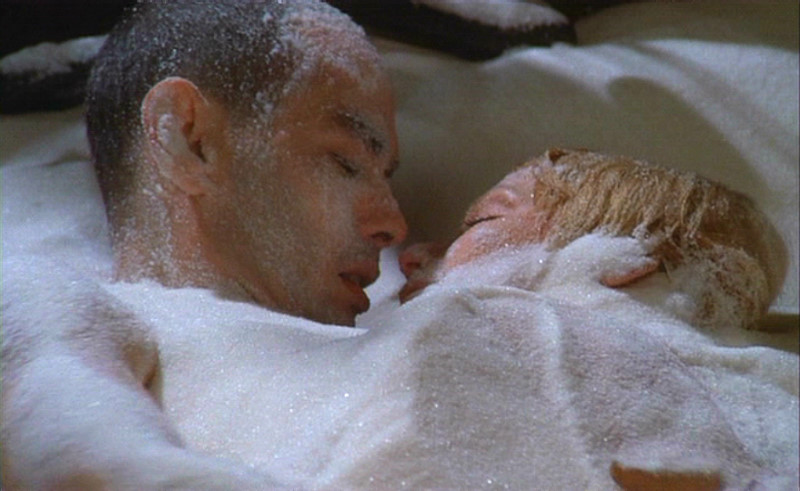
This movie is little known in the United States outside of the ravenous cineastes who hunger for each new Criterion release. This, friends, is a damn shame. The movie, a madcap fusion of political theory and sexual politics in the extreme, is made all the more poignant because the beauty of its most puzzling and challenging images is identical to that of its most serene. Take for example that a scene of two people copulating in a vat of sugar is just as clear and breath-taking as that of a long shot of a boat made out trinkets and political artifacts with Karl Marx as the figurehead tooling down a crowded canal. The movie's incendiary nature wouldn't be half as effective without Pierre Lhomme's beautification of every dirty detail, and this movie gets pretty dirty.

9. I Fidanzati - Lamberto Caimi
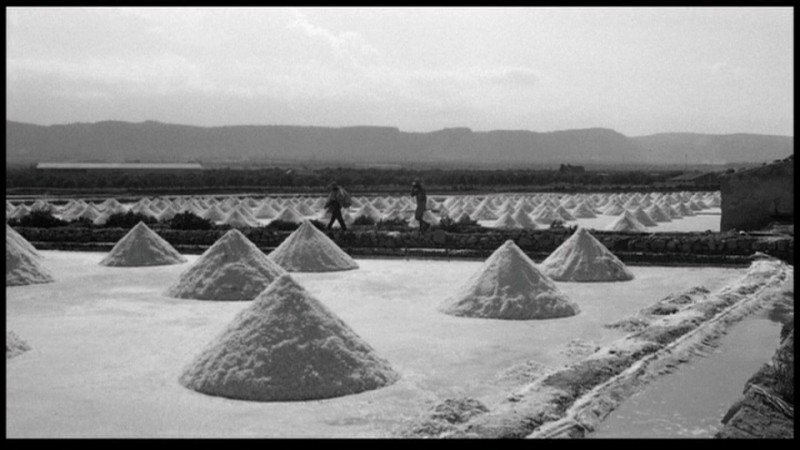
Black and White photography is easy to make look good, easy to look sloppy and incoherent, and hard to make perfect. Would you believe that one of the most mesmerizing sequences in the history of black and white film was shot by a first-time cinematographer. I guess technically I Fidanzati was Lamberto Caimi's third film, but his work on his first movie, Il Posto, was essentially identical to his work here. Ermanno Olmi's films, which were Caimi's first gigs, evolved out of work-place documentaries their factory produced, which were amazingly well-realized and insightful. Even more impressive was that the photography was just as impressive as anything that showed up in any of Fellini's films of the same period. The sequence I described earlier takes place about midway through the film. The protagonist walks from a beach to a tired-looking derrick nearby. It looks like a precursor to the kind of work Robert Elswitt would do in There Will Be Blood. The textural capabilities of black and white film are as pronounced as I've ever seen them.

10. Apocalypse Now – Vittorio Storaro
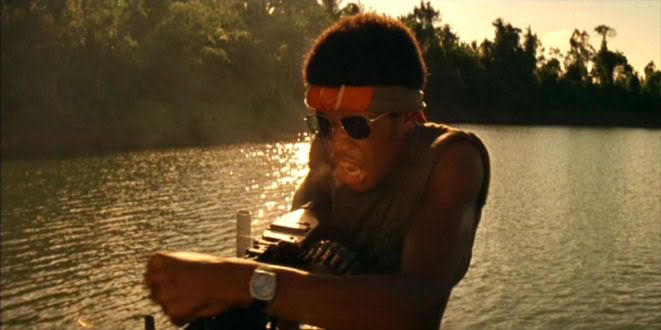
I once tried to explain to someone why I loved cinematography so much, using Apocalypse Now as a sort of exhibit A (my actual wording was fairly juvenile, but it was only to get my point across). I've often thought of the film as DP Vittorio Storaro's as much as director Francis Ford Coppola's because he's half the reason this movie is so outstanding. When Martin Sheen reads over Kurtz' dossier while "Satisfaction" blares on Clean's radio, there's nothing better. The contrast between Sheen's tanned, hairy skin, and the crystal blue waters below him have long symbolized the genius of the film; light vs. dark, American men vs. the natural world. The point becomes clearer minutes later when Robert Duvall's Air Mobile unit shreds the bejesus out of VC target zone so that he can surf a six foot peak. The overwhelming violence stood out to my friend, which is of course the point of an anti-war film. Another viewing or a little more knowledge of cinematography and she'd see that the reason anti-war films of this caliber work is because, like Children of Men, the violence is shrouded in so glorious a light, because that's how it appears to the men who make war and because that is how a clear picture is crafted. How do you make someone remember your anti-war message? You give them images they'll never forget - they can be violent, they can be troubling, but they can also be beautiful.

11. A Very Long Engagement - Bruno Delbonnel
12. Master & Commander: The Far Side Of The World: Russel Boyd
13. Birth - Harris Savides
14. The Thin Red Line – John Toll
15. Maitresse – Nestor Almendros
16. Down by Law – Robby Müller
17. Au Revoir Les Enfants - Renato Berta
18. The Third Man - Robert Krasker
19. Gate Of Flesh - Shigeyoshi Mine
20. Broken Flowers – Frederick Elmes
21. The Village – Roger Deakins
22. Lawrence Of Arabia – Freddie Young
23. Y Tu Mama Tambien – Emmanuel Lubezki
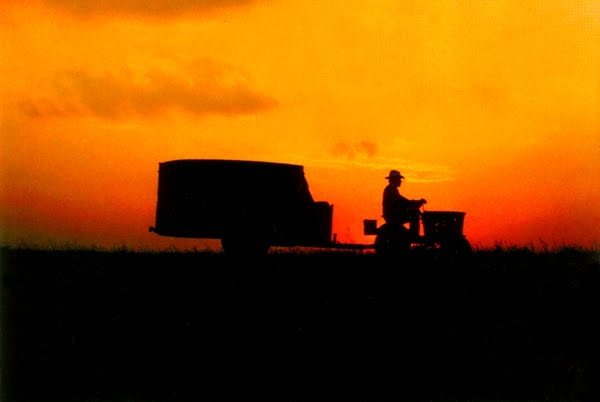
24. The Straight Story – Freddie Francis
25. Manhattan - Gordon Willis
26. Days Of Heaven – Nestor Almendros
27. Great Expectations – Emmannuel Lubezki
28. The Conformist – Vittorio Storaro
29. Sleepy Hollow – Emmannuel Lubezki
30. Contempt – Raoul Coutard
31. Cries & Whispers – Sven Nykvist
32. George Washington – Tim Orr
33. Youth Without Youth - Mihai Malaimare Jr.
34. Fargo – Roger Deakins
35. Brief Encounter - Robert Krasker
36. Blowup - Carlo Di Palma
37. Pierrot Le Fou – Raoul Coutard
38. McCabe & Mrs. Miller – Vilmos Zgismond
39. Harry Potter & The Order Of The Phoenix – Slawomir Idziak
40. A Little Princess – Emmanuel Lubezki
41. Gosford Park – Andrew Dunn
42. There Will Be Blood – Robert Elswitt
43. Interiors - Gordon Willis
44. Port of Shadows - Eugen Schüfftan
45. Ivan's Childhood - Vadim Yusov
46. Let Sleeping Corpses Lie - Francisco Sempere
47. Blood For Dracula - Luigi Kuveiller
48. 28 Days Later – Anthony Dod Mantle
49. Crouching Tiger, Hidden Dragon – Peter Pau
50. The Mission - Chris Menges

Honey in the Pot

Well, I have a few pieces of exciting news to relay. First, a few months back I wrote a piece about one of my favorite bands, Honeychurch, and their album Makes Me Feel Better. Well Shilough Hopwood, singer, songwriter, and multi-instrumentalist for the band, read it and liked it and enlightened me. Shilough and I spoke about a favorite song of mine off the Makes Me Feel Better record called "From The Sky", which I recently covered as part of a Covers EP The Congregation put together. He made me feel much better than I am with his words. First off Shilough explained that he basically played every instrument on the song when they recorded it. The drums were his, the guitars both his (a Fender Telecaster and a 12 string electric dueling for a heart-warming few moments). He is a genius on the highest order. Not because these parts are virtuosic or especially difficult. In fact, it's just the opposite. By taking incredibly simple elements and essentially supercharging them in that reverb soaked way of his, he took something small and made it huge and timeless. I'll never tire of that song and I thank him immensely for his kindness.

Second, I wrote and recorded an album. Well, wrote's a bit of a stretch. I took a lot of musical cues from other artists, friends, and movie scores. Anyway, the ideas are hardly all mine and I wouldn't have done it without my friends. Anyway, I hear Shelly's recording music too and it blows mine away effortlessly, so there. Anyway, it's about how much I love my friends and don't want to leave them for college. or prison.

Recently I've gotten the chance to meet a few very charming musicians in Doylestown. The first is Bethany Walk-Spiers of the band Feverfew. Having sharpened her chops in hardcore bands, Bethany moved on to playing complex and dizzying pop blues. She's a terribly nice person and has a whole bag full of stories to tell. Their the kind I love, stuff about Gerard Way from My Chemical Romance vomiting back when he had integrity. Lovely. The second is area musician Paul Fugozzoto. Now i'd actually seen Paul once without knowing it when he opened for Honeychurch under his nom de plume Ponieheart. Paul, a good and gentle soul writes folky pop tunes that melt you like butter. His voice has that natural echo that some people are just born with. Paul and Bethany have at least one thing in common, they'd both like to play in King Crimson tribute bands. I, for one, would love to be a part of that little collaboration. I've also gotten to know a fellow named Matt Rhodes, guitarist/singer/bassist for NY-sound-influenced rockers The Lone Pine Cones. The Lone Pine Cones played at the World Cafe recently and I've loved their music ever since I first heard it all those months ago. Matt and I met through non-musical channels (my little sister and his better half are childhood friends), and he's a terrific guy. He, like me, is an unabashed fanboy with a love for all things indie rock. He and I have traded concert stories, battle scars and guitar licks, and he can hold his own like few others can. Having seen the Lone Pine Cones play a few times now, watching his bass-laden trances are a real treat for anyone who likes brash rock music. Now, I don't like to devote too much of time to overtly fantasizing, but I'm just saying, playing In The Court Of The Crimson King with Paul, Bethany, and Matt would be unmitigated insanity.

Thank god almighty

4/26/08 a date I didn't realize dave put up that post for me. THANKS DAVE. happy earth day to you as well. sorry I didn't notice earlier.

I would also like to say that I created a wikispace called eyecreate.wikispaces.com that I want everyone just to glance at. It would be awesome if you came apart of it though. For anyone who has congregation recordings it would be awesome if you uploaded it onto my wiki. All you have to do is go under audio and upload the file, the genre, and the name of the band! Also, look at the rest and see if you want to include anything else!

Radio Man

because I love Radiohead, and because I believe they would agree with my streaming their work for free, and because I don't particularly care after they shitchanged my employer out of record sales to stick it to the man (something I remain conflicted about. I think I love Blair Elliott and his family more than I love Radiohead, so there EMI), and because if someone doesn't like it they can just come and sue these videos right off the internet and because i know my friends love Radiohead as much as I do and deserve to see this without buying it, and because the quality isn't great anyway, and because it originally aired on VH1, I'm going to post this free studio concert on Film Punk. A first if I'm not mistaken. I'd like to thank my TiVo. I've also uploaded the few videos I didn't have a few days ago. Thanks, America! Watch, Watch!
Bodysnatchers

Nude

Myxamatosis

Weird Fishes/Arpeggi

Optimistic

House of Cards

15 Step

Reckoner

Where I End And You Begin

Bangers 'n Mash

Go Slowly

All I Need

Videotape

The Gloaming

Bonus: Radiohead on SNL in 2000. Kate Hudson was the host, so I'd marry this episode if I could. I'd like every episode of every television show to feature both of these guests. Brief Note, Recently on Elvis Mitchell: Under The Influence, Laurence Fishburn likened the work of his favorite actors to Thelonious Monk's dancing when his band would swing just right. When he felt he no longer had to aid the band, he could simply enjoy his creation, thus Fishburn's talk of an actor's Swing. When Peter Lorre and Sydney Greenstreet act in Maltese Falcon or whenever Peter O'Toole walks in front of a camera, we have Swinging. I'd like to submit a modern take on his example. When he speaks of Thelonious Monk dancing to his own music, I was immediately reminded of the wild dance I'd seen Thom Yorke do when I saw Radiohead perform a few years ago and in the many filmed performances I've watched. This, friends, is swinging.
Idioteque

Here they are on the Late Show in 2003, rocking as hard as they ever have. There's something truly heart-warming about seeing all of them in suits, Jonny especially. Three guitars, wonderful attire, blistering noise, a delightful time had by all. I should point out that this was from the first DVD I ever burned consisting of performances from live TV. This was when I was first getting into Radiohead and seeing this was like being given the combination to a vault.
2+2=5


And here, because I'm in a particularly anarchical mood, and because I'm writing a speech about this band for a class, is their 2007 masterpiece In Rainbows Side A in it's entirety. Absolutely Free

15 Step
Bodysnatchers
Nude
Weird Fishes/Arpeggi
All I Need
Faust Arp
Reckoner
House of Cards
Jigsaw Falling Into Place
Videotape

I love this band like a member of my family.

"Do Angels Exist?" "Do You Believe in Aliens?" "Is Global Warming Real?"

I stumbled across a website where people take surveys, and apparently their input is appreciated by some greater power. I thought I'd share some results. I don't spend hours on the Internet, so I can't tell you who these people are that vote on websites, but I can tell you that these results from "popular" surveys are the same people voting.

So, when asked: Is Al Gore right when he states that humans are responsible for Global Warming?
46.81% said yes and 53.19% said no.

Next question: Do angels, in whatever form they my take, truly exist?
70.46% said yes and 29.54% said no.

It gets better: Are we being visited by aliens from outside this solar system?
62.21% said yes and 37.79% said no.

Lastly: Do Ghosts really exist? Are we experiencing visitors from beyond the grave?
86.79% said yes and 13.21% said no.

So, in summary, the average Internet-site-goer-who-votes-on-surveys-and-possibly-votes-for-the-president-of-the-United-States believes that ghosts, aliens, and angels are real, but that there is no way in hell that humans are destroying the earth. Maybe the aliens are responsible.

Genius

There is one piece of music and film that shines above all others of the type. It transcends time, trends, and taste. Fans of film and music will know exactly what I'm talking about and will be unsurprised to hear me say that it is one of the greatest achievements by any artist.

Stop Making Sense
by Jonathan Demme & Talking Heads

Now this defies easy classification and so cannot fall under many of my series headings. It is a documentary/performance and so cannot fit in with my 100 favorite fiction films. It is a live performance and so cannot be grouped with studio albums. It is not unknown and so I can't claim to be doing anyone a service by harping on it's genius here on this lonely website. It isn't under-rated, per se, but it's genius on a level that maybe seven people in a given generation will achieve. I'll frame this little opinion piece with some perspective. When some artistic things catch on, music, film, what have you, a lot of time the fans of that movement will have a dilemma. When the White Stripes starting getting huge and again when their Icky Thump record sold like weed at Hampshire, fans were perplexed. Many of my friends, Siren Records owner Blair Elliott, and my talented friend (she was in 10th grade when we spoke on the subject) Caitlin Mcginnis were equally stumped, though they were both fans of a kind, who don't give their favor to bands easily. Their point is well-received; this was art that wasn't supposed to catch on. It wasn't music for the masses, it wasn't created in a lab for people to enjoy, they didn't labor over the melodies or instrumentations to make sure they had a commercially viable sound. No, they did it, and will continue to do it because it's what they believe in. So, do fans trust the new affection for the weirdness, or do they rebel against it, citing selling out as the cause. The same I believe can be said of Talking Heads. Talking Heads are...well, I'll say this, I don't know who anyone whose opinion I respect who doesn't like them. They are not as abrasive or brash as the White Stripes, but that they caught on was a triumph for artists everywhere. The product of three RISD students and a guitarist/keyboardiest whose only demand was that he be allowed to finish his year at Harvard, they cannot be said to be commercial (At the very least, they're commercial appeal is completely incidental). They went from making mild psych-pop to blissfully weird idiosyncratic funk-rock in the span of three years and in the process recorded three of the greatest albums of all time. All the while of course, their artistic egos flared like gas ranges. Artists being what they are, these were strange people with big, big dreams. And as is only natural, with those dreams, comes conflict. Their conflicts are rumoured to have persisted up until the moment of their ultimate concerts' start. The concerts in question? Three nights at a theatre in Los Angeles that would be crafted into the ultimate concert experience.

Thanks in part to Jonathan Demme's minimalist style and the elaborate stage show meticulously mapped out by head Head David Byrne and his bandmates Tina Weymouth, Chris Frantz and Jerry Harrison, Stop Making Sense makes for just as entertaining a film as it does a kick-ass live record. I hesitate to praise Stop Making Sense so unabashedly because I have some pretty strong things to say in its favor. Live records are often roped in with studio albums in estimations of popular music. James Brown's groundbreaking Apollo concert or Aretha Franklin's many live performances are usually given rank amongst Let It Be or London Calling (not that there's anyway to distinguish a superior record, mind you), and so it is clear that many people aren't interested in making the distinction. And there are cases like The MC5's Kick Out The Jams, which was both their debut and a live record. Here we have what could have been taken as a live record, a film, and/or a soundtrack to a motion picture, which is how the record is listed in the credits. On the IMDB, Frantz, Weymouth, Byrne, Harrison and their five session players are listed next to their instruments. Alex Weir is his guitar; Weymouth is her bass, Bernie Worell is his keyboard. They aren't playing the parts of musicians, they are playing the parts of their instruments, cogs in the machine of the experience of the band. They are aware of their roles, and fulfill them as good as any troupe of actors has ever. But let us take this strictly as a live record for a moment. If we take the opinion that live shows and/or concert recordings are a much more accurate showing of a bands capabilities, and Stop Making Sense is almost certainly the greatest rock concert ever released, what we have by the transitive power is the greatest performance by any band ever recorded. Though I'm speaking entirely in theoretical terms, I stand by my claim fiercely and gladly stack Stop Making Sense next to Hendrix at Monterey, Live At Leeds, Wilco's Kicking Television, Kick Out The Jams, The Last Waltz, or the televised James Brown performance that prevented riots from breaking out all across America. The real difference between those performances and the Talking Heads' farewell to obscurity was that the Heads were artists and cared as much about aesthetics as they did attitude. They most certainly had the sound to back up their stage presence, but they also had a live show the likes of which had never been seen. I guess it's fitting that former Funkadelic keyboardist Bernie Worrell joined them on stage because the only band who'd ever come close to this sort of hypnotic stage presence was George Clinton's Parliament and their mothership landings.

Where else in rock history can a band's sound be seen to expand as well as heard? We start with David Byrne playing his Martin acoustic guitar next to a ghetto blaster with a drum program on tape. Towards the end of the song a riser is wheeled out by men in black uniforms. This sense of progress, a machine being assembled for enhanced performance, is crucial to the success of the piece. From there Tina Weymouth, the greatest white bass player, joins him with her beautiful blue instrument and her molasses-thick tone, and so do the unseen voices of Lynn Mabry and Ednah Holt. When they've completed "Heaven", Chris Frantz and his military precision start "Thank You For Sending Me An Angel". The machine grows. Jerry Harrison and his black Stratocaster match Byrne's sunburst, the first electric guitars of the evening. Then the band grows to its full size to realize its potential. Worrell and his enormous hands, Alex Weir and his proto-mustang guitar and high-energy bouncing about, Steve Scales and every hand drum imaginable, and Ednah and Lynn who perform the greatest two-person backing performance I've ever seen. Doing the work of the Supremes or the Vandellas, these two girls sound like a choir and have the stage presence of Little Richard, James Brown or Prince. Byrne is something to behold, as well. Alternately marching in time to his own music, writhing on the floor, running laps around the stage, and rocking elastic guitar solos, it's a small miracle he never passed out from exhaustion (I suppose we can thank cocaine). Concerts like this aren't merely art installations, they're marathons and contact sports. Musicians will experience the adrenaline of scoring a touch-down and winning the super-bowl, athletes may never know the sensation of their visions feeding the hungry minds of their fans. Have you ever made ten thousand people dance? People who may never dance again? No other film brings you inside that feeling, of complete artistic success, like Stop Making Sense. The footage of the David Byrne song "What A Day That Was" is particularly compelling. We see Bryne's bulging eyes, Weymouth's nervous glances, Alex Weir chugging away at his guitar, Lynn Mabry and Ednah Holt's bright faces all glaring from above the intense low-lighting. Their shadows dance against the vast walls like tribal gods in wide shots. The band, though seemingly miles apart judging from Demme's close-ups, are so in tune with one another. One moment always gets me, of the consescutive guitar solos on "Crosseyed and Painless" the last song on the record. After watching Weir play rhythm for most of the evening, to see him lose control and deliver a screaming lead that primes Byrne's burning and whirling finishing blows has force enough to wake the dead. Some songs, like "What A Day" only appear on Stop Making Sense in these particular forms. "Psycho Killer" never sounded so clear, "Crosseyed" so high-octane. Some songs, like "Girlfriend is Better" and "Life During Wartime" simply come to life in ways they don't on their respective records. My favorite example of this is the non-single "Making Flippy Floppy" which sounds like instructions from the almighty here; it's absolutely flawless. I've never been so excited by a keyboard.

Stop Making sense is something of an anomaly, because though it is much easier to listen to MP3s today, I've found myself just as compelled to watch the film as I have to listen to the record. To see the movie is to see the world's most progressive rock band in action. It is to witness the melding of art and rock in heaven. It is to understand what all bands have since been striving to achieve, consciously or not. Talking Heads are as essential to today's musical climate as Giorgio Moroder, Michael Jackson, Phil Spector, Paul Simon, David Bowie,  John Lennon, or Keith Richards. They don't get the credit of many of these figures, but, they are crucial to the development of an artists' reception in the 21st century. What other event would allow squares to get behind a man on cocaine dancing in an enormous suit to post-punk disco written by three other dorky white people. (The difference between say The Sex Pistols and Talking Heads: unprecedented talent of all of its members) Stop Making Sense is a testament to the world of the artist combining with the lives of all other people and shall continue to inspire as long as humans can perceive it.

My Favourite Film Number 4

This is part of my effort to write about my 100 favorite films in two pages or less. This one is still in it's rough stages.

The Last Of The Mohicans
by Michael Mann

In order for one to understand my love for this film, one must know the role it has played in my life. My childhood had a very definite incidental soundtrack; my parents loved music and movies more than anything else I can think of. Along with the music of Richard Thompson, R.E.M., and Talking Heads, there were films that both my mom and dad loved enough to watch regularly. The film that enthralled me most of these white noise pictures was Michael Mann’s Last of the Mohicans. As a child it was easy to understand why I loved it: the sound of cannons and muskets firing, that visceral score, swordsmen on horseback, chaotic atmosphere, intense fighting with knives and hatchets, what’s not to love? As I got older and began to remember the film, I felt I probably had an incomplete picture as I don’t think I had ever sat down and watched it all the way through. When I finally took the time to view our battered VHS copy, I was amazed there was so much I had missed. It took a few years to appreciate the nature of the romantic direction it takes, the criticism of the colonial mindset, and that the reason I loved watching every second was because of the unbelievably gorgeous cinematography, but I did know that this film was going to last forever because at its core was unbridled passion the likes of which I’d never encountered before and have rarely seen since.

The plot, though idiosyncratic to boot, might be the most satisfying love story ever filmed. In the forests of an America caught in the midst of the French Indian War, a white man raised by Mohawk Indians and the daughter of a Scottish general fighting the French meet by chance. When the English regiment assigned to protect the woman, Cora Munroe and her sister on their way to their father’s garrison, they are ambushed by a Huron war party. The man, Hawkeye (Nathaniel by birth), his adopted father and brother come to their rescue and escort the sisters and Cora’s inept suitor Duncan to the fort. Nathaniel and Cora do not understand each other, and are at odds for a time due to their differences. When they see that perhaps they are not so different, they begin to fall in love, unfortunately this happens to coincide with Nathaniel’s decision to lead the colonial militia stationed at Munroe’s fort to leave the fort to check on their families (the Huron war party has evidently been busy). Nathaniel is nearly hanged for conspiracy to aid sedition, but a brief truce with the French leads the English army out of the fort and into the arms of the waiting Huron. It seems their leader, Magua, has a blood feud with Munroe and wishes to see both the man and his two daughters killed. This proves to be a greater obstacle than British shackles for Nathaniel, who must rescue Cora after she is taken north to the Huron land by force, but it is also the single greatest display of love ever filmed.

As a kid, I got that this movie was different from most others; I returned to this before I re-watched many of the movies intended for my age group. I know that this is due mostly to my love of the film’s soundtrack. Trevor Jones’s half of the score sounds like the musical equivalent of thunder and makes everything on screen ten thousand times as urgent and romantic. It was because of the music that I understood that though the violence is what attracted me to the film, it is the boundless love between the heroes that makes this film transcendent of its time and constraints. The movie is powerful enough, for example, to leave its weak source materials behind (which include James Fennimore Cooper’s unwieldy novel and the 1936 movie starring Randolph Scott). This is a movie that benefited from the time of its conception as much as it did the people who crafted it. There are the two composers (Randy Edelman was brought on due to time constraints to score lighter sections of the film, the standout being the scene in which a courier is dispatched from the fort), Jones’ music being some of the greatest ever written for a film (the source of his recurring theme was a Celtic traditional). The two greatest scenes of the film (Hawkeye’s race across the battlefield to rescue Cora, and the final clash between the Mohicans and Hurons) would be flat were it not for Jones’ compositions. His music is so important because so much goes unspoken. Michael Mann and co-writer Christopher Crowe were smart enough to leave much of the feelings (the resentments especially) silent so that the resolution of these conflicts could be simple and effective. When Magua murders his enemy, he makes a point of telling him why; when he fights with Chingachgook, Hawkeye’s father, they have no need for words. When Hawkeye and Cora first kiss passionately to Jones’s swooning strings, they don’t utter so much as a word. Mann knows that words aren’t always good enough, nor are they always necessary.

Who better to capture the urgency and passion of a man who discovers how much he will do for love than Daniel Day-Lewis. He may have spent 8 months in the woods learning how to run and fire a musket at the same time, but what makes his performance is the fire in his eyes when Cora is in danger. Today’s stable of leading men simply pale in comparison to Day-Lewis, who is at much at home throwing a knife as he is madly declaring his love with what little language his Hawkeye knows. Because we love the character, because we wish him to succeed, we suspend our disbelief. Could three men continually outfight entire regiments of armed soldiers? When the outcome is so pleasing, it’s hard to answer truthfully. With the music pounding, the brilliantly choreographed battle raging in the background, and the heroine in danger, belief is happily given over to the beauty of the film. Michael Mann has always been a master of building tension, and here he shows the simplest way to achieve it; two lovers are apart, one is in danger, the other starts running and will not stop.

Dante Spinotti may not have a lot of other work to his name, but he more than earns his place among the world’s greatest cinematographers here. Spinotti succeeds in making the woods and water that surround the characters as beautiful as the story itself. In a film about an America untainted by capitalism or the age of industry, he shows just how flawlessly and effortlessly gorgeous the natural world is. His footage of the North Carolina woodlands is stunning and has few rivals. While Mann’s compositions are doing their part, it’s the fathomless color of an endless world that captures the eye. From the opening pursuit of a buck, where every flash of moving bodies swims in a chasm of glorious, untouched scenery. The surroundings lose much of their charm when the greedy English occupy the frame (in one striking example, a perfectly composed shot of a bridge and its reflection on the pond below is slowly crossed by horse-drawn carriages). When the soldiers transporting Cora and her sister are ambushed, the scene is dark, dusty, and surrounded by dying foliage. The makeshift road is a pale brown and the forest is enshrouded in gun smoke and the red from uniforms and blood (as in the mesmerizing clash between the Hurons and the English refugees). When Nathaniel and his family take charge and lead the three survivors to Munroe’s fort, they immediately happen upon a small river framed in a rock bed. Between the deep green of the forest that extends for miles around, and the pristine water and stone, it is perfection. The lesson that Cora learns by falling in love with Hawkeye, that one must abandon material foibles and the petty English gentrification of the land, is one that Spinotti’s camera has already taught the audience subconsciously. This is a film that not only celebrates the love between two disparate people, but also declares its love for the land like fire from a cannon.

My Favourite Film Number 3

This is part of my effort to write about my 100 favorite films in two pages or less. This one is still in it's rough stages.

Night of the Living Dead
by George A. Romero

Though his body of work is small and uneven, George A. Romero has done more to influence trends in independent cinema than John Cassavetes. Entire production houses have been built on love for Romero’s movies; their homages, no matter how carefully considered, are never as satisfying as the real thing. Much of horror cinema can be traced back to a cemetery in Butler County, PA. George A. Romero wasn’t a film student, he was just a kid who loved films. He used to rent reels of films so he could watch films like Tales Of Hoffmann in his grandparents house in New York City where he lived at the time. He spent his youth consuming movies and at his earliest possible opportunity, gave back to the world he loved so much. Initially hanging out at editing labs, he quickly became head of a Pittsburgh production house and started directing commercials. It was when he and a few friends each contributed six hundred dollars and long hours of their time that history was forever changed.

A shy woman named Barbra and her obnoxious brother Johnny arrive at a cemetery in the middle of the nowhere to plant a wreath on their father’s grave. They argue, wonder about the dead radio reception, pray, and then a man in a suit assaults Barbra and murders Johnny with his bare hands. Barbra runs and the man chases her all the way to an empty farmhouse next to a gas pump. She locks the doors, but the man is outside, and soon more men just like him show up. No American film had ever thrust its audience so deeply into harm’s way. The man is dead, the woman is catatonic and alone, danger has nothing preventing its entry into the house to make short work of her. Audiences must have experienced the ultimate double-take when the hero finally shows up and he is a handsome, strong black man. Duane Jones, the best actor Romero was acquainted with at the time, gives the performance of a lifetime as Ben, the resilient, forward thinking brains and brawns in the small house of survivors. The monologue he delivers about wanting to drive his truck into the group of the living dead is pitch-perfect. Next to the bitter Mr. Cooper, the biting Mrs. Cooper, the invalid Karen, the slow-witted Judy, the well-meaning dope Tom, and vegetative Barbra, Ben is the only protagonist worthy of the name. He is the most levelheaded, the most reasonable, and yet it is his actions that lead to everyone’s demise. And even when the story seems to have brought us out of the fire with the arrival of local law enforcement, Romero has one last cruel ace up his sleeve.

This film was the start of not just Romero’s life as a director, but of his career as a maker of existential horror films. His movies present heroes with more than just the movie monsters they by definition have to fight. The real threat is in the oppressive air that surrounds the characters at all times, the feeling of utter helplessness. In all of his horror films the real reason to be frightened isn’t necessarily because of the ghastliness of the zombies, vampires, or killer, but because that thing has invaded your well-being and done all it can to erase it. In Night we are shown immediately what this is like when Barbra’s brother is killed in front of her very eyes and the man who does it just has time to wipe his mouth before he starts in on her. Ben’s troubles really start when the cowardly Mr. Cooper comes up from the basement and begins acting unreasonable apropos of nothing. He ends doing battle more seriously with Cooper than the ghouls who wait patiently for them to self-destruct.

This being a horror film, it is the horrific elements, not the well-crafted characterizations, that it is remembered for, and this film became infamous for one scene. After reports on television advise all survivors to head to rescue stations, Ben, Tom, and Judy try to fuel up Ben’s truck. When things go awry and the truck goes up in flames, the undead hoards partake of the newly barbecued lovers in what is cinema’s most important gore scene. Thanks to black and white cinematography, real meat, and the impassive looks on the zombie extras faces, a macabre scene was achieved that was wholly original at that point in history. This scene was what put the film into production limbo; it’s the reason that it can be found in every dime horror bin across the country, why there are legions of zombie film fans all over the world, and why I want to make movies.

There are a few titles that will always spring to mind when horror movies as a genre are brought up in conversation; George A. Romero’s Night of the Living Dead will always be one of those names. The images of crowds of the undead roaming about and eating flesh are unforgettable and have been copied more times than can be easily counted (even if they were borrowed from lesser known films from a few years earlier). This was also effectively the catalyst of the "cabin in the woods" genre. Even if you’ve never seen Night of the Living Dead, you know it by reputation; it is one of ‘those’ films, the ones with unspeakable things that are never elaborated on in polite conversation. These are the films I spent my youth searching for; these are the films I plan to make someday. It was Romero’s drive that most influenced my decision to make movies. He had no permit, he had no money, the only thing he had was ambition and friends.

The acting, cinematography, music, and editing are all solid considering the budgetary restraints. Compare Duane Jones' or Judith O’Dea’s performance to those of the leads in any Jack Hill or Roger Corman movie and a few things become clear. The first is that Romero’s family was incredibly supportive and functional. The second is that Romero was capable of working with people in ways that maybe only John Cassavetes understood as well. His movies would not seem quite so scary were it not for the actor’s capability of showing how far from comfort they have fallen. Cooper acts out of concern for his pride, but he also has a family to worry about. When he and Ben clash, sympathy initially falls in Ben’s court, but then consider that Cooper’s actions are understandable given the extreme circumstances. He is pig-headed and loud, but he isn’t the villain the black-and-white filmic code of ethics paints him as subconsciously. He seems the villain because a film needs a villain and the zombies just don’t cut it for the entire second act.

Since Night of the Living Dead had no producers with expectations, it could do whatever it pleased and the existential nightmare world it creates is really just the beginning. On top of its casting and gore scenes, there is that ending; it defies all expectations, all standards of decency. Just after Barbra is carried away to certain death by her zombie brother, Karen, the little girl, dies, only to be revived as one of the undead, and then she murders her mother with a jagged trough. Things like this just weren’t done in films but Romero pulled no punches. This was the end of the world like no one had ever shown it: brutal, dark, and terrifying. No other filmmaker in the world had been as bold as George Romero, and rarely has anyone taken the chances he took. When he finished editing the film, Romero through the reel into the back of a truck and drove around looking for some place to screen it. Courage and vision drove this man to his destiny, and I can only hope that I can be allowed to make films of my own and continue telling the world about George Romero and his legacy.

Success

The Congregation played last Saturday and we covered an Echo & The Bunnymen tune. This isn't the one, but this music video is doing things for me.

My Favourite Film Number 2

This is part of my effort to write about my 100 favorite films in two pages or less. This film is important to me for a lot of reasons, as evinced by my naming the place after it. So I only hope my words help you seek it out and uncover its mysteries. 

Apocalypse Now
by Francis Ford Coppola

“You Americans are fighting for...the biggest nothing…” That’s how artists must have felt all throughout the 1970s. A friend of mine who was around for it told me that people had been predicting a progressive era before the early 60s happened. They killed everyone…the peace movement became a joke…no one seemed to believe in love anymore. The films of the 1970s all had that feel, that joy was on it’s way out. Bertolucci, Scorsese, Coppola, Makavejev, Godard, Peckinpah, Bergman; it was a tough love the great directors gave to the world in the 70s. Film theory was being tested in a big way; the old ways of the studios was essentially abandoned, and vision was now dark, elaborate, and unfathomably long. The ways of the peaceful artiste, the harmless beatnik were gone in favor of the colorful realist. The idealist was dead; murdered like the ridiculous protagonists in Easy Rider. The centerpiece of the beautiful banquet of morbidity and lost love was Apocalypse Now.

Three hours long, darker than noir and twice as violent, and astoundingly beautiful, Francis Ford Coppola’s Apocalypse Now long went unseen as he intended it (and unlike more zealous epics like 1900 or The Last Emperor, it does benefit from it’s length), and so the breadth of Coppola’s disdain for America/organized humanity was long unknown. The movie is not a war film as had ever been done before. It’s a message, an elegy to peace and love, written backwards. Based on Joseph Conrad’s Heart of Darkness, Apocalypse follows Captain Benjamin Willard on a mission up the Nung River into Cambodia during the Vietnam war to kill a renegade colonel called Kurtz. He’s asked to do it by dry higher-ups in olive fatigues, and we will slowly learn the metaphor, the real nature of the mission as Coppola and co-writer John Millius envisioned it. Williard, the hero, has been sent to murder an idea, the innocence of America. Kurtz is an affront to order, standing in the way of the tidy military operation the men in green wish they were running. He is the free love that turned sour when Charles Manson started killing people (Manson’s face makes an appearance in a newspaper that the high-strung Chef reads in the mail). He is the irony of sending a pot-smoking 17-year-old African American to murder families to make his own family proud. The politics I suppose couldn’t be more clear-cut, the recurring musical theme is a Door’s song for pete’s sake. This is a movie that fed hundreds of cynical teenagers who’d missed 1968 by a few years.

“He dies when it dies”. Dennis Hopper’s photojournalist, the last jabbering follower of the dying colonel squeals when Willard finally arrives to do the deed. When Willard kills the man (an act just as inevitable as the one in I Shot Jesse James), his armed followers, his children, throw down their guns and obey the conquering soldier, just like the baby boomers threw away their ideas, put suits on, and started their own wars. Murder is literally everywhere and men are supposed to function as people, let alone as soldiers. Kurtz’ retreat into his own world would make sense to any bored basement-dweller today, and so the legacy of the late 70s lives on. Will they act when the time comes? The Iraq War continues. During the late 70s the young mavericks were getting to use old Hollywood stock players they had so long worshipped. Wim Wenders got Nicholas Ray, Roman Polanski got John Huston, Bernardo Bertolucci got Sterling Hayden and Burt Lancaster, and Coppola got Dennis Hopper and Marlon Brando. Brando’s first appearance in the film is not unlike a child’s nightmare. Martin Sheen, the man we’ve been pulled into complicity with, our guide through the horror of war, is a man of average height. The photograph we’ve seen of Kurtz makes him look like a beast; sasquatch or a serial killer. He lies, bathed in shadows, his enormous head and hands looking inhuman next to Sheen’s. His face is always partially shrouded in shadow, just like the mission. Of course Brando is almost no match for Sheen who gives one of his strongest performances. He wears every second of combat on his face, and I feel no one else was quite capable of taking this journey from weary GI to bleary-eyed killer and staying in control.

And what a journey. This film is as much Coppola’s as it is Walter Murch and Vittorio Storaro’s. Murch, the chief editor and sound designer gives this movie it’s frantic, combat-like pace. All war films that followed were in his debt. The sounds, breaking from the background and raging to the foreground, is riveting. Like the characters, it moves in and out of fog, becoming warped here and crystal clear there. He went to great lengths to let us know the difference between the ending throws of Ray Manzarek’s organ and the guitar solo on the small tape player at the Do Lung bridge. Storaro, already one of the greatest working cinematographers, paints the most vivid picture of his career. The last trick the movie has up its sleeve is the change in color scheme. As Willard nears his objective, the danger heightens, the death toll rises, and the colors become lush and tropical. I’m always stricken by the difference between Martin Sheen’s sweating figure and the serene water behind him. Every set piece and symbol comes in colors; the purple flares, the blood, the pink tracer rounds fired from the jungle, the deep greens that constantly surround the boat. Smoke, haze, fog, rain, fire, layer upon layer, each ignited by the ferocity of their context. It is a brilliant, bold color scheme, one that is wonderfully dissonant with the muddled humanity on display. The movie tries repeatedly to evoke the feeling of a drug-induced state; I surmise that the vividness of the color, and the incredible soundscape were attempts at recreating both the feeling of war through the filter of an acid trip.

Part of the reason I love this film as much as I do is because of the history I’ve had with it. In the sixth grade, when my dreams were still hazy, I was eyeing my first electric guitar, my love for film already cemented, my teacher, a 30-something ex-soldier, used to talk to me freely, unlike the rest of my class. We would discuss music and film (I bought him a Grateful Dead bootleg for Christmas, and he lent me The Doors greatest hits), and he suggested I watch Apocalypse Now. The sound and the color were not given justice on the warped VHS tape I rented, and there were many Americans who had never heard the word Redux, but I knew this wasn’t like anything I’d ever seen before. “Do you think Kurtz was right to do that?” My teacher asked me the day after I watched it. He clearly considered doing something similar, fed up as he was with my classmates. I had no idea; I still have no idea. At the start of my senior year, after my initial foray into foreign cinema, I found it playing, heavily censored, on network television. They began running it once a week, and I made a ritual of watching it (always with guacamole chips and black bean salsa). The place where I usually tuned in was when the boat stops at a French plantation. Willard listens in a daze to the noise of an entire family (the conversation is a marvelous insight into colonial mentality, but that’s not what did it for me). After dinner Willard and Roxanne, the only member of the family not related by blood retire to the deck of the house. Her silky French tongue and the swelling synth music prepared me for something that never came; a tender love scene. Instead Roxanne takes Willard to her bedroom, gets him high like she would her deceased husband, and then undresses, a scene made more haunting in the TV edit as her naked body would become a dark blur in the lowlit room, a nightmare in the middle of a rapturous dream. The scene isn’t tender or romantic, but overpowering and urgent. Her words to him make perfect sense, more sense than anything about the Vietnam War, “All that matters is that you are alive.”

All Real Men's Likes and Dislikes

Whenever I sign out of my hotmail account I am always brought to MSN's mainpage and there is always some ridiculous article title in the center of the page. And occaisonally I'll click on it just if it is possible for the articles to get worse. And each time I am surprised to see that yes, indeed, the human race (as represented by "journalists") have less interesting or intellegent things to say.

Today I came across this article: 5 dates no guy wants to go on. By Mark Miller.

Here is the bio that is found at the end of the article: Mark Miller has written on sitcom staffs, performed stand-up comedy in nightclubs and on TV, been a humor columnist for the Los Angeles Times Syndicate, and enjoys reading National Geographic. He can be reached at mark.writer@gmail.com. For the gal’s point of view on bad date choices, read Don’t take a woman here!

Mr. Miller's article generalizes men (and women) grossly and lumps them all into one category. Everything in " " is Mr. Miller's:

"During courtship and dating, women — being the more creative gender — will often come up with the majority of suggestions for where they’d like to go and what they’d like to do with their romantic partner. You’d think this would be a positive thing. After all, their motivation appears genuine.

“'Oh, come on, it’ll be fun!' they say to us. And yet according to my latest “Aw, Jeez, Do I Have To?” survey of myself and my friends 96% of these suggestions are viewed by men as embarrassing, boring, or uncomfortable." *Because clearly, him and his friends, who all share the same exact interests, can speak for all men everywhere.* "Ladies, the following is inside information—a select listing of some of your most common activity suggestions, what men don’t like about them, and what we’d like to do instead

"Hiking
"Hiking is an activity many men look forward to with the same relish they take in reading Aristotle in the original Greek, receiving a prostate exam, or attending a Celine Dion concert." *Really? If we're using stereotypes, isn't this one backwards? I thought women were the ones who were supposed to hate hiking. Although he did say 'many men' instead of implying 'all men', hiking is something that anyone, regardless of gender, who is athletic would enjoy doing.* "The way we see it, nature is way overrated." *Fantastic. Thanks for recognizing that everyone relys on nature everyday for it's ability to grow food and provide us with medecine to name a few of numerous ecosystem services.* "How many flowers can you smell? How many sunsets can you ooh and ahh over? How many coyotes can you worry about being in the vicinity? Plus, there’s no access to the Internet or email. No TV sports." *Yes, because ALL men love watching sports on TV.* "Bugs everywhere. What about any of this spells fun? Unless you look at fun as the first three letters of funeral.

"You want your shot of nature? Invite us to the beach at sunset. Take a blanket and a six-pack, make out for half an hour," *Because apparently men only like beer and making out* "...then head home so we can get back to civilization. That’s enough nature to hold us for the next three months."

"Opera
"If given the choice of how to spend a Friday or Saturday night, what guy wouldn’t vote for putting on some uncomfortable formal clothing after spending a couple of hundred dollars for tickets, then another hefty chunk for parking, all to hear overly-costumed and overly-made-up folks belting out tunes that don’t have a beat and don’t rhyme, in a language only U.N. translators can understand?" *Yes, that's right. Only U.N translaters can understand multiple languages. Although, I would agree that the average American can only understand English and no other language. And there are operas that are sung in English.* "Exactly. And yet we still get the evil look from girlfriends when we try to stay awake during Madame Butterfly by playing a video game on our cell phones.

"If we must do something cultural and uplifting, at least make it ballet, where the women are in shape, wearing form-revealing clothing and moving their bodies in ways that cause us to imagine them with us in a variety of other non-dance situations." *Excuse me. Isn't a date normally with a girlfriend, or at least somebody that you're interested in? If you are trying to imagine having sexual relations with a ballet dancer, perhaps you shouldn't be on a date. But I guess since ALL men imagine having sex with ballet dancers, then we women must submit to the idea that our dates are interested in women who are most likely skinnier than us. "It ain’t Dancing With the Stars, but it sure beats counting down the seconds ’til it’s over when the fat lady sings.

"Travel
"If my extensive online-dating experience has taught me nothing else, it’s that, at least according to their dating profiles, the one thing every woman most enjoys is travelling. Yes, they all want to get out of the country and see the world, explore other cultures, become enriched and broaden their horizons." *So, now only women like to travel and study other cultures. And yet I know (and know of) many males who love the idea of traveling and want to do it.* These are all noble and worthy pursuits. Men, however, view travel slightly differently. We even spell it differently. We spell it this way: t$r$a$v$e$l. *I thought both genders worried about money. But I guess women always force men to spend money - never the other way around* "We also view it as time away from our jobs. This will virtually guarantee that not only will a huge stack of work be waiting for us upon our return (and that our bosses will find out the business runs just fine without our being there), but we’ll no doubt come down with some exotic disease and need to be treated in a culture where doctors are still playing catch-up with the wonders of Medieval medicine." *First, people travel all the time without getting sick. Second, all medecine is superstitous, inlcuding the medecine in the United States. Plus there are many, many countries that have the similar, and arguably more advanced medecine than us.*

"Got the travel bug, ladies? That’s why God created National Geographic. We’ll gladly treat you to a subscription." *Because National Geographic is like a vacation in magazine form!*

"Clothes shopping
"This is how men view clothes shopping: You get to follow your sweetie from store to store with the added bonus of holding her purse as she tries on one dress, blouse, or pair of shoes after another, while you struggle to convince her that each garment does not, in fact, make her butt look big. (Even the shoes!) Occasionally you meet the eyes of another girl’s boyfriend there against his will, and the look you give each other is as though you’re both begging, “PLEASE FOR THE LOVE OF GOD, PUT ME OUT OF MY MISERY NOW!”

"You want to try on clothes? Great, we’re OK with that. Just not in the mall. And we don’t care if you try to sweeten the offer with cappuccino and doing some clothes shopping for us. Instead, here’s what we would be interested in: We’ll light candles, put on some mood music, pour some wine, and you can give us a private fashion show. Oh, sure, it won’t be nearly the same without the neon lights, price tags, and judgmental stares from other women who think we’re perverts as we wait for you to emerge from the dressing room. But it’ll be close enough for us." *This has always been a stereotype of men - not wanting to go clothes shopping. And it is more true than any other the other situations that the majority of men probably do not want to go shopping with their girlfriends. I'm okay with this, given what the article is about. But still...not ALL men*

"Relationship workshops" *What couple considers a 'relationship workshop' a date? And I've never heard of any of these seminars or workshops.*
"Naturally, we men are going to want to avoid the mistakes we made in our past relationships, and we’re not averse to keeping our current romantic relationship as perfectly tuned up as our cars. But that doesn’t mean we welcome the prospect of attending the “Enhancing Couples’ Intimacy Workshop” or “The Two of You: Closer than Ever! Seminar” to which you’re so determined to drag us. It’s bad enough our intimacy needs enhancing; must we now attempt to jump-start it in a face-to-face with other romantic losers? We’d rather get up at 5 a.m. Sunday morning to join you on a bird-watching walk." *Oh, so the way to get a man to enjoy nature is to threaten to take them to a relationship workshop?* "We’d rather get in touch with our feelings and cry about what we never got to tell our fathers. We’d rather attend a taping of Ellen.

"You want to enhance our intimacy? We’re all for it. Hold our hands, kiss us passionately, give us a massage, get naked with us—you’ll be stunned at the intensity of intimacy enhancement. In fact, let’s start right now. After all, we went hiking with you; it’s your turn to do something we enjoy. Hey, where are you going? Oh, come on, it’ll be fun! *Hmm...only men enjoy sex now, and not women. A man has to force a woman to have sex with him after she forced him to go on one of the five dates no man ever wants to go on. It can be a mutally agreed on 'activity' in which both members enjoy themselves.*

After reading this, I am afraid to see what the equivalent article about females says.

The Underated Work of Genius: Freddie Francis

Freddie Francis was an odd duck. If you've heard of him, it's as Hammer studio's number two director (after Terence Fisher). He gave the world gems like Paranoiac and Day of the Triffids He delivered such misfires as Trog, The Creeping Flesh and The Deadly Bees to the british aisles during the 60s and 70s. Direct worth a damn he often could not; he was however, a pretty goddamned legendary cinematographer, up there with the the other Freddie of British camera magic, Young, the man behind Lawrence of Arabia. There's some adage or other about bands who aren't very interesting doing their best work covering other songs. It isn't quite the same thing but for whatever reason Francis couldn't give Christopher Lee an iota of direction in his own movies to save his life, but he was capable of making other people's work look gorgeous. Don't let me downplay his talent, he captured some of the most arresting photography ever committed to film.


Now the way that some of you may have ever encountered Francis performing his side job is if you've ever seen any of David Lynch's lesser known work. He was a cinematographer before he was a director, but before that, he apprenticed for a still photographer in Ealing, and then (like many other men in the horror film profession) became a war photographer. When he left the army he worked under cinematographers Oswald Morris and Christopher Challis on films like John Huston's Moby Dick and Powell and Pressburger's Tales of Hoffmann (little six degrees for you, George Romero's favorite film as a child was Tales of Hoffmann (he and Martin Scorsese unknowingly used to rent it while the other didn't have it out) and Romero would cement his cult status with Tom Savini's make-up effects, who, like Francis, had also been a war photographer, on their magnum opus Dawn of the Dead. Imagine if Francis had ever photographed a Romero film...man, oh man). Anyway, he soon became a cinematographer, and won an academy award for his photography on Jack Cardiff's Sons and Lovers. If Jack Cardiff trusts you behind the camera - he was no slouch there himself - then you knew a major talent had arrived. His tenure as a technician was to be short-lived, as he soon went into directing full-time.

He never came close to duplicating his success as a cinematographer when he directed films (could be because they didn't trust cinematographers to make great films, so he got handed films from the bottom of the barrell. Jospeh V. Mascelli had sort of set a precedent I suppose). As it stands, most of his films were just good ideas that showed promise, but had no follow through and precious little of the mindboggling visual flare he exhibited as a cameraman. A budget the size of a caddis fly will have that effect. In the 80s through what I take to be a sort of "he's around, why don't you ask him" series of events, Francis went behind the lens to photograph David Lynch's The Elephant Man. He would give up directing in 1986 and go on to do some pretty amazing things with a camera lens. Following The Elephant Man, Lynch hired him again for Dune (a black eye, to say the least, but nothing he couldn't recover from). Soon after he did the cinematography for Glory, for which he won his second academy award. For a 72 year old man to win an oscar for something he hadn't done professionally in 20 years must have been a hell of a thing. He deserved it too. Glory, for all the things I'm not crazy about, is a fairly beautiful film, even if it pales in comparison to the work he did earlier in his life on the likes of The Innocents. And it wouldn't even approach the beauty of his last film.

He would do Scorsese's ill-conceived remake of Cape Fear, Bob Hoskin's all-but-entirely forgotten Rainbow, but the late career work that really makes him immortal to me is work on David Lynch's The Straight Story. I wasn't expecting too too much from this movie. Produced by Disney during Lynch's downtime between being shunned by NBC and praised by college kids, I knew it was a message movie with heart and very little of Lynch's usual flare (by which I mean hyper-sexualized violent behavior and vomit-enducing, limitless villainy). No, this was a quiet sort of film. We follow an elderly man who travels several hundred miles to visit his dying brother on a lawnmower. This is based on an actual story, stars Sissy Spacek and Richard Farnsworth and is sort of like an uninteresting story someone might have told on Twin Peaks. What caught me completely off guard were the images; the midwest has never looked so striking; so breathtaking. How Francis lost the academy award I simply can't fathom. This is exactly what was missing from all Lynch's other work; images that made the story grander than itself, that could reduce anyone to tears (especially in the context of the story), that scream out for humanity. Here's what man hath wrought; we have to live with it, and this is without question the most beautiful it will ever get unless man walks back into the woods.

Francis died not long after shooting finished for The Straight Story. Lynch has since abandoned celluloid for digital. He's experience a little in the way of a resurgence in conversation about the art of cinematography, but I feel his legacy is trapped beneath his subpar work as director or his predictable work on Glory. He could work magic, but often hid his talent away. I'm glad someone thought to coax a few more truly striking images out of him before he left us for good. 

Berlin

What makes a man do the things he does? Why do we choose one second over another? Every day men will make hundreds of tiny decisions and thus life. We decide to stop to drink from a fountain. We choose to think briefly about religion. We choose which character will live or die. There must be a reason for all of them, otherwise why would we make them. We make these decisions every minute. These thoughts come to me when I listen to music and hear all the ways the music could have gone. When I hear Joy Division's Unknown Pleasures. When paintings show women one way and not another. These thoughts come to me after I watch movies of a type. Mostly foreign movies, mostly German movies. Mostly Rainer Werner Fassbinder movies.

Berlin Alexanderplatz
by Rainer Werner Fassbinder

For a good half-dozen of his staggering output, I treated Fass like one of my cinematic nemeses; I felt ok writing off him as too strange for his own skin. He made strange movies and he made straight-forward movies, but they were all about the same stylistically. Slow, languorous, sexual, iconoclastic, claustrophobic, pensive... It seemed that until about 1978 his movies were almost always too stifling for me to sit through. He seemed to care more about the thoughts and images he was suggesting than getting a natural performance out of any of his actors (I hadn't discovered Bresson yet, reader. Pity me.) He frequently cast himself or one of a few of his stock players as people with no control over their circumstances. Men taken advantage of by those with power, women who felt old and dry because of their oppressive social surroundings. His movies were all very similar in a few ways. Their pace: running is a rarity in his films and no one speaks quickly when they can take their time. Their style; the outrageous fashion statements and bizarre characterizations. People cry, kiss, give monologues to no one, demand insane things from those below them. To me he was like the Klaus Nomi of film; the few who know him love him and defend him, but they also tend to read too much into his insanity. Not that there aren't things to be found in the canon they leave behind. I could complain about the hours that felt like days spent watching his movies hoping desperately for something to leap out of the malaise and prove Fassbinder's worth as a filmmaker, but a more interesting course of action is to ask why. Why do people love him? Not so interesting, too broad. Why did he do what he did? Why are there barely more than 60 lines of dialogue in The American Soldier? Why move from the completely unique style of the Bitter Tears of Petra Von Kant to the neorealist social drama of Fox and his Friends? It doesn't make any sense how one man could be as motivated as he was (43 feature films in 26 years, I'm not sure anyone but Joe D'Amato or Takashi Miike has matched his productivity while still leaving so distinct a stamp) could have made such lackluster examinations of the world he lived in.

He was a troubled man. He was a homosexual with two ex-wives who used production times to sleep with his leading men. His movies did scratch the surface of his problems (I feel like Fox & his Friends was as close as we come to Fassbinder the man). He tackled just about every dramatic genre there was and did his part to question (if not piss on) their assumptions. He often challenged the racist attitudes of early american films (while still perversely paying tribute to them) as in his disturbing western Whity, and his Douglas Sirk inspired melodrama Fear Eats the Soul. Learning of his admiration and later support for Sirk did a lot to warm me up to him. Fass punishes the womanizing heroes of his noir cycles (and his audiences by making them as slow and bleak as possible) and makes sure to give them sexually charged motives from both sides of the id. He spent so much time making tiny films with total control that when money started flowing in and expectations mounted there was bound to be change. Sweeping, beautiful changes.

Fassbinder loved the book Berlin Alexanderplatz for a long time before he made his film. He chose the name of its hero Franz Biberkopf, as the name of the man he plays in Fox & His Friends, the only time he built a film around himself. He used Berlin as a vehicle to display every complicated emotional hang-up he had ever experienced. He also cast just about everyone of his favorite actors. If El Hedi Ben Salem hadn't been in a french prison, I'm sure he'd have been in there too. It was a labor of love unlike any other. It took a year to complete and the finished film is nearly 16 hours long. It is among the longest movies ever made (yet somehow it feels shorter than The Bitter Tears of Petra Von Kant). It follows the life of massive, abrupt but sweet-hearted Franz Biberkopf after he is released from prison (his four year stint, we learn, was the product of his beating his girlfriend to death). He experiences unemployment, many girlfriends, deceitful acquaintances, rejection, highs, lows, insanity, love, and hatred. I was struck watching it realizing that this man had so much to offer the world but waited until this time in his life to finally let it all out. I imagined Maximilian Schell's harried lawyer Hans Rolfe in Judgment at Nuremberg "I want to leave the German people...with a shred of dignity." There has never been a more complete depiction of Weimar-era Germany. But that's not why I love this movie. Anyone could make a film about the horrors of living in Germany (Ingmar Bergman did it with David Carradine in The Serpent's Egg, and if that bizarre-o-world collaboration could yield results, then anything can), but not everyone can pour their heart into reels of film like Fassbinder did in 1980.

Any seasoned art fan can tell you about the many reappraisals they've experienced. In general, they're personal, chance encounters with one piece of an artists oeuvre. A boyfriend recommends a record, you spy a photograph that clashes with the pieces around it. Some people will tell you it happened when they saw Jeff Tweedy's breakdown in I Am Trying to Break Your Heart, or one of the thousands of Rolling Stones documentaries out there. I can tell you what made me want to give Rainer another chance was seeing the picture of him making Berlin Alexanderplatz. I'd seen it before on the Criterion Collection webpage above the New German Cinema page, but I had no idea it was him. I'd seen him in Fox, Whity, and Fear Eats the Soul and a few other of his movies and he looked...well, he kind of looked like me. He had a pale, round face, he was kinda short and a little out of shape and he seemed meek and unimposing. I felt bad for him in most of the roles he'd given himself. But then I saw that picture again with his name in the margins. What had happened? I knew he'd died prematurely (a drug overdose in 1982), but that didn't really explain how he'd gone from the awkward chubby guy in 1975 to the gruff, arthouse biker staring provocatively at the camera in 1980. At the end of his life, Fassbinder was a mess of a man. His lover would hang himself in prison the same year.

Berlin Alexanderplatz is a beautiful film, one of the thousand or so best. The cinematography is incredible (proto-West Wing sunbathing aplenty), the characters are fascinating, the music is perfect, the production design is remarkable, the acting is phenomenal, there isn't much wrong with the movie. It flows unlike any other Fassbinder film (which in a movie that already takes a day to watch is pretty fucking important). If I had to cite one thing that I was displeased with at the time, it was the epilogue. The movie is told in thirteen one hour chapters and a two hour epilogue. The epilogue is Fassbinder's id run wild as it never had before. Here we see the beautiful, logical, colorful narrative we've been following so closely for the last day and a half dissolve into piles of naked bodies, brothels, satanic boxing matches, biblical judgment, quarreling angels, and all kinds of other madness. Not that it isn't effective, but, I feel like there was some way to explain the madness of Franz Biberkopf better than playing Elvis and Kraftwerk in the 1920s. It's like he had spent so long making this serene movie and needed at the last to take a knife to it. To slash his canvas, as the saying goes. Was this inevitable, that someone as self-destructive as Fassbinder would unhinge the story. He couldn't get through one film without harping on bisexuality and zombie-like sexuality. Before this point, Berlin was one of the most thoughtful films I'd ever seen. It still is, but I wish he hadn't slipped up like that and felt the need to show Gottfried John kissing his cellmate or Gunter Lamprecht in boxing shorts (he looks like Tor Johnson). He needed to squeeze his caberet in the back door. But the more I've thought on it, the more I see: it wasn't his until the epilogue. The man may have vanished behind a beard, sunglasses and a leather jacket, but he was still the chubby kid from those early features, and that kid saw the world just so. I can't begrudge him these final moments to himself - they are his soul bared. 

Whoever that guy is at the beginning of I Am Trying To Break Your Heart who says that ambition doesn't equal record sales couldn't have been more right. Berlin was a cult favorite when it came out, and has since disappeared. I don't think it ever got a vhs release because of its excessive length, and it appeared on American television exactly twice, in the 80s. It has to this day never been publicly shown from start to finish without interruption. I'm not sure what Rainer would have to say about this. He had to know he wasn't making Gone With The Wind (though I don't think I need to tell you which I'd prefer to watch), but still, the fact that there is a Rainer Werner Fassbinder Society and not one of them has paid to show the man's best film in its entirety in a movie theatre is a little disheartening. I can sit through anything (Female Vampire without once hitting fast forward. All of Carl Theodor Dreyer's films. Any DW Griffith film you put in front of me. All of Ed Wood's films. Gamera vs. anyone. 1900, anyone? Raymond Bernard's Les Miserables. Length or quality mean little to me. Watching movies is just what I do), but, I feel like there's gotta be someone out there who liked it as much as I did. This picture below is of him in Fox. He's the one with his eyes open. The photo below this one is of him making Berlin.

The reason I get so upset about this is because after I saw the tole that making films to the sounds of crickets had on Fassbinder, I questioned my future. If the reality of making movies or just trying to live as an artist could drive a man to this kind of devastation, what chance do I have? He might have been self-destructive, but no one had ever managed to put a leash on this guy and his work. Say what you will, his films are entirely his own. I respect him immensely even if I can take or leave a lot of his work and obviously recognize his contribution to the world I live in, but more than anything I feel some kind of connection to the guy. He was emotionally confused, clearly very awkward, stylistically alienating, and something of a pariah. Berlin Alexanderplatz is the work of a brilliant mind and his visual transformation is what confirmed this. People feel this way, I think, when they hear about Ian Curtis' suicide. What made this man so haunted? What made his world so dark that his music sounds like darkness and that made him end his life? Why did he do what he did? Why do we keep going back? Their lives frighten and excite us and their art does twice that. I'll be giving Fass and his films another chance from now on.